Andrej Karpathy coined “vibe coding” in February 2025 for a way of working where you “fully give in to the vibes” and forget the code exists. By November, Collins Dictionary named it word of the year for 2025.
I have been watching the numbers behind that phrase get repeated without a source attached, and most of them do not survive a check.
So this is a rebuild: every figure below comes from a named study, with the link, and where the primary research contradicts the popular number I have said so.
What’s your vibe coding challenge?
Select your situation below.
Most developers now use AI tools, but only 12% vibe code professionally. You want the ones who can review what the model wrote. Our developers in Vietnam and Philippines average $3,500-5,500/month and come pre-vetted for AI tool proficiency. Browse AI-ready developers →
AI has changed what a senior engineer spends the day doing, and rates are shifting with it. Our 2026 rate card shows Vietnam full-stack devs at $4,000-6,000/month vs $12,000+ locally, all with AI-assisted workflows built in. Get 2026 developer rates →
Engineers who can supervise AI output are the scarce part, and finding them takes time. Our EOR service lets you onboard pre-screened Southeast Asian developers in 7 days, with payroll, compliance and benefits handled. Explore EOR solutions →
Demand for engineers who can direct and audit AI output is rising faster than supply. Our Asia Tech Salary Index tracks real compensation data across Vietnam, Philippines, and Indonesia for 2026. View Asia salary data →
Key Findings: Vibe Coding Statistics 2026
- 84% of developers use or plan to use AI coding tools, up from 76% a year earlier. Only 51% of professional developers use them daily (Stack Overflow 2025).
- 72.2% say they do not vibe code as part of their professional work. A further 5.3% answered “no, emphatically”. Just 11.9% said yes (Stack Overflow 2025).
- 46% of developers actively distrust the accuracy of AI output, against 33% who trust it. Only 3% highly trust it.
- Experienced developers were 19% slower with AI tools in a randomized controlled trial, while believing they had been 20% faster (the METR trial).
- 45% of AI-generated code samples introduced an OWASP Top 10 vulnerability. Java failed 72% of the time (Veracode, 2025).
- 66% of developers name “AI solutions that are almost right, but not quite” as their single biggest frustration. 45% say debugging AI code takes longer than writing it.
- 90% of software professionals now use AI at work, a 14-point rise year on year (DORA’s 2025 State of AI-assisted Software Development).
- 25% of Y Combinator’s Winter 2025 batch had codebases that were 95% AI-generated, per YC managing partner Jared Friedman.
- 80% of new GitHub developers use Copilot in their first week, and the Copilot coding agent authored over a million pull requests in five months.
Adoption: Near-Universal Tooling, Minority Trust
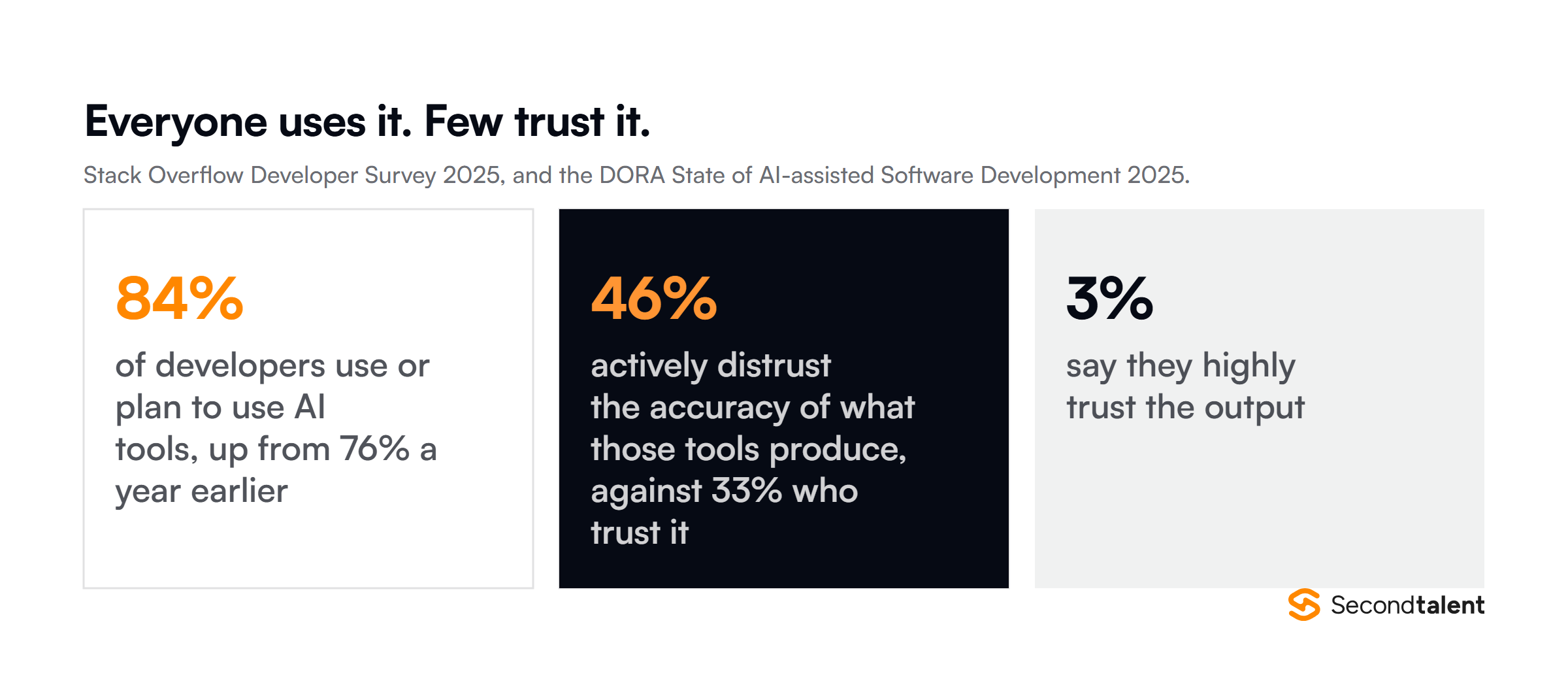
Adoption is close to settled. DORA’s 2025 State of AI-assisted Software Development puts 90% of software professionals using AI at work, up 14 points in a year.
Stack Overflow’s 2025 developer survey puts 84% using or planning to use AI tools, against 76% the year before.
Trust went the other way. In the same survey, 46% of developers actively distrust the accuracy of what these tools produce and 33% trust it. Three percent report highly trusting the output.
Adoption and confidence are moving in opposite directions, which is the most important thing in this dataset.
Daily use is lower than the headlines suggest: 51% of professional developers reach for AI tools every day.
The wider category is covered in our AI coding assistant statistics, and the org-level picture in AI adoption in enterprise statistics.
Most Professional Developers Do Not Actually Vibe Code
This is the number that gets left out. Stack Overflow asked developers directly whether vibe coding, defined as generating software from LLM prompts, was part of their professional work. 72.2% said no. Another 5.3% chose “no, emphatically”.
11.9% said yes and 2.8% said yes, somewhat.
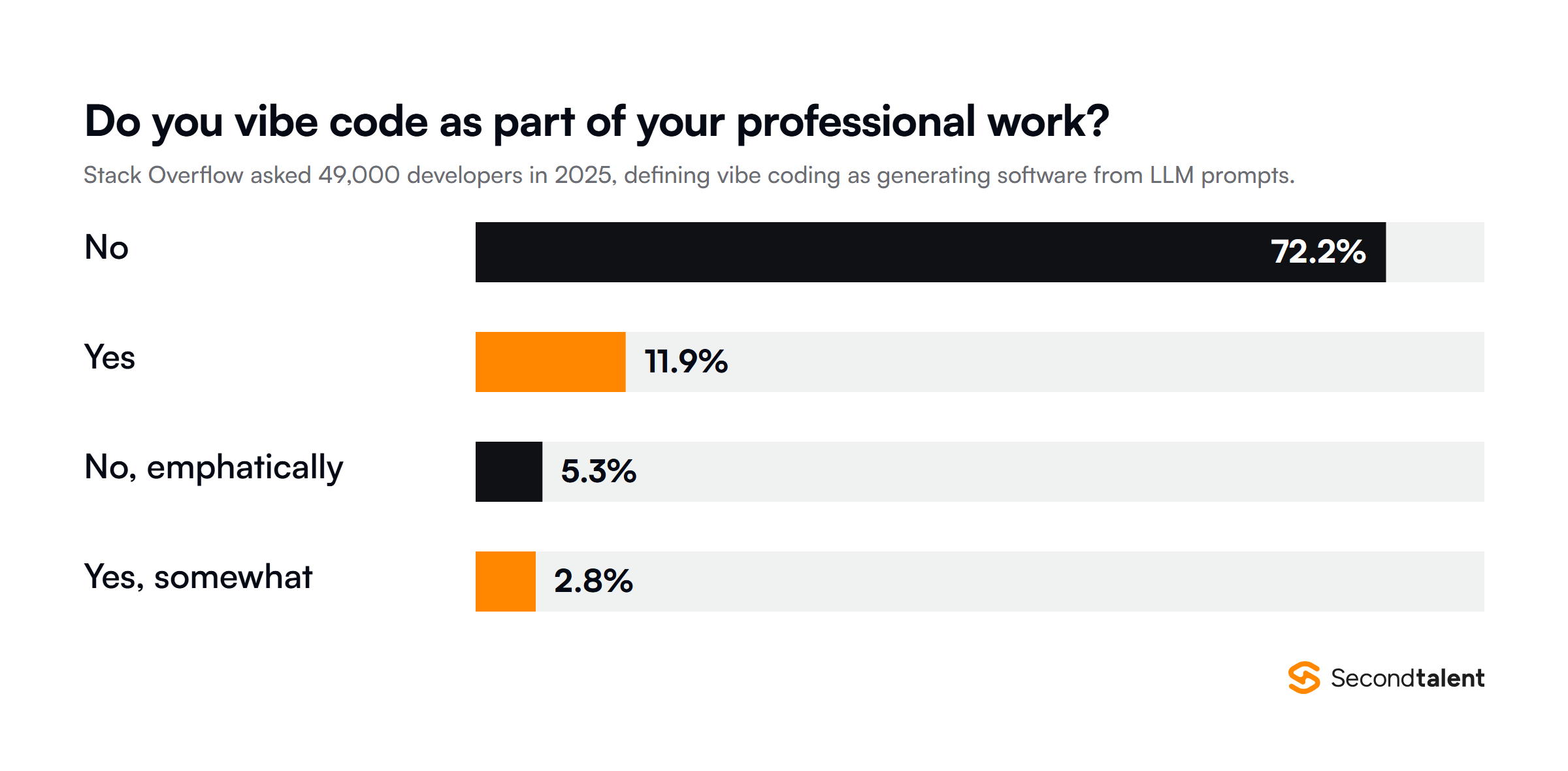
So roughly one developer in seven vibe codes at work. The rest use AI as an assistant they supervise line by line, which is a different practice with a different risk profile.
Any statistic that treats AI tool adoption and vibe coding as the same thing is overstating the second by a factor of about six.
Productivity: The Gap Between Feeling Faster and Being Faster
Self-reported productivity gains are the weakest evidence in this field, because METR ran a randomized controlled trial that measured both.
Sixteen experienced open-source developers worked 246 real tasks in repositories they already maintained, with AI access randomized per task.
They forecast a 24% speed-up. Afterwards they estimated they had been 20% faster. The recorded task times showed them 19% slower.
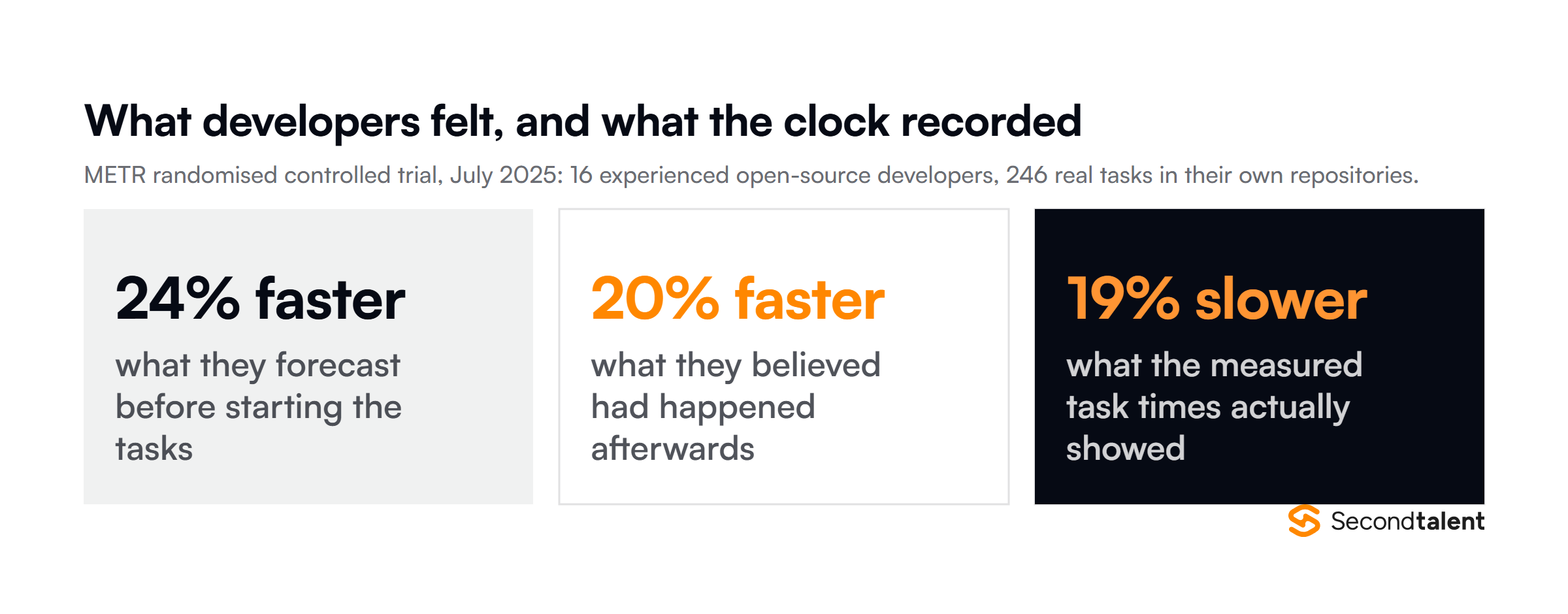
Two caveats matter. The sample is small and skewed to expert maintainers working in codebases they know intimately, which is the scenario where AI has least to add. And it used early-2025 models.
Treat it as evidence that self-reported speed-ups are unreliable, not as proof that AI slows everyone down.
DORA’s 2025 State of AI-assisted Software Development lands in the same place from a different angle: AI is an amplifier. It magnifies whatever your delivery system already does.
Teams with weak review and unclear priorities ship low-quality work faster.
The practical read for anyone hiring: measure task throughput and change failure rate before and after, and ignore how fast the team says it feels.
That is the same discipline we apply when we place full-stack engineers who work in Cursor and similar tools all day.
Code Quality and Security: The Measurable Cost
Veracode tested more than 100 models across Java, Python, C# and JavaScript. 45% of generated samples introduced an OWASP Top 10 vulnerability.
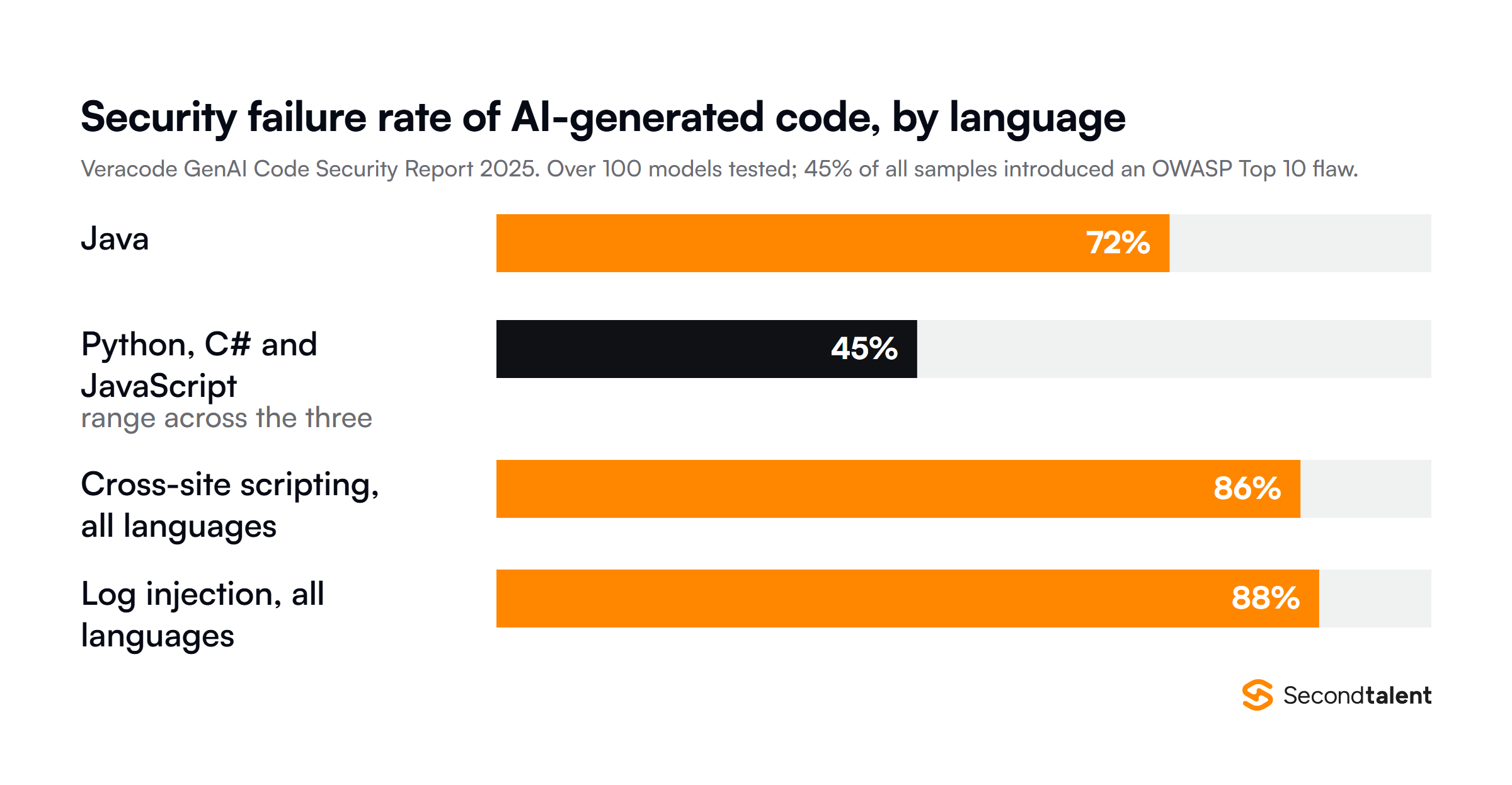
Java was worst at a 72% failure rate. Python, C# and JavaScript ran between 38% and 45%. Against cross-site scripting the models failed 86% of the time, and against log injection 88%.
Veracode’s conclusion is the part worth keeping: scaling the model up did not improve security. This is a systemic property of how these models generate code, not a gap that the next release closes.
Developers see it from the other side. 66% name “AI solutions that are almost right, but not quite” as their single biggest frustration, and 45% say debugging AI-generated code takes longer than writing it themselves.
| What the research measured | Figure | Source |
|---|---|---|
| Samples introducing an OWASP Top 10 flaw | 45% | Veracode GenAI Code Security Report 2025 |
| Java security failure rate | 72% | Veracode 2025 |
| Failure against cross-site scripting | 86% | Veracode 2025 |
| Developers citing “almost right, but not quite” | 66% | Stack Overflow 2025 |
| Developers saying AI debugging takes longer | 45% | Stack Overflow 2025 |
| Measured speed change, expert maintainers | 19% slower | METR RCT, July 2025 |
Where Vibe Coding Genuinely Dominates: Early-Stage Startups
The strongest adoption signal comes from Y Combinator.
A quarter of the Winter 2025 batch had codebases that were 95% AI-generated, according to managing partner Jared Friedman, who noted every one of those founders was technical enough to have written it themselves.
That is the honest shape of the trend. Vibe coding wins where the codebase is young, the reviewer is the author, and the cost of a rewrite is a weekend. It struggles where code has to be maintained by someone who did not prompt it.
Platform scale backs this up.
GitHub’s 2025 Octoverse reports 80% of new developers using Copilot within their first week, the Copilot coding agent authoring over a million pull requests in five months, and AI repositories nearly doubling to 4.3 million.
What This Changes About Hiring
Put the three findings together and the hiring brief writes itself. Tools are ubiquitous, output quality is unreliable, and developers cannot tell from the inside whether they are going faster.
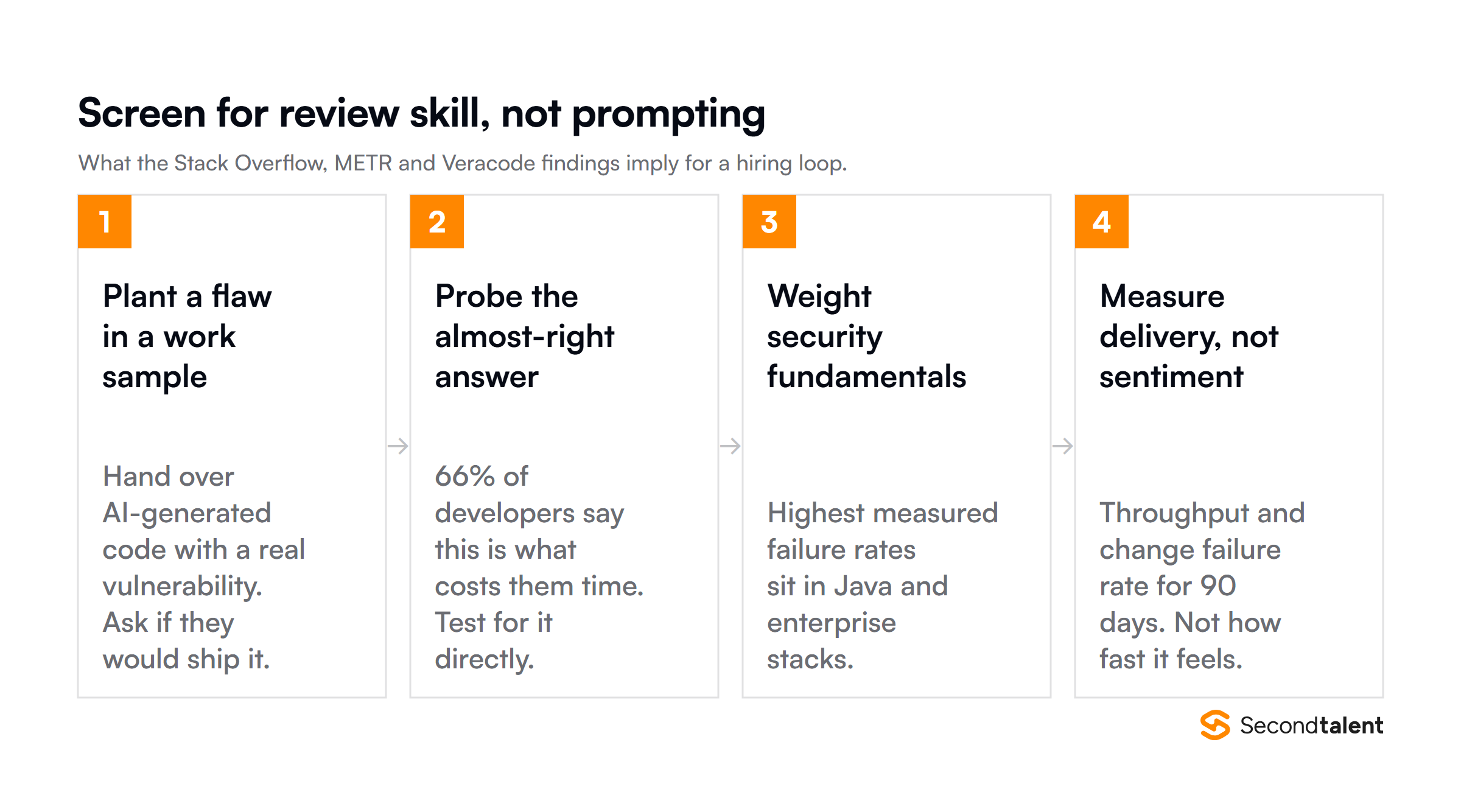
- Screen for review, not for prompting. Prompting is a week of practice. Spotting the almost-right answer is the scarce skill, and it is what 66% of developers say is costing them time.
- Give a work sample with a planted flaw. Hand over AI-generated code with a real vulnerability in it and ask the candidate to ship it. That question separates the two groups faster than any interview.
- Weight security fundamentals higher for Java and enterprise stacks, where the measured failure rate is worst.
- Measure delivery, not sentiment, for the first 90 days. Throughput and change failure rate, not how productive the team reports feeling.
We vet on exactly this. Engineers in Vietnam, the Philippines and Indonesia come through a work sample before they reach you, and our AI engineers in the Philippines are screened on reviewing model output rather than producing it.
Current pay bands sit in the developer rate card and the Asia Tech Salary Index.
If you would rather not run payroll and compliance yourself while you scale, our EOR service covers it, including Vietnam and the Philippines. Or start with the hire developers pool and tell us what you are building.
Final Words
Vibe coding is real, named, and genuinely dominant in one place: pre-product-market-fit startups where the author is the reviewer. Everywhere else the data describes something more ordinary.
Developers use AI constantly, trust it less each year, and mostly do not hand it the wheel.
If I had to keep one number from this page, it would be the METR result. Those developers were certain they had gone faster and were wrong by 39 points. The 19% figure itself may not generalize beyond expert maintainers.
Whatever you decide about AI tooling, decide it on measurements rather than on how the sprint felt.
FAQs
What is vibe coding?
Vibe coding is generating software from natural-language prompts to an LLM, accepting the output without reading it closely.
Andrej Karpathy coined the term in February 2025, describing it as fully giving in to the vibes and forgetting the code exists. It differs from AI-assisted development, where the developer reviews every suggestion before it lands.
How many developers actually vibe code?
About one in seven professionally. Stack Overflow 2025 found 11.9% answered yes and 2.8% yes, somewhat, while 72.2% said no and 5.3% said no, emphatically.
AI tool adoption is far higher at 84%, but that mostly describes supervised assistance rather than vibe coding.
Does vibe coding make developers more productive?
The only randomized trial to date found the opposite for expert maintainers. the METR trial measured 16 experienced open-source developers as 19% slower with AI access, while those same developers estimated they had been 20% faster.
Self-reported productivity gains should be treated with caution. Gains are more plausible on greenfield code and boilerplate than in large codebases the developer already knows.
Is AI-generated code secure?
Often not. Veracode tested over 100 models and found 45% of samples introduced an OWASP Top 10 vulnerability, rising to 72% for Java. Failure rates were 86% against cross-site scripting and 88% against log injection.
Larger models did not perform better, so this is not a problem the next model release solves.
Should I require vibe coding skills when hiring developers?
Hire for review skill instead. Prompting takes a week to learn; judging whether generated code is correct and safe is the part that takes years and the part the data says is failing.
A practical screen is to hand a candidate AI-generated code containing a real flaw and ask whether they would ship it.
How much of the world’s code is AI-generated?
There is no reliable global figure, and the widely-quoted “41% of all code” number does not trace to a published methodology.
What is measurable is platform-level: GitHub’s 2025 Octoverse reports 80% of new developers using Copilot in week one and the Copilot agent authoring over a million pull requests in five months.
Treat any single global percentage with suspicion.