
TL;DR: US tech hiring is recovering in 2026, but unevenly: the unemployment rate for tech occupations fell to 2.8% in July, CompTIA says. Software development postings on Indeed are still about 24% below their February 2020 level. Software developers earned a median $135,980 in May 2025, according to the BLS.
Technology companies announced more US job cuts than any other industry through August 2026, 155,126 on Challenger, Gray & Christmas’s count. They also led every industry on announced hiring plans, at 19,751.
In August alone, tech workers across the economy gained 86,000 jobs while tech companies cut about 14,700, CompTIA’s reading of BLS data shows.
- 1Senior roles made up 71% of the rise in US software development postings on Indeed between May 2025 and May 2026.
- 2Recent computer engineering graduates had a 7.8% unemployment rate in 2024, the second highest of 73 majors the New York Fed tracks.
- 3The share of US job postings that mention AI roughly doubled in a year, to 6.7% at the end of August 2026.
- 4The BLS expects computer programmer jobs to shrink 7% by 2035, while data scientist jobs grow 35%.
How Strong Is US Tech Hiring in 2026?
Stronger than at the start of the year. The unemployment rate for tech occupations peaked at 3.9% in March, then fell four months running, CompTIA’s monthly analysis of BLS data shows.
In June it stood at 2.9%, against a national rate of 4.2%.
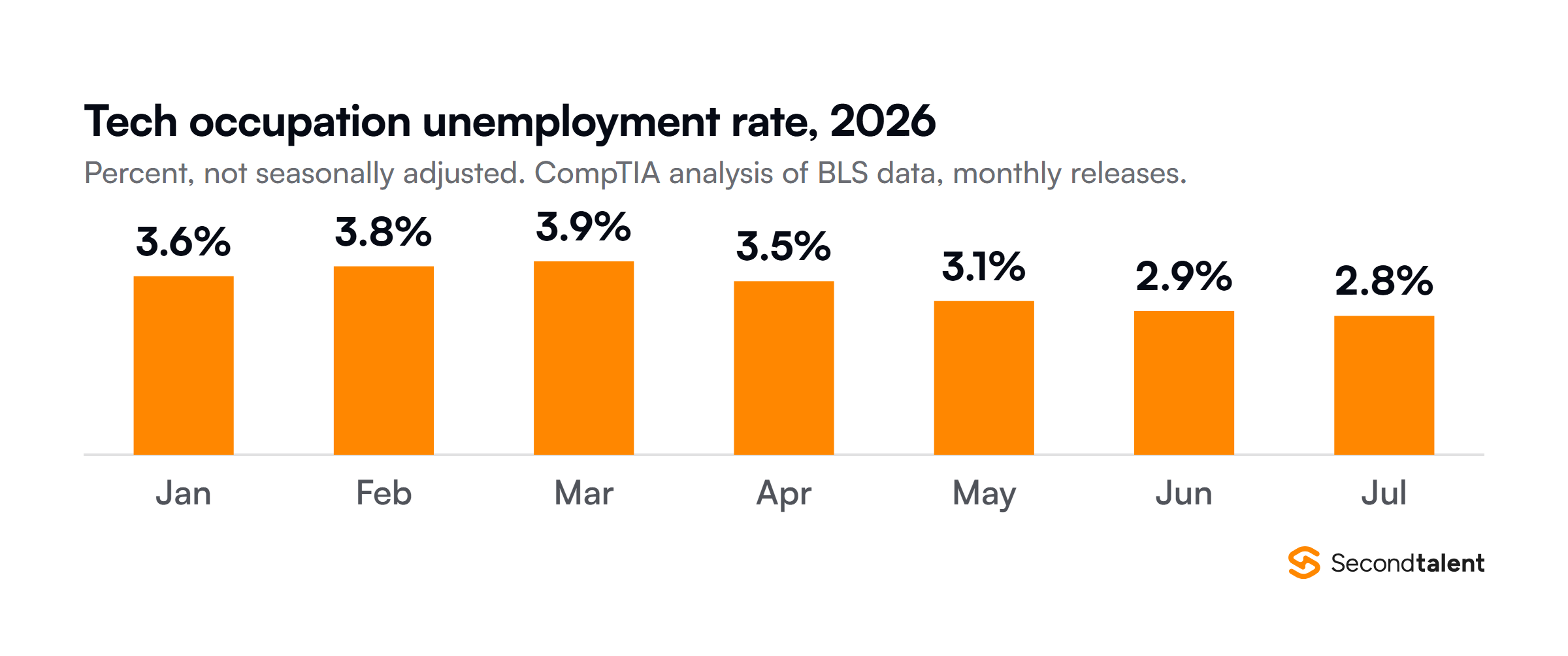
The job counts behind those rates swing hard. Tech occupation employment fell by 118,000 in March, rose by 260,000 in April and dropped by 26,000 in July.
CompTIA notes that monthly occupation data from the BLS “tends to experience higher levels of variance and volatility.”
2025 shrank, 2026 is forecast to grow
CompTIA’s State of the Tech Workforce 2026 projects tech job gains in all 50 states. Texas leads with 32,238 projected new tech jobs, ahead of California at 16,949 and Florida at 14,453.
Among metro areas, New York City (11,317) and Dallas (11,013) lead, and San Francisco ranks fifth at 3,906.
How Many Tech Jobs Are Employers Advertising?
Nearly 600,000 active tech job postings were open in August 2026, and 42% of them were new that month, CompTIA found in Lightcast data. The total was more than 465,000 in January. It passed 600,000 by June, then eased.
Software developer postings fell by 2,602 from July, the largest monthly drop among the top five roles. Tech support postings grew by 653.
By industry, professional, scientific and technical services firms posted the most tech jobs in August, 68,236, followed by manufacturers at 31,552.
Dice’s August 2026 jobs report, also built on Lightcast data, shows tech postings up 18% on a year earlier and down 2% on July.
Manufacturing, software, consulting, technology and retail employers each raised tech postings by more than 30% over the year.
Are Software Developer Job Postings Recovering?
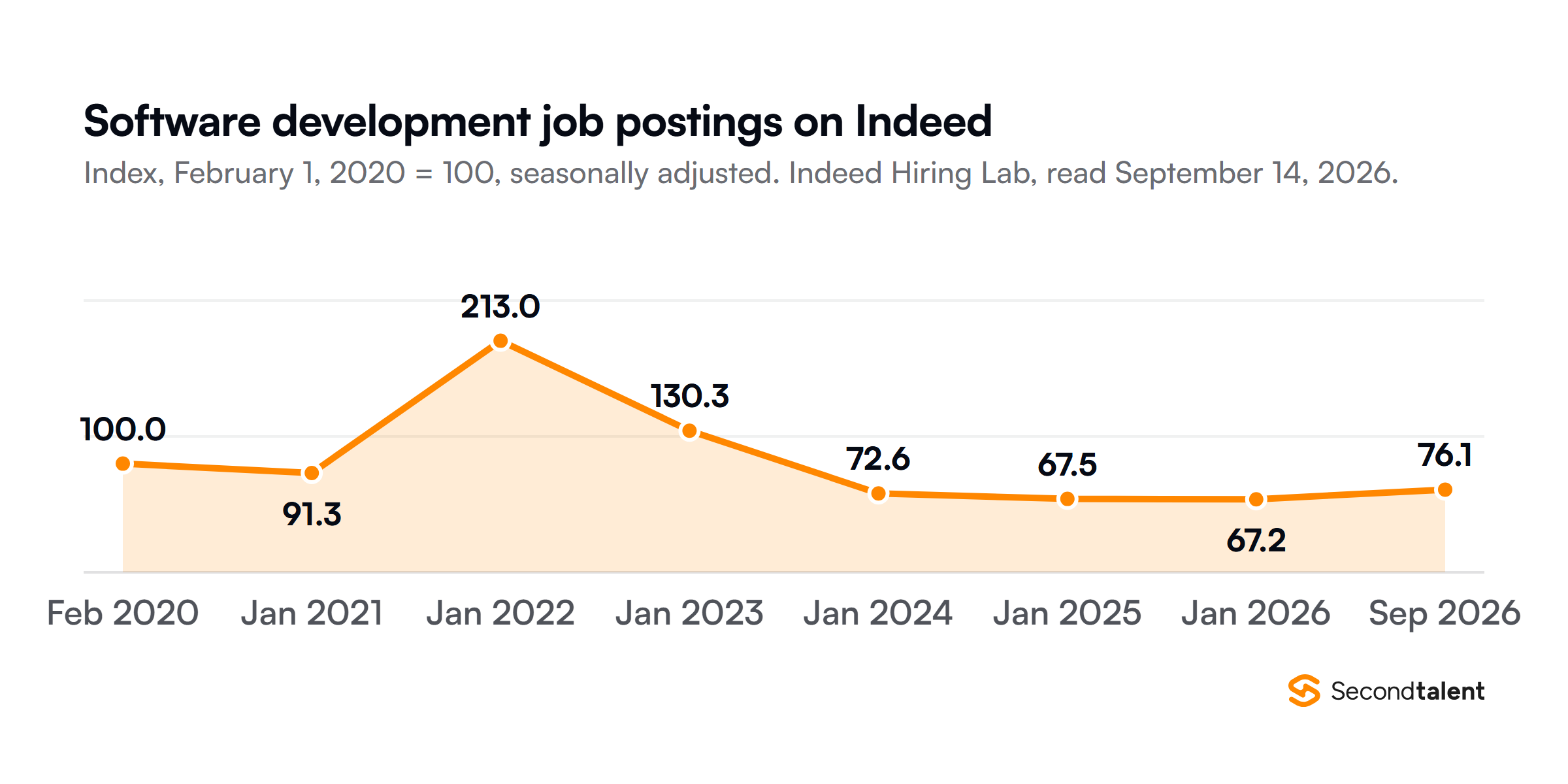
Yes, from a low base. Indeed’s index of US software development postings peaked at 233.8 on February 28, 2022, more than double its February 2020 level.
It bottomed at 61.1 on May 17, 2025, and stood at 76.1 on September 4, 2026, in Indeed Hiring Lab’s public data.
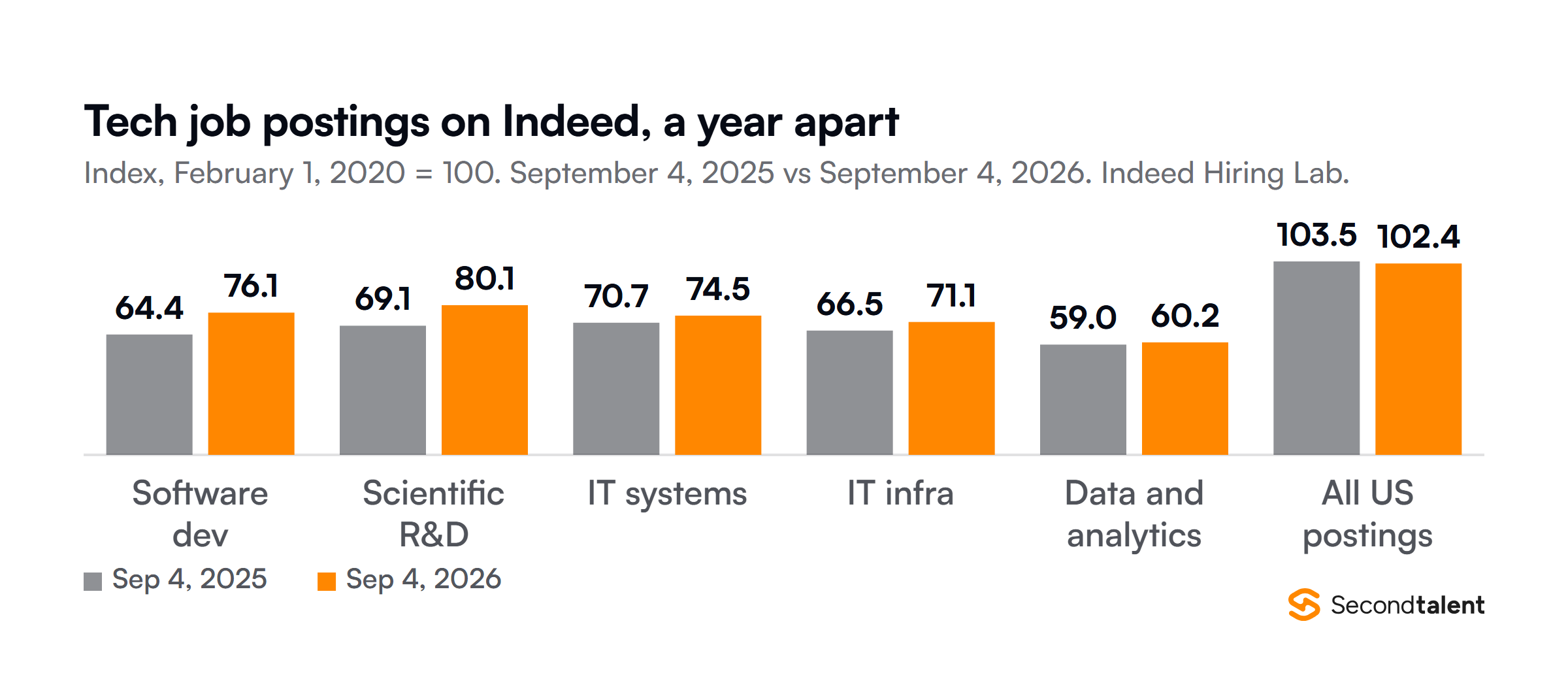
By our calculation from the same index, that is 18% more software postings than a year earlier. All US postings on Indeed read 102.4, roughly level with February 2020 and slightly lower than a year earlier.
Senior roles and AI titles lead the rebound
Indeed Hiring Lab economist Guillermo Gallacher found that 71% of the rise in software development postings between May 2025 and May 2026 came from senior roles. Jobs with AI in the title made up 37%, and the two groups overlap.
His July 2026 analysis also found that the most AI-exposed occupations generally fell furthest from May 2022 to May 2026, then rebounded most over the past year.
“This suggests demand is growing for experienced professionals who can work with AI, not necessarily a broad-based recovery across all software roles.”
Indeed Hiring Lab, July 8, 2026
Other tech categories recovered less. Data and analytics postings barely moved over the year and are 40% below their 2020 baseline, the weakest of Indeed’s 47 occupational categories.
Scientific research and development postings rose almost as fast as software.
Our look at the future of software development jobs covers what these shifts mean for engineering teams and which roles are growing.
Which Tech Jobs Will Grow Through 2035?
Data scientists, on the Bureau of Labor Statistics’ 2025 to 2035 projections. Their employment is set to grow 35%, adding 95,400 jobs to the 275,600 that existed in 2025.
Computer and information research scientists (22%) and information security analysts (21%) come next.
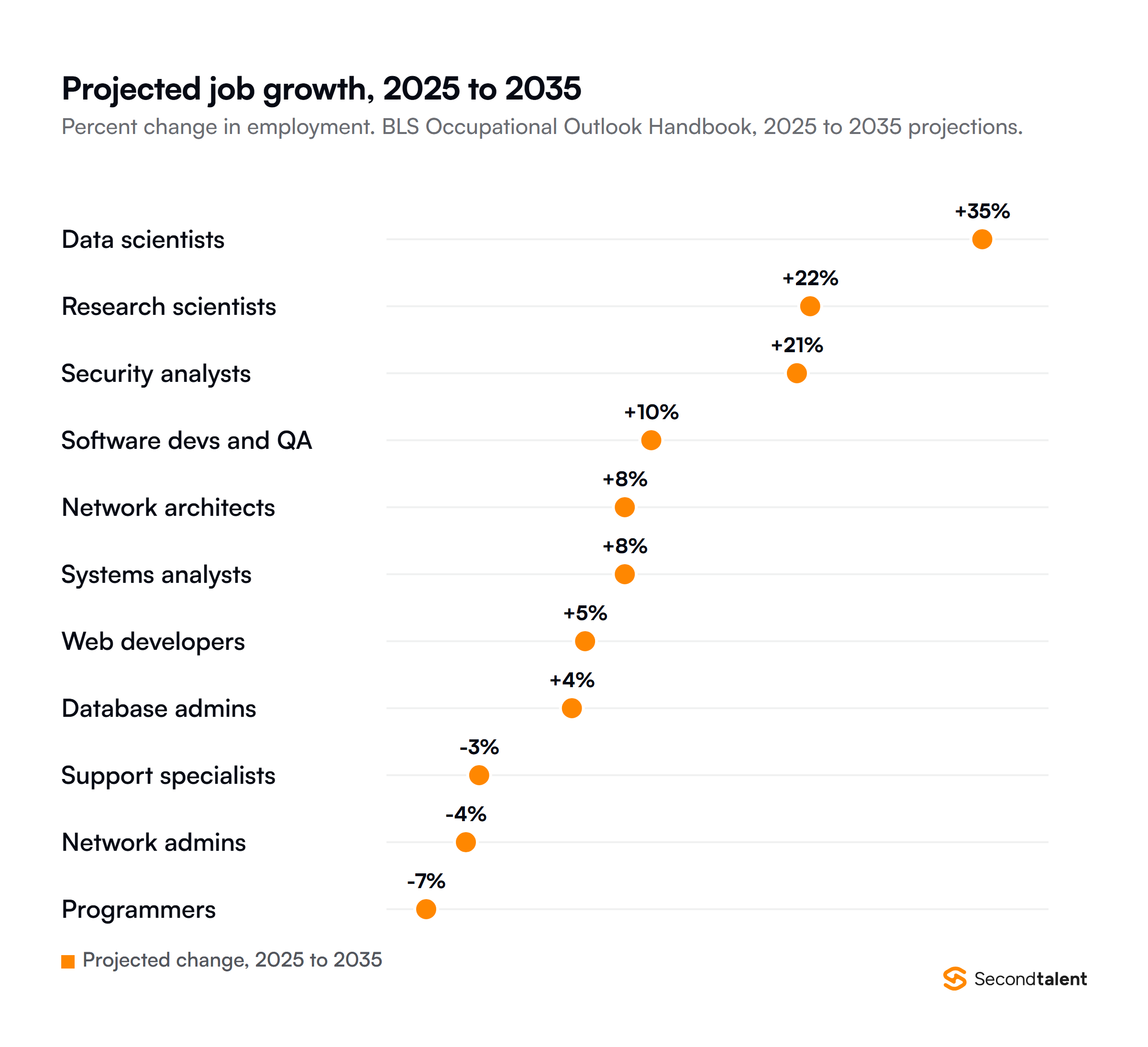
Software developers, quality assurance analysts and testers form the largest group, with 1,905,400 jobs in 2025. BLS projects 10% growth and about 106,100 openings a year, many of them to replace workers who move to other jobs or retire.
Across all computer and IT occupations, it expects about 280,000 openings a year.
Three occupations are set to shrink: network and computer systems administrators by 4%, computer support specialists by 3% and computer programmers by 7%. The BLS gives a direct reason for programmers.
“To save time and money, many companies are expected to leverage technologies, including artificial intelligence (AI), to automate repetitive programming tasks.”
BLS Occupational Outlook Handbook, computer programmers
Even so, the BLS still expects about 4,400 openings for programmers each year, all of them replacing workers who leave.
How Much Do Tech Workers Earn?
The median computer and IT worker earned $109,470 in May 2025, more than twice the $50,980 median for all US occupations, BLS data shows. Software developers earned a median $135,980, and the top 10% of them earned more than $214,670.
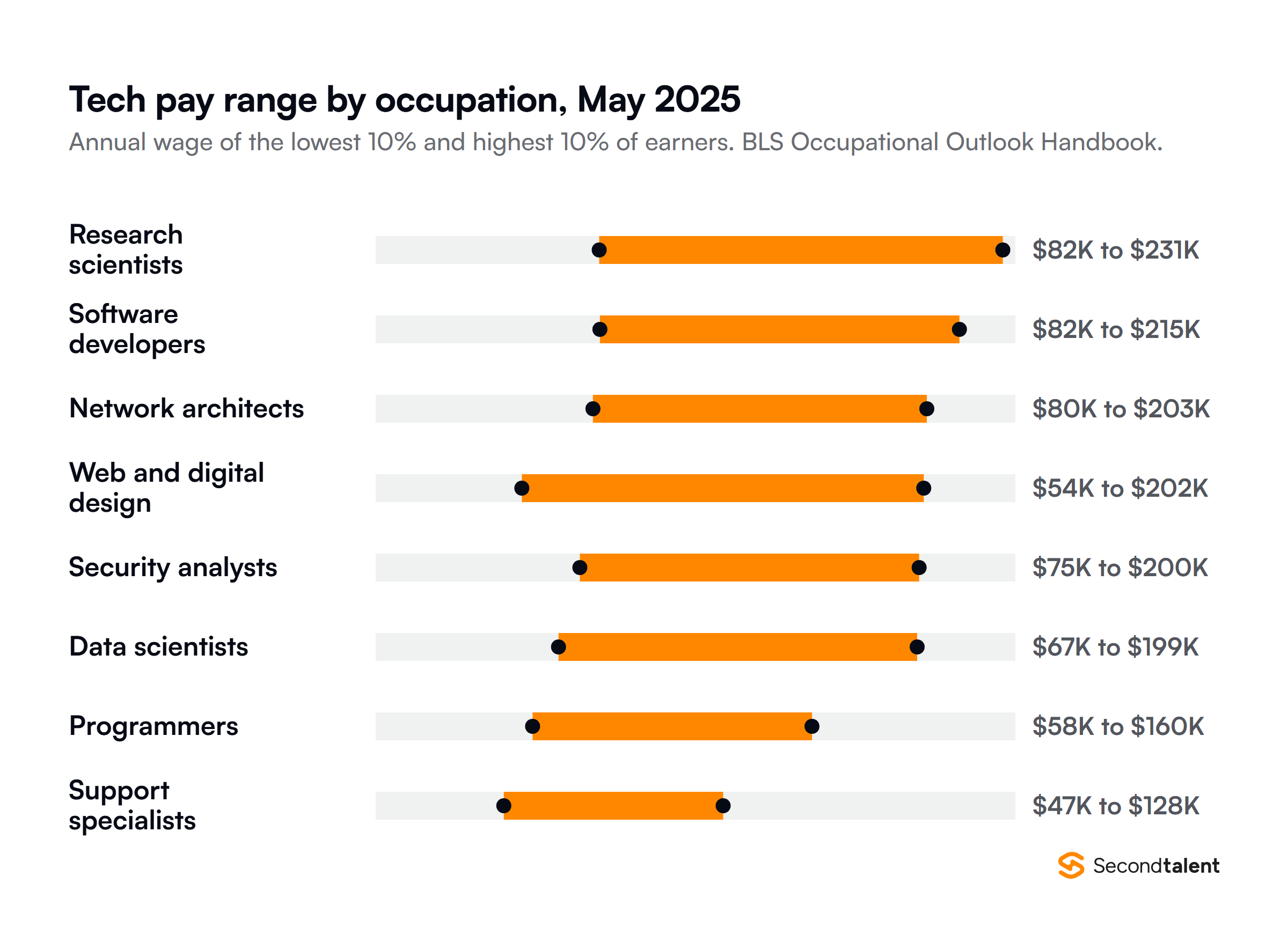
The employer matters as much as the title. Software developers at software publishers earned a median $164,550, against $132,050 at computer systems design firms.
Computer and information research scientists had the highest median in the group at $140,300, and computer support specialists the lowest at $62,890.
Big tech pay on Levels.fyi
Levels.fyi figures run higher, because they measure total compensation, including stock and bonus. Its End of Year Pay Report 2025 puts the US median software engineer package at $155,000 at entry level and $312,587 at senior level.
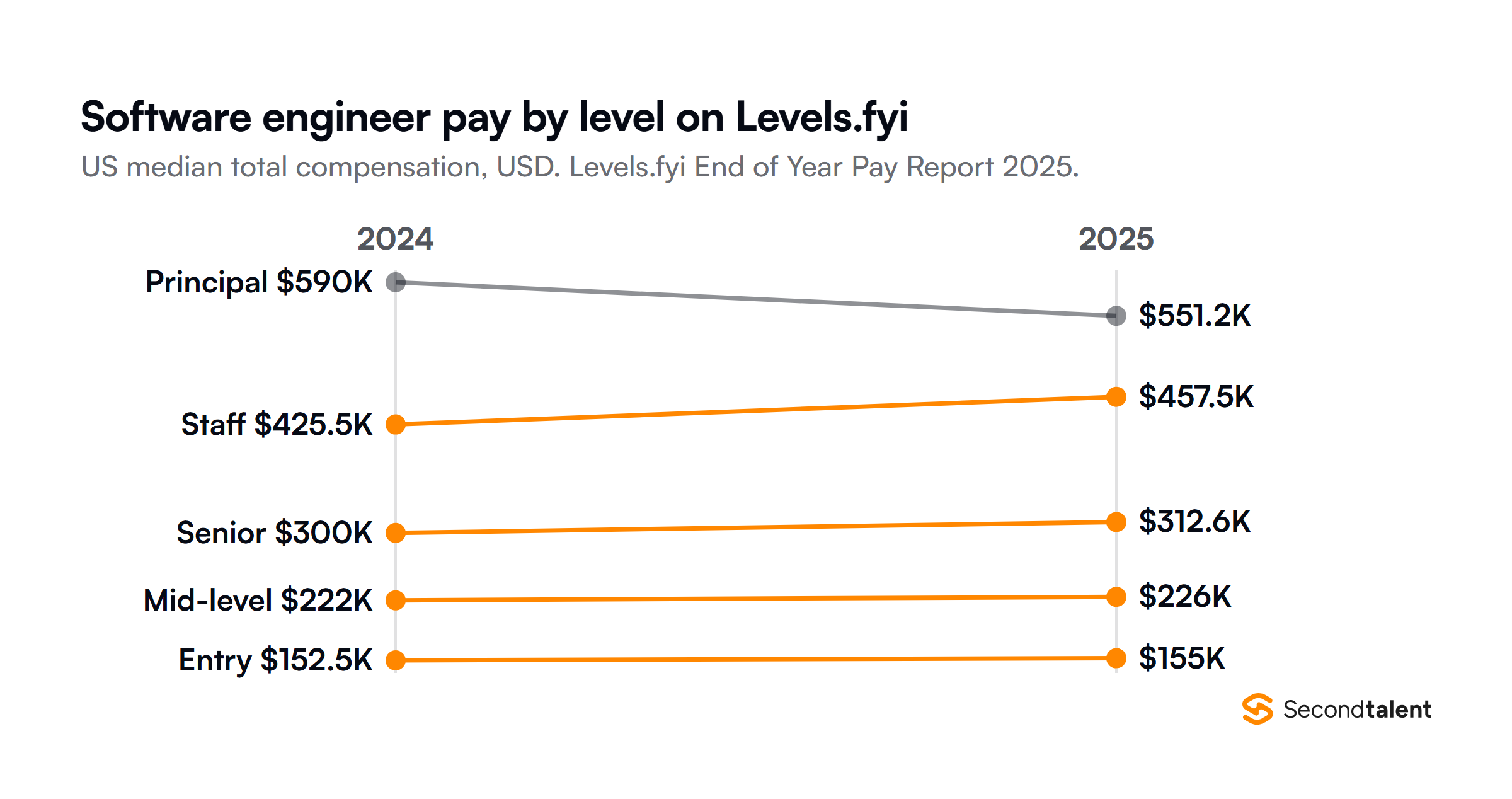
Staff engineers gained the most, up 7.52%, while principal engineer pay fell 6.58%. The San Francisco Bay Area led US metros at a $278,000 median, followed by Seattle at $250,000 and New York City at $193,000.
For pay outside the US, see our ranking of countries with the highest software engineer salaries.
How Much Do Employers Want AI Skills?
Demand for them is still rising. Active US job postings asking for AI skills passed 320,000 in August 2026, up 4.5% from July, in CompTIA’s analysis of Lightcast data. In January the count was more than 275,000.
That total covers dedicated AI roles and any job that expects AI fluency.
- 320,000+ active US postings asking for AI skills, August 2026 (CompTIA)
- 3.4% to 6.7% of all Indeed US postings mentioning AI, August 2025 to August 2026
- Nearly 14,000 postings seeking AI and machine learning expertise, July 2026 (CompTIA)
- +101% AI and machine learning tech postings, August 2026 vs a year earlier (Dice)
Indeed’s AI tracker counts postings that use terms such as “machine learning” or “artificial intelligence.” Its US share was 1.9% in February 2020, 2.7% in January 2025 and 4.4% in January 2026.
Those skills also earn more. PwC’s 2026 Global AI Jobs Barometer, built on more than one billion job ads, puts the average wage premium for AI skills at 62%, up from 57% a year earlier.
Jobs requiring specific AI skills grew 69%, against 9% for the job market overall.
The skill names are changing too. Dice lists Responsible AI, AI Agents, Agentic AI and AI infrastructure among the skills that grew more than 200% in tech postings over the year to August.
Our guide to the most in-demand AI engineering skills matches those skills to pay.
What Is Happening to Entry-Level Tech Hiring?
It is the weakest part of the market. Computer engineering and computer science graduates aged 22 to 27 had the second and fourth highest unemployment rates of 73 majors in 2024, New York Fed data shows.
The rate for all recent graduates was 4.2%.
| Major | Unemployment | Underemployment | Early-career median wage |
|---|---|---|---|
| Computer engineering | 7.8% | 15.8% | $90,000 |
| Computer science | 7.0% | 19.1% | $87,000 |
| Information systems and management | 6.0% | 25.6% | $67,000 |
| Mathematics | 5.8% | 26.2% | $70,000 |
| Electrical engineering | 3.2% | 21.1% | $82,000 |
| All majors | 4.2% | 39.4% | $58,000 |
Graduates who do land a job earn well. Computer engineering graduates start at a median $90,000, against $58,000 for all majors, and their underemployment rate is less than half the average.
Job ads lean toward experience. In April 2026, 20% of tech job postings sought workers with zero to three years of experience, 28% wanted four to seven years and 17% eight years or more, CompTIA reported.
PwC’s study of 2.4 million US entry-level jobs found a split. Entry-level roles most exposed to AI are seven times more likely to require senior skills such as leadership.
Openings for those roles grew 35% since 2019, while other entry-level roles shrank 10%.
How Do Tech Layoffs Fit With the Hiring Numbers?
Technology accounts for a larger share of US job cuts this year than any other industry, Challenger reports. Its tech total through August compares with 102,239 a year earlier.
August was the quietest month of 2026 for tech, with 6,103 cuts.
AI was the most cited reason for cuts across all industries so far this year, at about 22% of the total.
Yet employers also announced plans to hire 119,825 workers through August, the strongest January to August total since 2023, and tech companies made more of those plans than any other industry.
Inside tech, the cuts fall in specific places.
In CompTIA’s August figures, cloud infrastructure, data processing and hosting companies shed 7,700 jobs and telecommunications firms 2,100, while PC, semiconductor and component makers added 1,300.
Our tech layoffs statistics cover the largest cuts company by company.
Hiring Engineers Beyond the US Market
Most of the recent rise in US software postings is for senior engineers, many of them in AI roles. Second Talent matches companies with pre-vetted developers in Asia, and our developer rate cards show what each role costs by country.
For a US baseline, our US cost to hire guide breaks down local rates. Tell us what you are building and we will send matching profiles.
Frequently Asked Questions
Is 2026 a good year to look for a tech job?
It is better than 2025 for experienced workers. Tech unemployment fell every month from March to July, and senior roles drove most of the rise in software postings.
New computer science and computer engineering graduates face a harder market.
How many software developers work in the US?
About 1.7 million in 2025, the BLS estimates, plus about 187,600 software quality assurance analysts and testers. Computer systems design firms employ 29% of software developers, and finance and insurance companies 11%.
Is AI reducing tech hiring?
The data points both ways. Employers named AI in more US job cuts than any other reason this year. At the same time, postings that ask for AI skills keep rising, and Indeed finds the most AI-exposed occupations rebounded most since 2025.
Do tech jobs still need a degree?
Many do. The BLS lists a bachelor’s degree as the typical entry requirement for software developers, security analysts and data scientists.
In its February 2026 data, CompTIA found that a significant share of network support, tech support and web development postings do not require a four-year degree.