
TL;DR: The US workplace in 2026 is split between home and office: about 26% of paid workdays in July were worked from home, WFH Research finds. Kastle's 10-city office occupancy averaged 53.2% in the week to September 2. Engagement is sliding too, with Gallup putting the global rate at 20% in 2025, its lowest since 2020.
Tuesday is now the office’s busiest day by a wide margin. Kastle’s badge data put occupancy across ten US cities at 62.6% on Tuesday, September 1, 2026, against 34.0% on the Friday before.
Amazon, JPMorgan Chase and Dell all ordered staff back five days a week in 2025, yet phone data still counts August office visits 32.5% below 2019.
- 1Manager engagement fell five points in a year, to 22% worldwide, in Gallup’s 2026 report.
- 2A year after the UK’s big four-day week pilot ended, 54 of the 61 companies were still running it.
- 3Microsoft 365 users receive an average of 117 emails a day, and meetings after 8 pm rose 16% in a year.
- 4Illinois banned AI-delivered therapy in August 2025; licensed professionals may still use AI for admin work.
How Full Are US Offices in 2026?
Offices in the ten metro areas Kastle tracks were 53.2% full in the week to September 2, 2026, up 0.3 points on the week before.
The post-pandemic record is a weekly average of 56.3%, set in the week of December 8, 2025, when all office buildings also hit a single-day high of 66.0%, Kastle reported.
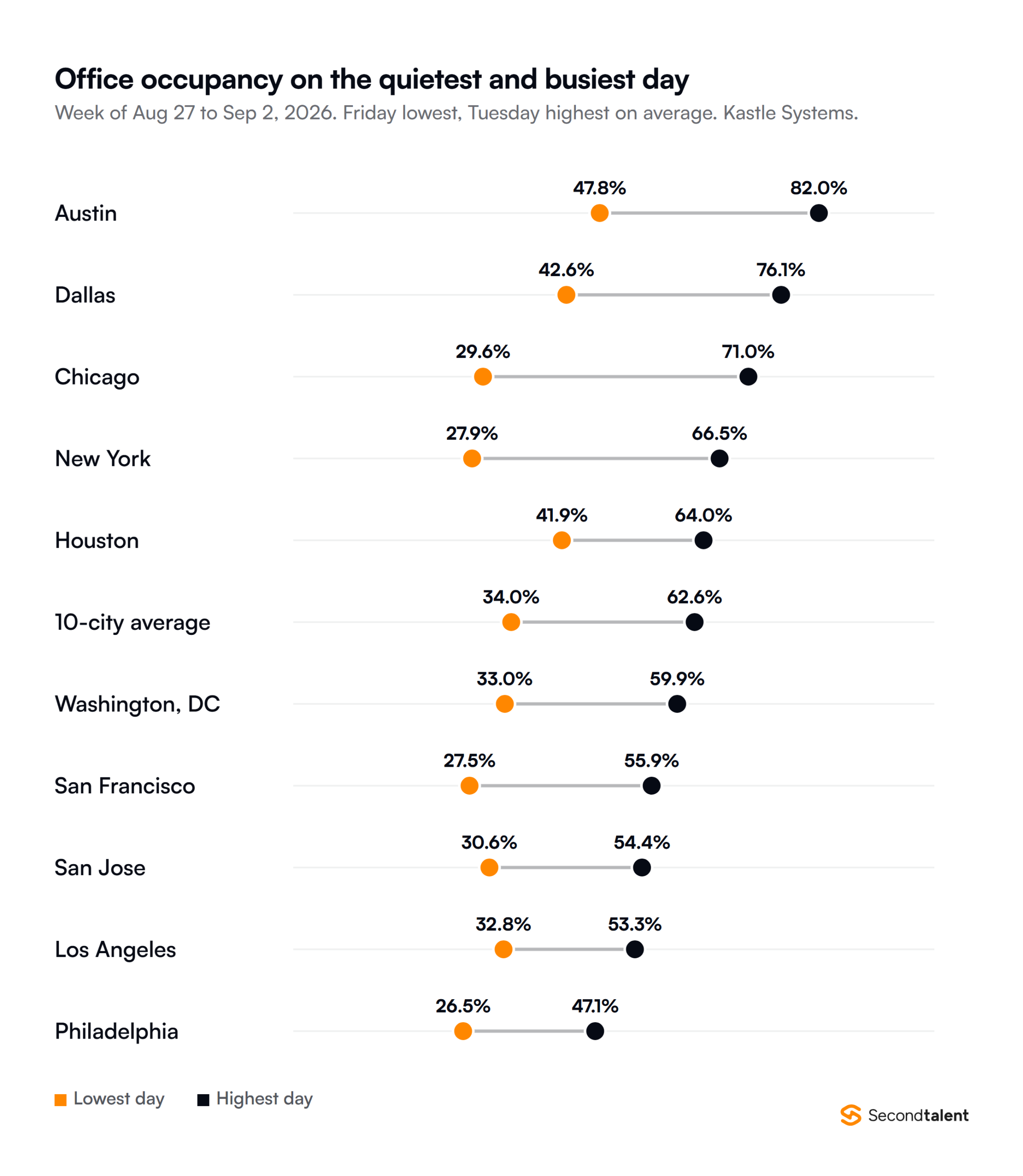
In Chicago, occupancy ran from 29.6% on the quietest day to 71.0% on the busiest. In Los Angeles the range was 32.8% to 53.3%. Austin had the highest weekly average of any city, 70.9%, and Philadelphia the lowest, 39.6%.
Class A+ buildings averaged 66.8%.
Placer.ai reads office visits from phone location data and gets a similar picture. Its August 2026 index had visits up 6.2% on August 2025 and 32.5% below August 2019, the smallest August gap since 2020.
How Many Employees Work Hybrid or Remote?
Only 6% of US employees who could do their jobs remotely said in November 2025 that they would pick full-time office work, yet 22% of them work that way.
Gallup’s hybrid work indicator puts 52% of remote-capable employees on a hybrid schedule as of May 2026 and 26% fully remote.
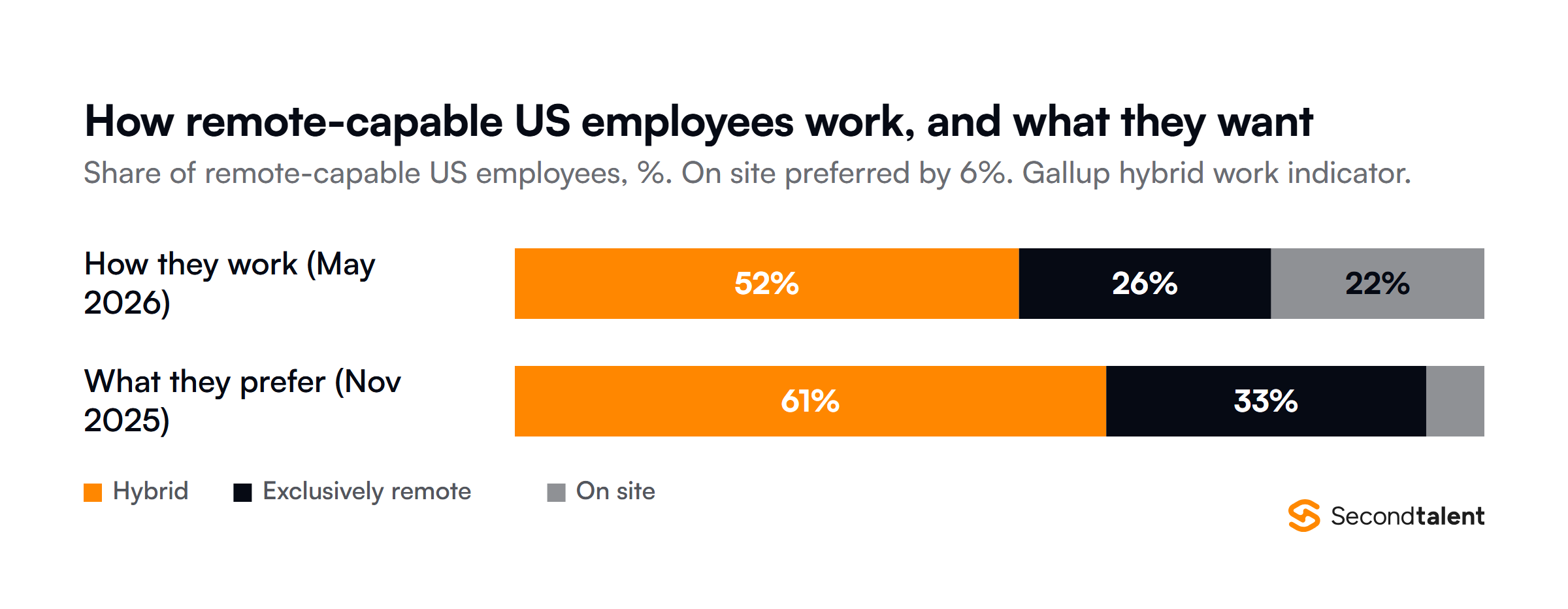
Gallup’s figures cover remote-capable employees only, which is why they run higher than measures of the whole workforce. Four trackers, four different groups of workers:
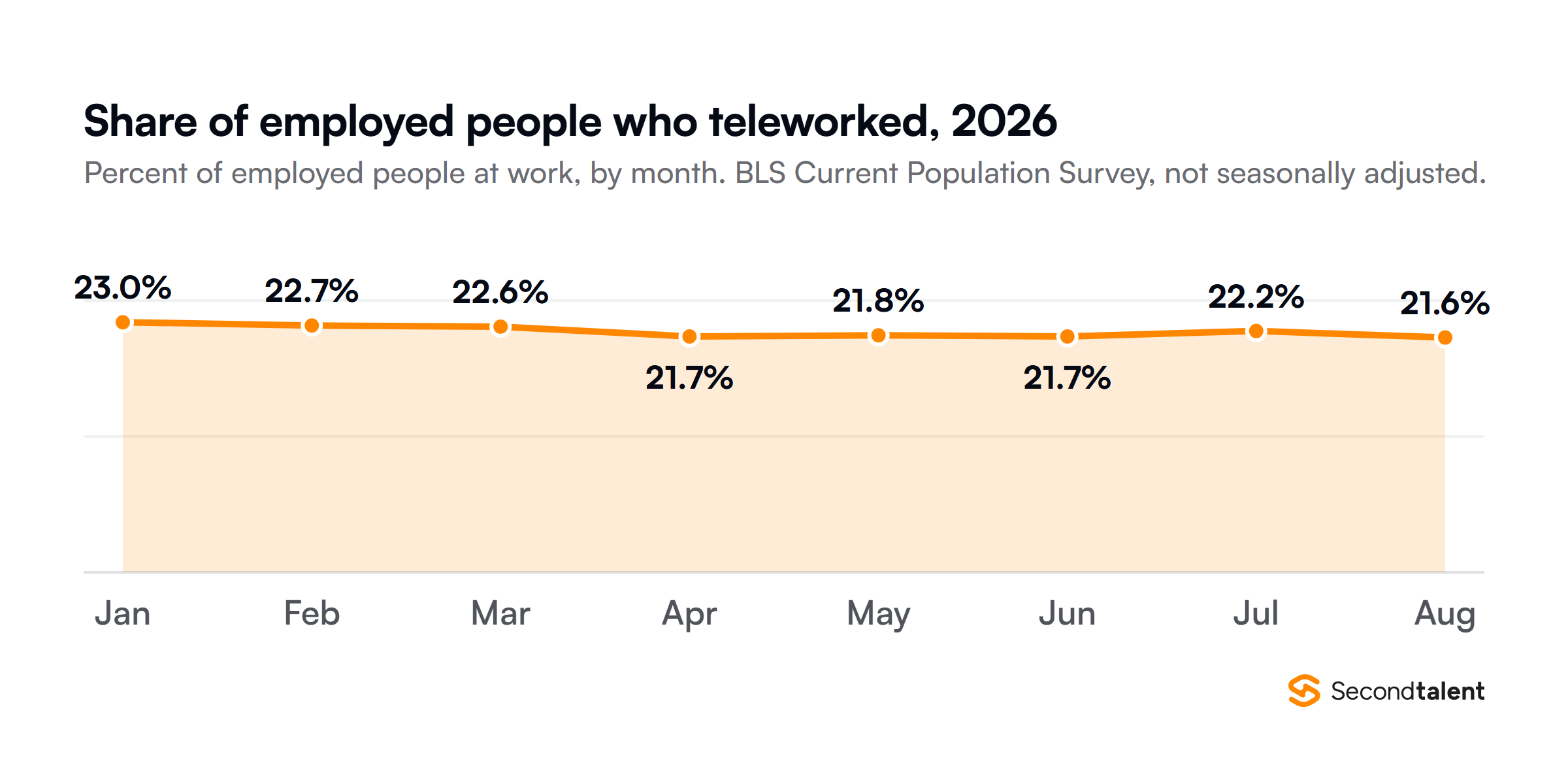
The telework rate has edged down since January
The BLS telework series peaked this year at 23.0% in January. By August it was 21.6%: 11.0% of employed people teleworked for some of their hours and 10.6% for all of them. Telework hours made up 15.0% of all hours worked.
Education splits the numbers. WFH Research’s September 2026 update has workers with a graduate degree doing 32.7% of full paid days from home so far in 2026, against 19.1% for those with a high school education or less.
Employers plan for 1.3 to 1.5 home days a week.
Company policy moved the other way. The Flex Index found required office days rose from 2.57 to 2.87 a week in the year to Q3 2025, while actual days worked from home moved up 1% to 3%.
The Flex Index has published no report in 2026, and the dataset is moving to the London School of Economics, with a first refresh due by October 6. Our remote work statistics cover pay and productivity.
Which Employers Now Require Four or Five Office Days?
Five-day office rules spread from Big Tech and banks to media companies between January 2025 and February 2026. Most orders apply to staff who live near an office, and several set four days rather than five.
Amazon’s chief executive Andy Jassy framed the change as a return to how the company worked before COVID. His memo said 15 months at three office days had “strengthened our conviction about the benefits.”
JPMorgan’s memo covered “most employees currently on a hybrid schedule.” Microsoft chose a phased rollout: Puget Sound first, then other US locations, then offices outside the US.
The federal order left agency heads to grant the exemptions they deem necessary.
Workers feel the rules. In the American Psychological Association’s 2025 Work in America survey of 2,017 workers, 66% said their employer requires in-person work at least some of the time.
61% worked fully in person, 25% hybrid and 14% fully remote. Our remote work hiring statistics show what these orders did to job postings.
What Happened When Companies Tried a Four-Day Week?
Sick and personal days fell from 2.0 to 0.7 during the UK’s 2022 four-day week trial, a 65% drop. The pilot, run by 4 Day Week Global with the think tank Autonomy, asked 61 companies to cut working time while keeping pay at 100%.
Autonomy published the results in February 2023.
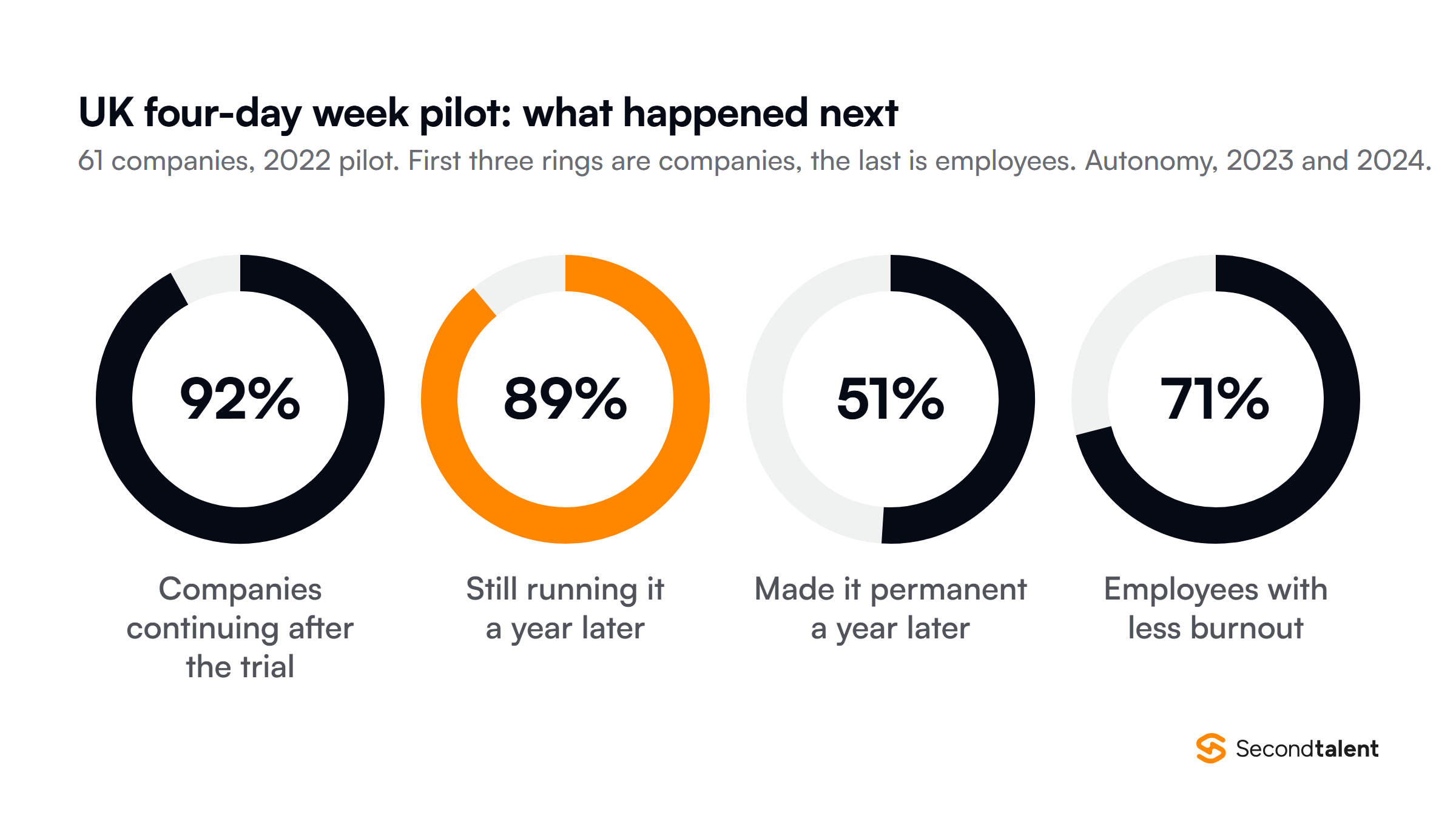
Of the 61, 56 carried on after it ended and 18 made the change permanent. A year later, at least 54 were still running it and 31 had made it permanent.
The evidence since the UK pilot
- Six countries, 141 organizations: a Boston College team’s study in Nature Human Behaviour (July 2025) tracked 2,896 employees before and after trials. Burnout, job satisfaction, mental health and physical health improved, a pattern not seen in 12 control companies.
- UK, 2025: a second national pilot with 17 companies and nearly 1,000 workers ended with all 17 keeping the shorter week. Almost two-thirds of workers reported burnout less often.
- First UK council: South Cambridgeshire District Council voted on July 17, 2025 to adopt a four-day week permanently.
- Tokyo: the metropolitan government gave its employees the option of three days off a week from April 2025.
The companies in these pilots all volunteered to take part, so results come from employers already keen on the idea. The Nature study’s control group of 12 companies is the closest check on that.
How Engaged Are Employees Around the World?
Europe has the least engaged employees of any region Gallup tracks: 12% in 2025, against 31% in the US and Canada.
The State of the Global Workplace 2026 report, published in April, found global engagement down two years running for the first time.
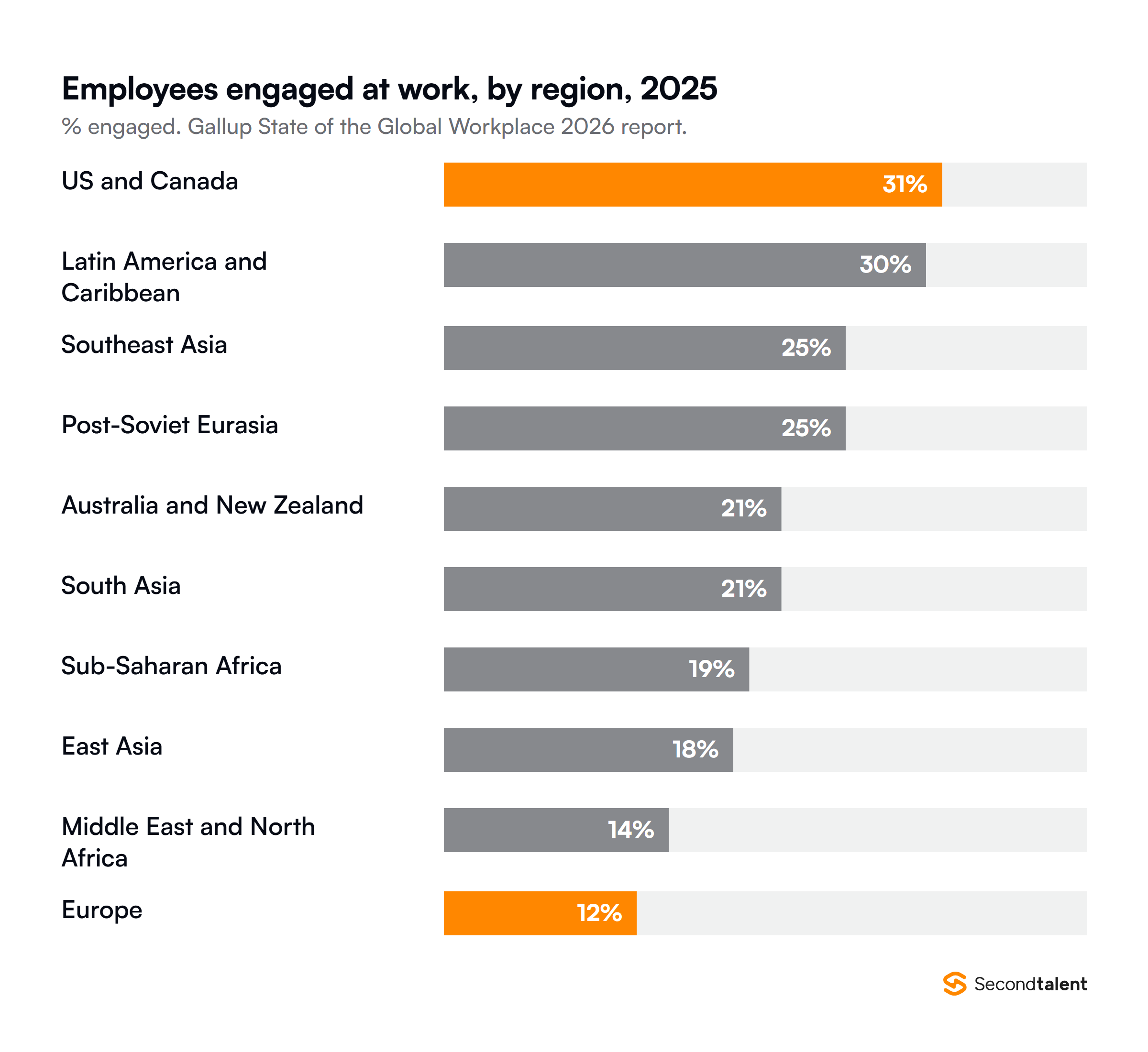
Gallup puts the cost of low engagement at about $10 trillion in lost productivity, or 9% of world GDP. The global rate peaked at 23% in 2022.
Manager engagement dropped from 27% to 22% in one year, and by nine points since 2022.
Managers shape much of a team’s workplace culture, and Gallup has put a number on it: a 2015 analysis found managers account for at least 70% of the variance in engagement across business units.
Some employers buck the trend. At organizations Gallup counts as best practice, 79% of managers were engaged in 2025, nearly four times the global average.
Engagement by where people work
Fully remote employees were the most engaged group in the 2026 report and on-site workers in jobs that cannot be done remotely the least:
- Exclusively remote: 30% engaged
- Hybrid: 25%
- On site, job could be remote: 24%
- On site, job cannot be remote: 17%
Job security weighs on US workers. 18% of US employees say it is somewhat or very likely their job will be eliminated in the next five years because of automation or AI, rising to 23% where AI is already in use.
Our employee retention statistics track what that does to quit rates.
How Stressed Are Employees at Work?
Half of employees in the US and Canada said they felt a lot of stress the previous day, the highest daily stress of any region in Gallup’s 2026 report. The global figures:
Job insecurity is a large source of that stress for American workers. In the APA’s 2025 survey, 54% said it had a significant impact on their stress at work, and 38% worried that AI may make some or all of their duties obsolete.
Chatbots, wellness apps and the first limits
Illinois was the first state to put limits on AI therapy. Its Wellness and Oversight for Psychological Resources Act, signed on August 4, 2025, bars anyone from using AI to provide mental health treatment or therapeutic decisions.
Licensed professionals can still use AI for admin and support tasks.
“Do not rely on GenAI chatbots and wellness apps to deliver psychotherapy or psychological treatment.”
American Psychological Association health advisory, November 2025
How Much of the Workday Runs Through AI?
38% of employed US adults say they use chatbots for tasks at work, in Pew Research Center’s June 2026 survey.
A narrower Pew question gives a lower answer: 21% of workers said in October 2025 that at least some of their work is done with AI.
Worry still beats hope. In Pew’s February 2025 survey, 52% of workers were worried about how AI will be used in the workplace in future, and 36% felt hopeful.
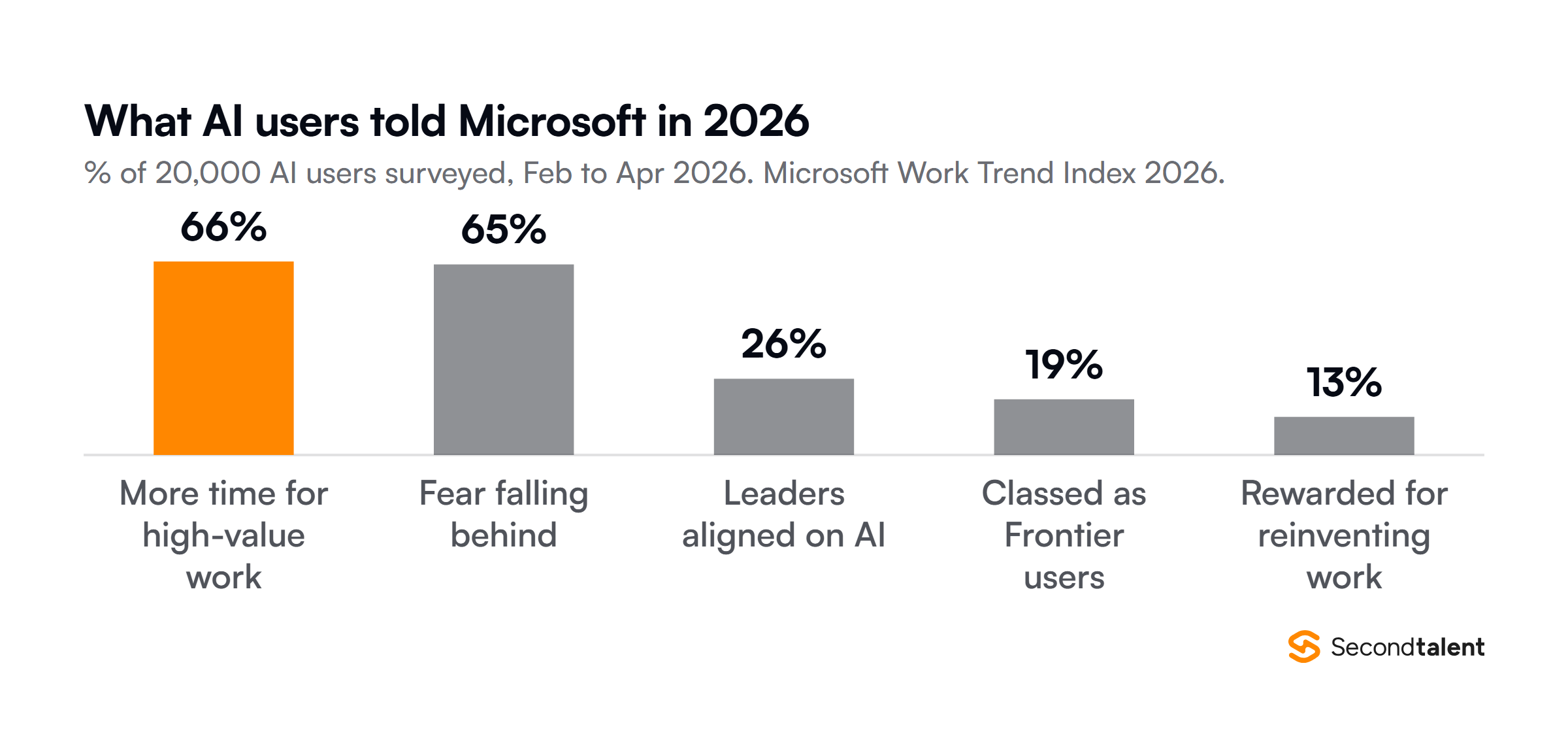
What 20,000 AI users told Microsoft
Microsoft’s 2026 Work Trend Index surveyed people who already use AI at work, from February to April 2026. Two thirds say it frees time for higher-value work, and nearly as many fear falling behind.
Few see their leaders aligned or their effort rewarded, and Microsoft classes only 19% as “Frontier” users.
The same company’s product data shows how long the workday has stretched. In its “infinite workday” report, 40% of Microsoft 365 users online at 6 am were reviewing email, and 29% of active workers were back in their inboxes by 10 pm.
The average worker gets 153 Teams messages each weekday.
Nearly half of employees (48%) and 52% of leaders said their work feels chaotic and fragmented.
Our AI in the workplace statistics go deeper on adoption, and the future of work facts on jobs and skills cover which roles AI is expected to create or cut.
Building a Team Across Offices and Time Zones
If office rules leave you short of engineers within commuting distance, you can hire further afield.
Second Talent matches companies with pre-vetted remote developers in Asia, and our tech industry hiring statistics show where the US market stands.
If you have no local entity, our employer of record service handles contracts, payroll and benefits. Tell us the role you need to fill and we will send matching profiles.
Frequently Asked Questions
Is remote work declining in 2026?
Slightly, on the government measure. The BLS telework rate was 22.1% in August 2025 and 21.6% in August 2026.
Office visits are rising too, but Placer.ai still has them about a third below 2019, so work from home has not returned to pre-pandemic levels.
Does a four-day week mean a pay cut?
Not in the main trials. The UK pilot required companies to keep pay at 100% while giving employees a meaningful cut in working time. Companies could choose how to cut hours rather than follow one model.
What share of office workers want to be in the office every day?
About 6% of them. Gallup asked remote-capable US employees in November 2025, and 6% preferred full-time on-site work, against 61% for hybrid and 33% for fully remote.



![Engineering Productivity Metrics to Track. Top 10 Key Engineering Productivity Metrics to Track [2026], by Second Talent.](https://www.secondtalent.com/wp-content/uploads/2026/09/top-10-engineering-productivity-metrics-featured-v2-768x403.jpg)