
TL;DR: ChatGPT hit 900 million weekly active users in 2026 with $25B+ annualized revenue. OpenAI closed a $122B round at a $852B valuation (March 2026) and 92% of Fortune 500 companies now run on ChatGPT.
ChatGPT crossed 900 million weekly active users in 2026, more than double the 400 million figure from the same window last year. OpenAI, the company behind ChatGPT, crossed $25 billion in annualized revenue in February 2026 and now generates roughly $2 billion per month. In March 2026 OpenAI closed a funding round with $122 billion in committed capital at a $852 billion post-money valuation.
The enterprise picture is equally loud. OpenAI says 92% of the Fortune 500 use its products, and it reported 50 million total paid subscribers across Plus, Team, Enterprise, and Pro tiers alongside the February user milestone. Deployed seat counts are the one figure here worth treating carefully: published estimates run from roughly 4 million to more than 7 million depending on the source and the month, so a range is more honest than a single number.
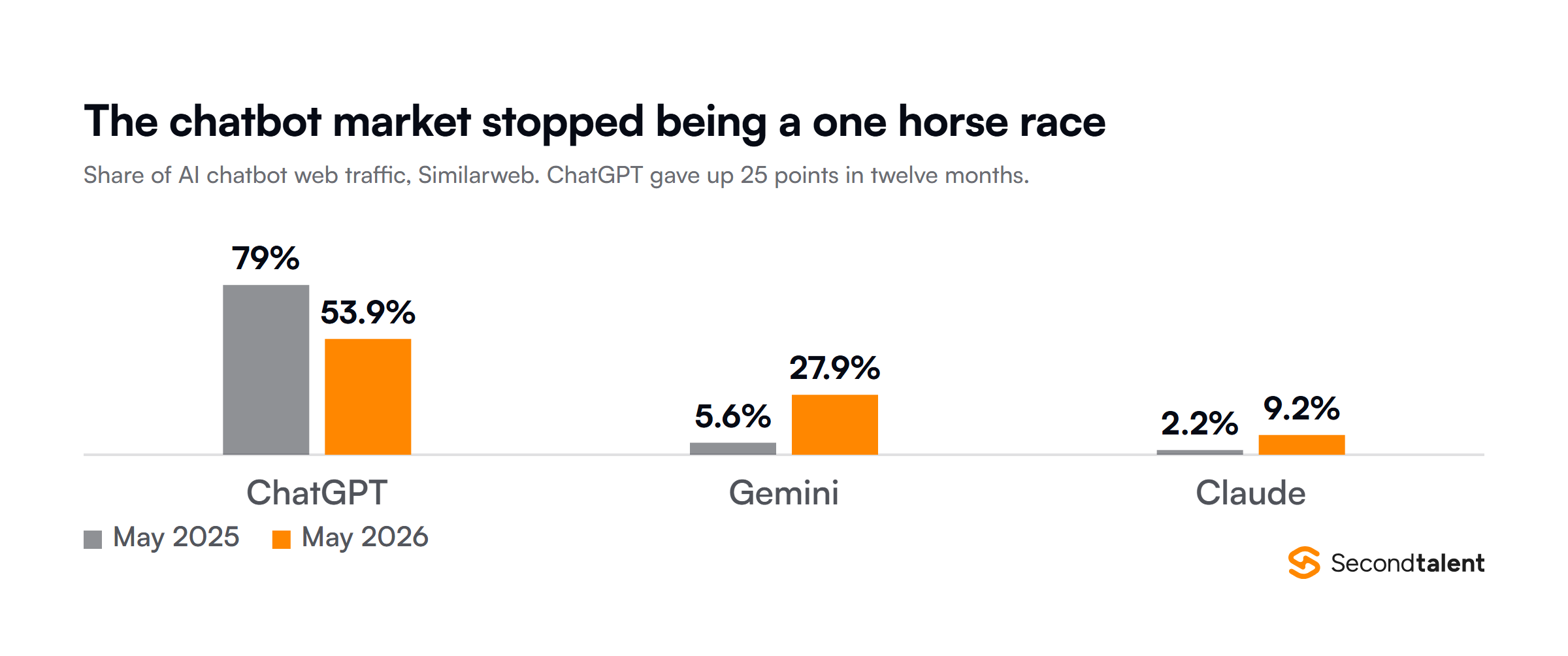
The competitive picture is where the 2026 numbers break hardest from the 2025 story. ChatGPT’s share of AI chatbot web traffic fell from 79.0% in May 2025 to 53.9% in May 2026 on Similarweb’s measurement, while Google’s Gemini climbed to 27.9% and Claude reached 9.2%. ChatGPT is still the largest chatbot by a wide margin. It is no longer the whole market, and a 2026 buying decision that assumes otherwise is running on last year’s data.
- 900M weekly active users in 2026 (up 125% year-over-year)
- $25B+ annualized revenue, roughly $2B per month
- $852B post-money valuation after $122B round (March 2026)
- 92% of Fortune 500 companies use ChatGPT
- 50M paid subscribers across Plus, Team, Enterprise, Pro
- 53.9% of AI chatbot web traffic, down from 79.0% a year earlier
- Over 2 billion daily queries processed
The rest of this post breaks down revenue, users, enterprise, valuation, market share, demographics, model benchmarks, and how ChatGPT compares head-to-head with Claude in 2026.
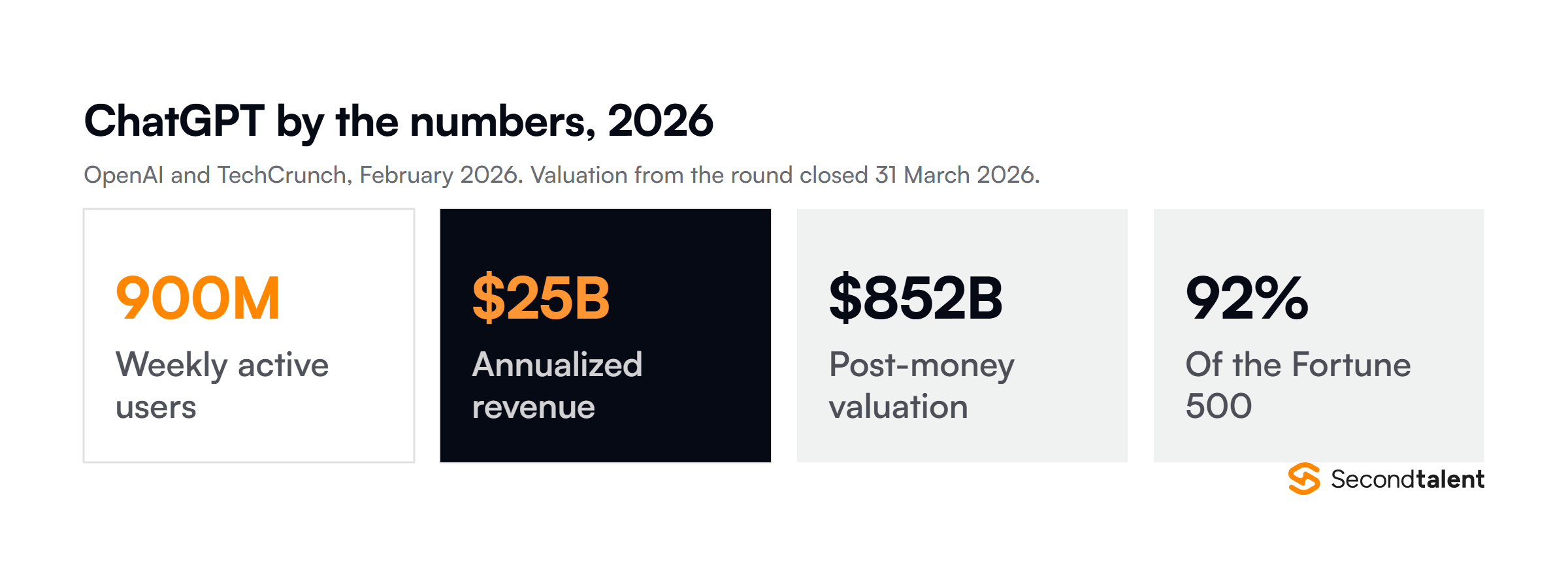
Key ChatGPT statistics for 2026
- 900 million weekly active users (up from 400M in 2025, a 125% YoY jump).
- 193 million daily active users. Over 2 billion prompts processed per day.
- About 5.5 billion website visits in July 2026 (Similarweb).
- Annualized revenue: $25B+ in February 2026, roughly $2B per month.
- OpenAI valuation: $852 billion post-money (March 2026), $122B raised.
- 92% of Fortune 500 companies are ChatGPT customers.
- Enterprise seat estimates range from about 4 million to more than 7 million.
- 50 million paid subscribers across all tiers (Plus, Team, Enterprise, Pro).
- 10 million Plus subscribers at $20/month = $2.4B ARR from Plus alone.
- Gemini reached 27.9% of chatbot web traffic in May 2026, up from 5.6%.
- GPT-5.4 flagship launched March 2026 with 57.7% SWE-bench Pro coding score.
- GPT-5.4 Mini delivers 94% of Standard’s coding performance at 6x lower cost.
How much revenue does ChatGPT generate in 2026
OpenAI’s revenue has roughly tripled year over year for three straight years. The company exited 2023 with modest revenue. By June 2025 it had hit $10 billion in annualized revenue. By February 2026 that number had more than doubled to $25 billion, with OpenAI now generating approximately $2 billion every month.
The mix is roughly 24% ChatGPT Plus at $20/month, 50% Team and Enterprise subscriptions, and the remaining quarter from API usage. The Plus tier alone generates $2.4B in annual subscription revenue from 10 million paying users. Team, Enterprise, and API together contribute the other $22-23B.
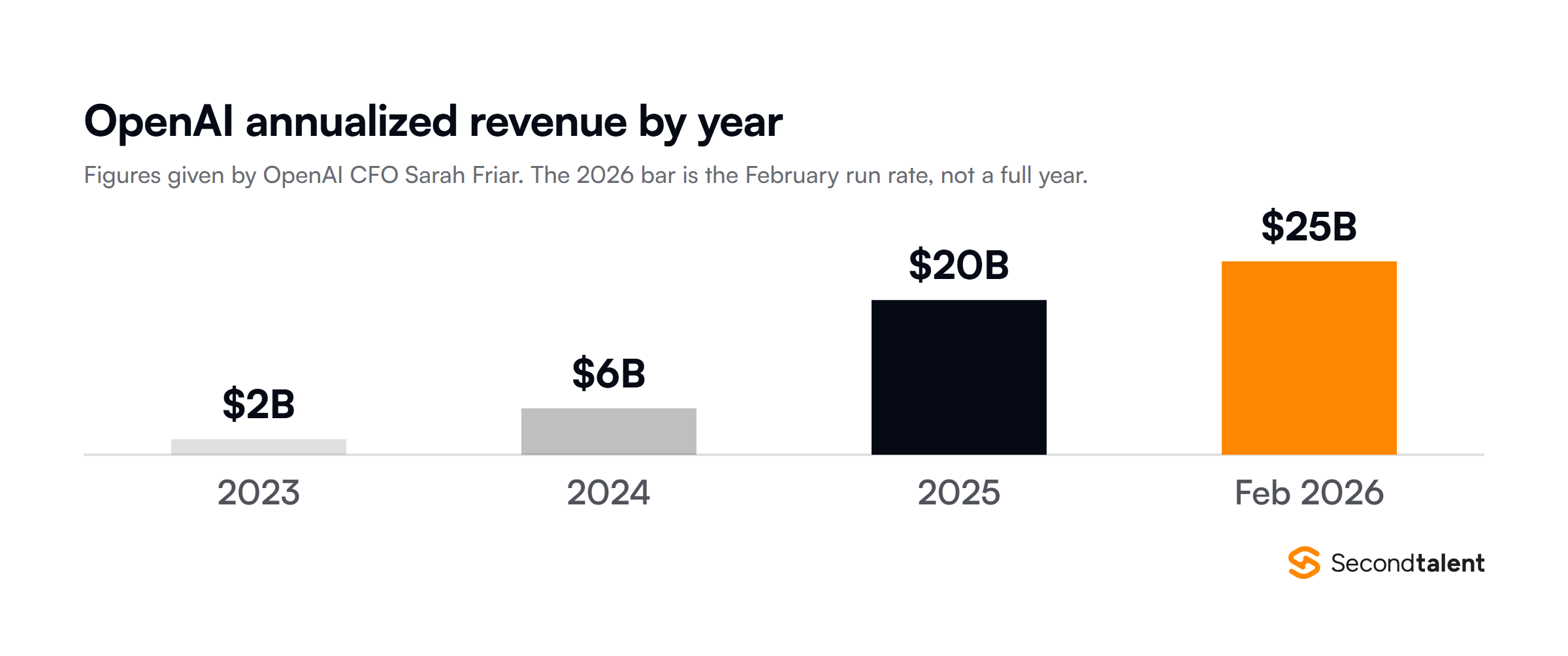
How many people use ChatGPT in 2026
ChatGPT’s scale is now closer to a social network than a SaaS tool. 900 million people use it every week. 193 million use it every single day. The platform processes more than 2 billion prompts per day, and received about 5.5 billion website visits in July 2026.
Weekly active users went from 400 million to 900 million in 12 months. That 125% year-over-year growth at this scale is unusual. Most consumer products plateau in the hundreds of millions. ChatGPT kept accelerating, with enterprise seat expansion doing much of the heavy lifting in the back half of 2025.
How deep is ChatGPT inside large companies
The most defensible enterprise number OpenAI publishes is its Fortune 500 penetration: 92% of those companies use its products in some form. That is adoption, not depth, and the two get conflated constantly. Seat counts are the closer proxy for depth, and they are reported inconsistently enough that the honest answer is a range of roughly 4 million to 7 million-plus deployed seats rather than a single figure.
One caution if you are building a business case on this. A per-tier retention split, usually quoted as 88% Enterprise, 68% Team and 59% Plus, circulates widely across statistics roundups. It does not appear in OpenAI’s own disclosures or in Sacra’s OpenAI research, and we could not trace it to a primary source. Treat it as unverified rather than as a benchmark to plan against, and ask any vendor quoting it where the number came from.
How has OpenAI’s valuation and funding changed
OpenAI has raised increasingly large rounds at increasingly aggressive valuations. The company’s path from under $30B in late 2023 to $852B in March 2026 is faster than almost any company in history.
Each round unlocks more compute, more research headcount, and more reach. For buyers this signals that the product roadmap has runway to build features that are computationally expensive (longer context windows, more tool use, larger model families). For competitors it signals that pricing wars are coming, not going away.
What is ChatGPT’s share of the AI chatbot market
ChatGPT is still the largest AI chatbot, but its lead narrowed sharply through 2026. Similarweb put ChatGPT at 53.9% of AI chatbot web traffic in May 2026, down from 79.0% twelve months earlier. Gemini took most of what ChatGPT gave up, rising from 5.6% to 27.9%, and Claude went from 2.2% to 9.2%. Any roundup still quoting 80% or more is describing May 2025.
Web-traffic share is also a weak proxy for where the money is. It counts visits to a chat interface, not API spend, seats, or production workloads, and it says nothing about which model a company has actually wired into its stack. The useful read for a buyer is directional: a market that was effectively single-vendor in mid-2025 now has three credible providers, and switching cost is the thing worth designing against.
Who uses ChatGPT, by age and geography
ChatGPT’s demographic is younger than most productivity tools but older than Claude’s. The largest cohort is 25-34 at 33.52% of users. The 18-24 group follows at 28.04%. Combined, the 18-34 bracket is around 60% of total users.
Gender distribution is more balanced than most AI tools. Approximately 54% of ChatGPT users are male and 46% female, with some surveys reporting the split even more even at 52% female versus 48% male.
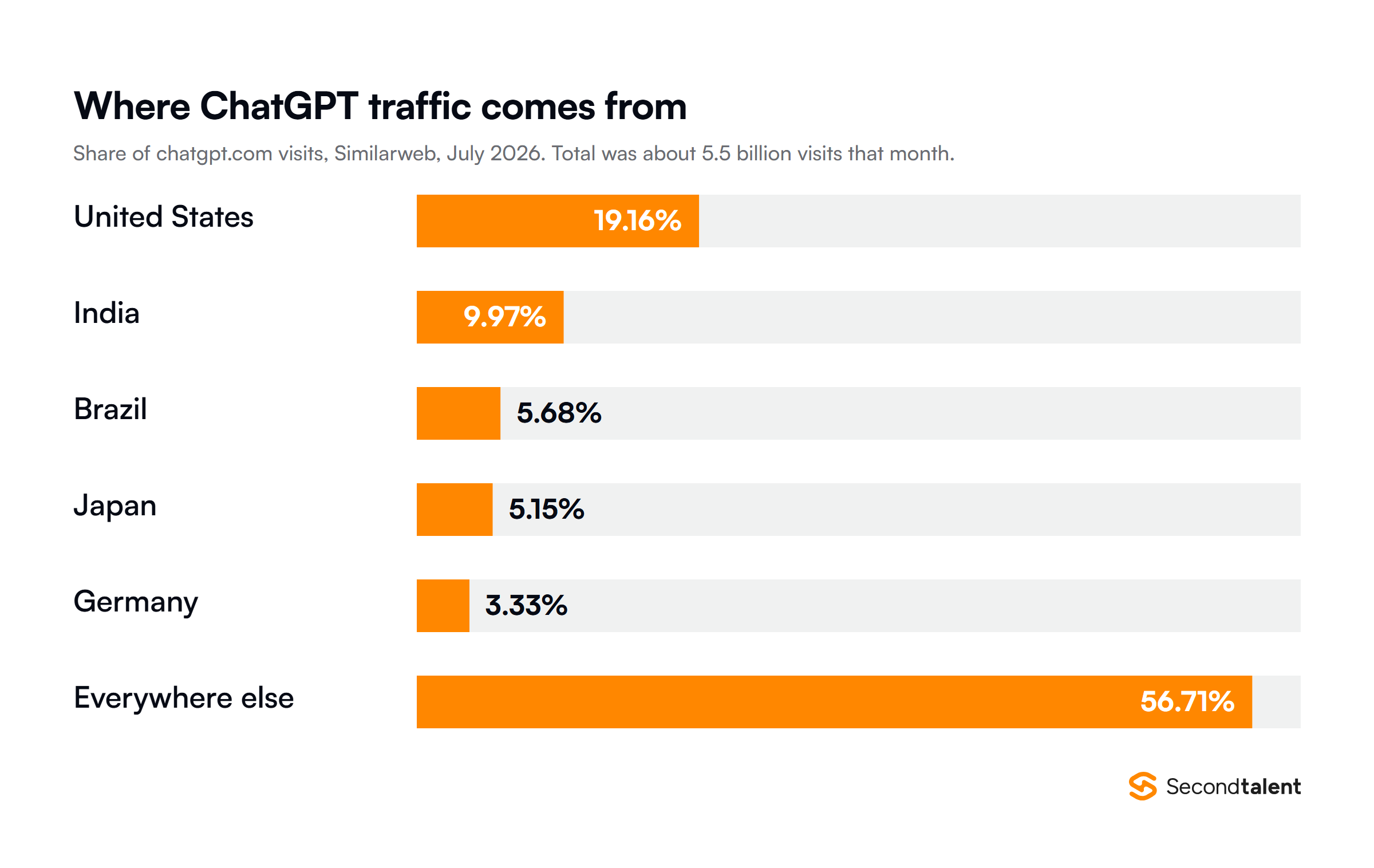
Top countries by share of ChatGPT traffic
- United States: 19.16% of visits
- India: 9.97% of visits
- Brazil: 5.68% of visits
- Japan: 5.15% of visits
- Germany: 3.33% of visits
- Rest of the world: 56.71% across 160+ countries
Shares are Similarweb’s July 2026 snapshot of chatgpt.com. The US is still the biggest single market, but its share keeps drifting down as international adoption accelerates. India is now close to 10% of all traffic, reflecting heavy adoption among students and India-based developers. The composition of the top five moves faster than most roundups admit: the United Kingdom sat fourth on earlier snapshots and has since been displaced by Japan and Germany.
How does ChatGPT compare to Claude in 2026
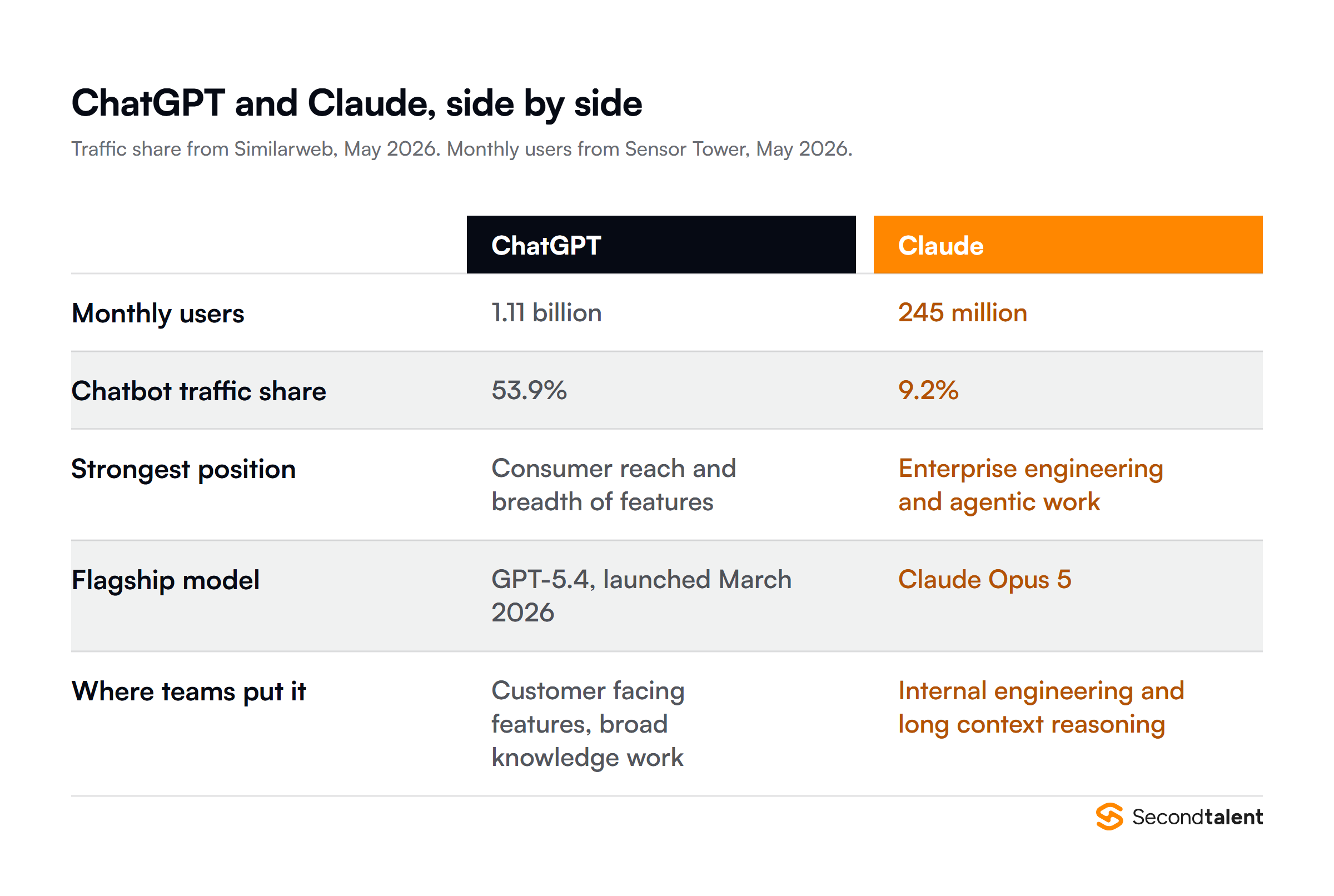
ChatGPT and Claude are increasingly serving different markets. The simplest head-to-head comparison on the metrics that actually matter for 2026 buyers:
For consumer-facing products with very high weekly usage, ChatGPT remains the default. For enterprise coding, agentic workflows, and long-context reasoning, Claude has taken the lead. Many teams now run both: ChatGPT for customer facing features, Claude for internal engineering workflows.
GPT-5.4 model family and benchmarks
OpenAI’s current flagship is GPT-5.4, launched in March 2026. The family includes GPT-5.4 (Standard), GPT-5.4 Mini, and a set of Pro tier variants. Earlier GPT-5.2 is scheduled for retirement on June 5, 2026.
| Model | SWE-bench Pro | OSWorld (computer use) | Input / Output $/1M tokens | Typical use |
|---|---|---|---|---|
| GPT-5.4 Standard | 57.7% | 75% | ~$3 / $15 | Flagship reasoning + coding |
| GPT-5.4 Mini | 54.38% | Not published | ~$0.40 / $1.60 | High-volume apps (6x cheaper) |
| GPT-5.2 (deprecating) | Not published | Not published | $1.75 / $14 | Legacy, retire by June 2026 |
GPT-5.4 Mini is the interesting entry. Six times cheaper than Standard at 94% of the coding performance means most production applications should default to Mini, with Standard reserved for the hardest reasoning tasks. That pricing structure mirrors what Anthropic did with Haiku + Sonnet + Opus.
What this means for engineering teams in 2026
Three practical takeaways for teams planning around ChatGPT for the rest of 2026:
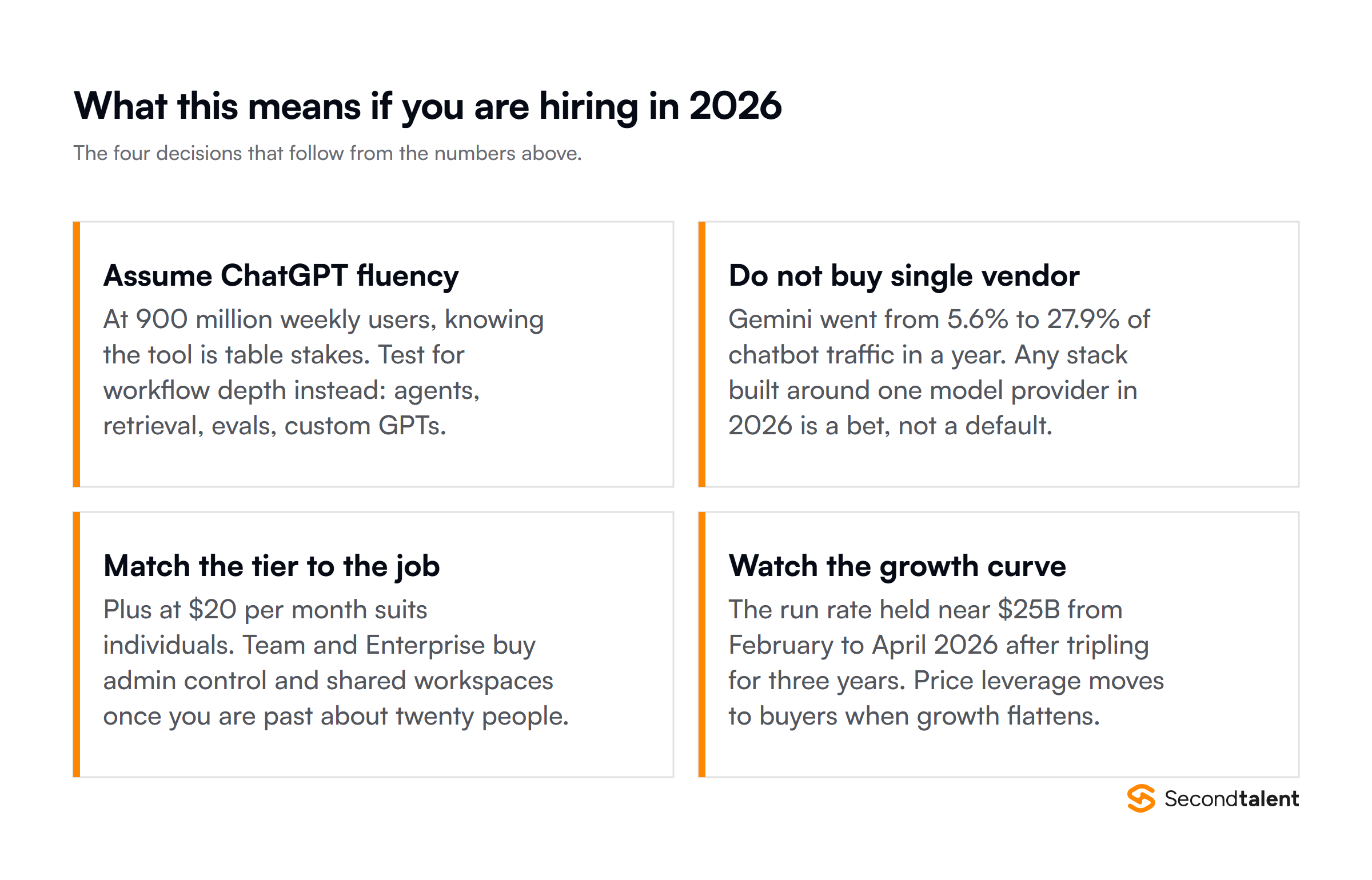
1. ChatGPT fluency is a default expectation. With 900 million weekly users and 92% Fortune 500 adoption, assuming a new hire knows how to use ChatGPT productively is reasonable. What matters now is fluency on specific workflows: agents, retrieval, custom GPTs, Team-tier API usage. That is a different hiring brief from a general backend role, and closer to what an LLM engineer actually does day to day. We match ChatGPT-fluent senior operators from Asia at 50-70% lower loaded cost than US peers.
2. Pick the right tier. Plus at $20/month is fine for individual knowledge workers. Team at $25/user/month unlocks shared workspaces and better admin. Enterprise pricing is negotiated, and buys SSO, admin controls, and data-handling commitments that Team does not carry. For teams over 20 people, Enterprise pays for itself in admin time saved.
3. Don’t assume ChatGPT-only. The data shows Claude is winning in enterprise. Most teams that are serious about AI in 2026 use both. ChatGPT for consumer-facing features and broad knowledge work, Claude for engineering and agentic workflows. The combined monthly cost is usually under $80 per seat.
Final words
ChatGPT is still the biggest AI product on the planet by users and revenue. 900 million weekly users, $25 billion ARR, and 92% of the Fortune 500 means ChatGPT is no longer a trend. It is infrastructure. But the one-size-fits-all era is over. Enterprise buyers in 2026 are pairing ChatGPT with Claude, and running GPT-5.4 Mini where Standard would be overkill. The teams that move fastest are the ones that stopped treating AI as a single vendor decision.
Data Sources
- OpenAI, on the March 2026 funding round and Fortune 500 adoption
- TechCrunch, ChatGPT reaches 900 million weekly active users
- CNBC, OpenAI closes its round at an $852 billion valuation
- Similarweb, chatgpt.com traffic and country breakdown
- Scale, SWE-bench Pro public leaderboard
- Business of Apps, ChatGPT statistics
- DemandSage, ChatGPT statistics
- TechnologyChecker, ChatGPT statistics
- Sacra, OpenAI research
- First Page Sage, ChatGPT usage statistics
- Artificial Analysis, GPT-5 benchmarks
- LLM-Stats, benchmark aggregate
FAQs
1. How many people use ChatGPT in 2026?
ChatGPT has 900 million weekly active users and 193 million daily active users in 2026. The platform handles over 2 billion prompts per day and saw about 5.5 billion website visits in July 2026. Weekly users more than doubled in 12 months.
2. How much revenue does ChatGPT generate?
OpenAI crossed $25 billion in annualized revenue in February 2026. The company generates roughly $2 billion per month. ChatGPT Plus contributes $2.4 billion, and Team, Enterprise, and API usage fees account for the remaining $22-23 billion.
3. What is OpenAI’s valuation in 2026?
OpenAI closed a funding round in March 2026 with $122 billion in committed capital at a $852 billion post-money valuation. That makes it one of the most valuable private companies in the world.
4. How many Fortune 500 companies use ChatGPT?
OpenAI says 92% of Fortune 500 companies use its products. Deployed enterprise seat counts are reported inconsistently, with published estimates spanning roughly 4 million to more than 7 million depending on the source and the month, so treat any single seat figure with caution.
5. ChatGPT vs Claude, which is better?
ChatGPT wins decisively on reach: about 1.11 billion monthly users against Claude’s 245 million, and 53.9% of chatbot web traffic against 9.2%. On coding, be careful how the benchmark numbers get quoted. Scores for SWE-bench Verified and SWE-bench Pro are routinely compared as though they were the same test. Pro is substantially harder, so a Verified score always looks better and the comparison means nothing. On Scale’s SWE-bench Pro public leaderboard, where every model runs on one standardised harness, GPT-5.4 leads at 59.1% and the highest-scoring Claude entry is Opus 4.6 at 51.9%. Newer Claude models are not yet scored on that board, and vendor-reported aggregates place them higher on different scaffolds. The defensible summary: both are strong at code, the public like-for-like evidence currently favours GPT-5.4, and most serious teams run both regardless.





![Singapore AI Companies Leading Southeast Asia. Top 10 Singapore AI Companies Leading Southeast Asia [2026], by Second Talent.](https://www.secondtalent.com/wp-content/uploads/2026/09/singapore-ai-companies-featured-v2-768x403.jpg)