
TL;DR. Of the ten AI recruitment platforms below, six still print a price and four route you to a sales call. The published ladder runs from $15 per user per month (Manatal) to $400 a month for a small team (Ashby).
On the four that publish nothing, anonymised contract data puts the real annual spend between about $9,000 and $145,000. Buy on pricing model first, feature list second.
Every price in the 2025 version of this guide has moved. Some vendors cut their entry rate, some restructured around AI credits, and four stopped publishing a number at all.
I rebuilt the comparison in September 2026 off each vendor’s own pricing page. Secondary round-ups were still quoting figures two repricings out of date, including the one this guide itself used to carry.
Second Talent places engineers across nine Asian markets, so we buy these tools and deliver the hiring they support.
That shapes what this guide flags: the metered add-ons and headcount bands that turn a $299 sticker into a five-figure invoice.
Quick comparison: what each tool costs in 2026
Prices read off each vendor’s pricing page on 9 September 2026, at the annual rate where the vendor offers one.
| Tool | Entry price | Priced by | Best for |
|---|---|---|---|
| Manatal | $15 per user/month | Seat | Agencies and small teams |
| Zoho Recruit | $25 per recruiter/month | Recruiter licence | Small business on a budget |
| Greenhouse | Not published | Quote | Structured hiring at scale |
| Juicebox | $99 per seat/month | Seat plus credits | Outbound sourcing |
| Fetcher | $115/month | Lead volume | Sourcing without a sourcer |
| Workable | $299/month | Headcount band | Recruiting plus HR in one |
| Ashby | $400/month | Headcount band | Data-led in-house teams |
| BambooHR | $10 per employee/month | Employee | ATS inside a full HR suite |
| SmartRecruiters | From $14,995/year | Quote | High-volume enterprise |
| HireVue | Not published | Quote | Assessment-led enterprise |
What to take away
Five things that decide this purchase
- The published price is a floor, not a price. Workable, Ashby and BambooHR all scale with headcount, and the figure on the card is the smallest band.
- AI is now metered separately at three of these vendors. Workable sells agent credits, Juicebox sells agents at $199 each, Manatal sells its AI Interviewer as an add-on.
- Four platforms publish nothing. Contract data puts Greenhouse near a $26,570 median and SmartRecruiters near $33,507, both far above the “starting at” figures still circulating.
- Adoption is wide and shallow. Only 10% of staffing firms run AI across a full workflow, so buy for the two steps you will automate this year.
1. Manatal: the cheapest real ATS with AI attached
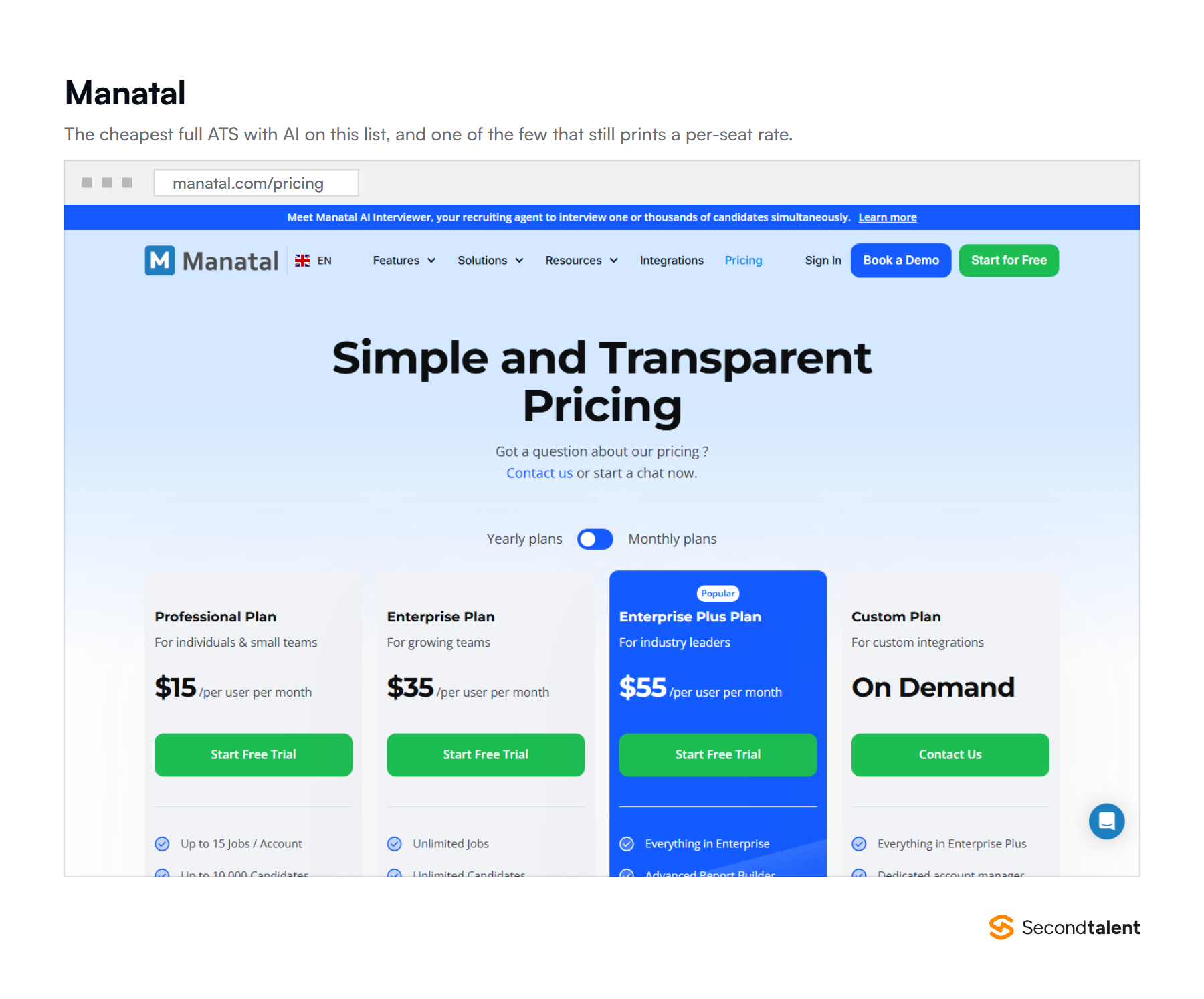
Manatal is the pick for a recruitment agency or a small in-house team that wants a working applicant tracking system without a procurement cycle.
It is the only tool here whose pricing page is headed “Simple and Transparent Pricing” and then actually is.
Three published tiers, all per user per month: Professional at $15, Enterprise at $35 and Enterprise Plus at $55 on annual billing, or $19, $39 and $59 month to month.
Volume sets the tier boundary, not features. Professional caps you at 15 jobs and 10,000 candidates and Enterprise removes both caps, so an agency running 30 live roles pays the $35 rate whatever its headcount.
Hiring managers are unlimited on every tier, which keeps the seat count to actual recruiters.
AI candidate enrichment, recommendations and the Copilot assistant come with Professional. The AI Interviewer does not.
Manatal promotes it across the top of its own site as an agent that can interview thousands of candidates at once, and sells it as a paid add-on rather than part of the seat.
Enterprise Plus adds direct ChatGPT, Claude and general LLM integration plus an open API. Teams that want to wire their own AI sourcing workflow around the ATS should start there and skip the middle tier.
- Best for: agencies and teams under 20 recruiters that need an ATS today.
- Where it struggles: enterprise governance. SSO and custom permissions only arrive at $55 per user.
- Price: $15 to $55 per user per month, annual. Custom tier on request.
2. Zoho Recruit: cheapest per recruiter, if you accept the job caps
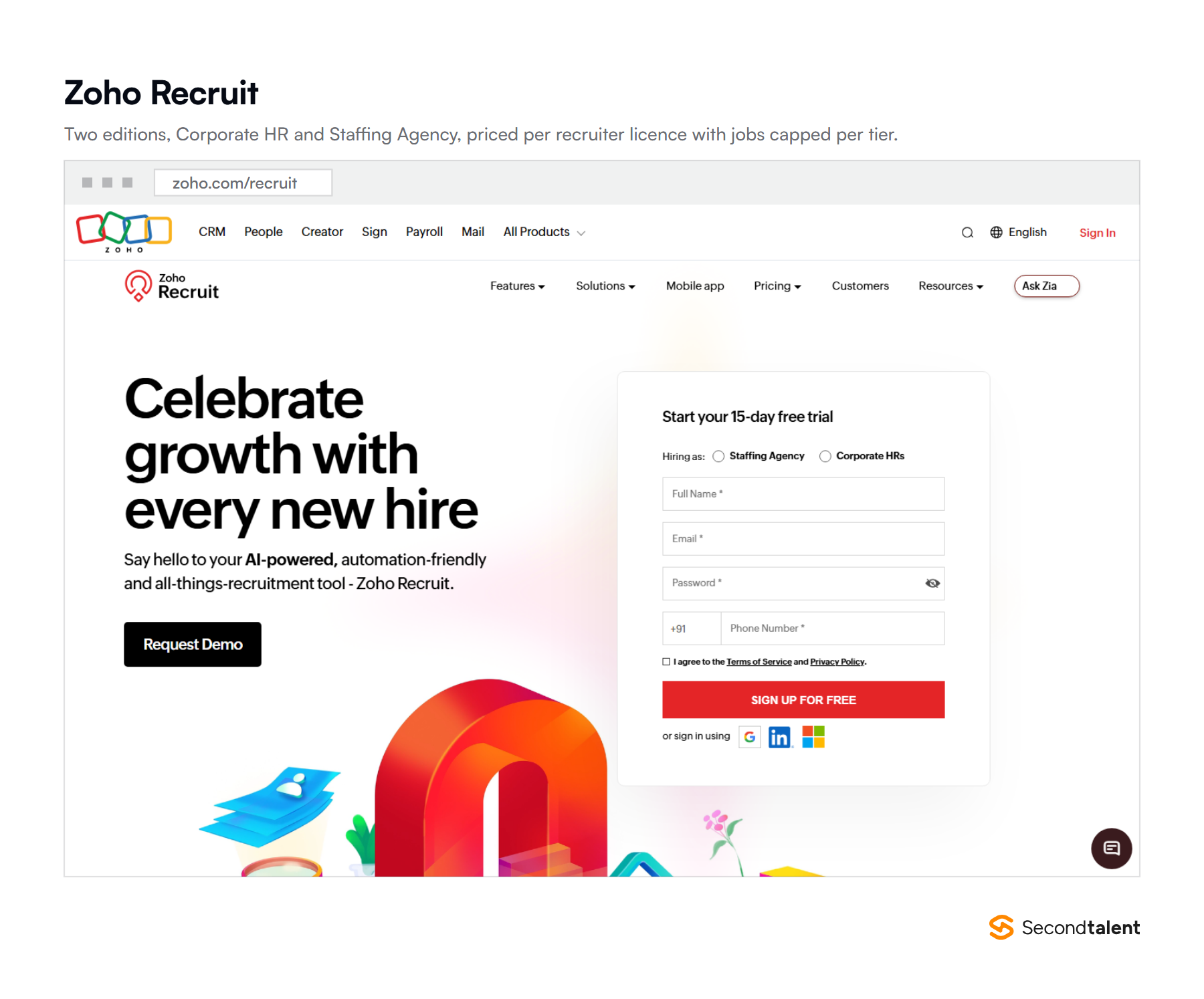
Zoho Recruit suits a small business that already lives inside Zoho’s other apps and wants recruiting to sit beside them.
It splits into two editions, Corporate HR and Staffing Agency, and picking the wrong one is the most common way buyers overpay.
The Corporate HR edition runs Free, Standard and Enterprise, at roughly $25 and $50 per recruiter per month on annual billing, or $30 and $60 month to month. The Staffing Agency edition adds a Professional tier in between.
The pricing page geolocates, so a reader in Asia sees the local list rather than the US one.
Job slots separate the tiers, not AI. Free covers 1 active job per recruiter licence, Standard 10 and Enterprise 20. A recruiter carrying 25 open roles needs a second licence however little work each role generates.
Standard is marked “Includes AI”, but Zoho holds Zia’s candidate matching back for Enterprise, along with the candidate and staffing portals and the automation builder.
Then read the add-on list, because three of them are priced outside the plan. Video interviews bill per job opening, so that line scales with hiring rather than headcount. Employee licences for the referral portal sell only in packs of ten.
The vendor portal for managing external recruiters is billed monthly on its own. None of the three works on the free edition.
- Best for: small companies and Zoho One customers hiring at low volume.
- Where it struggles: the job cap per licence, and add-ons that push the real bill 30% or more above the base rate.
- Price: free tier, then about $25 and $50 per recruiter per month on annual billing.
3. Greenhouse: structured hiring, with pricing by quote
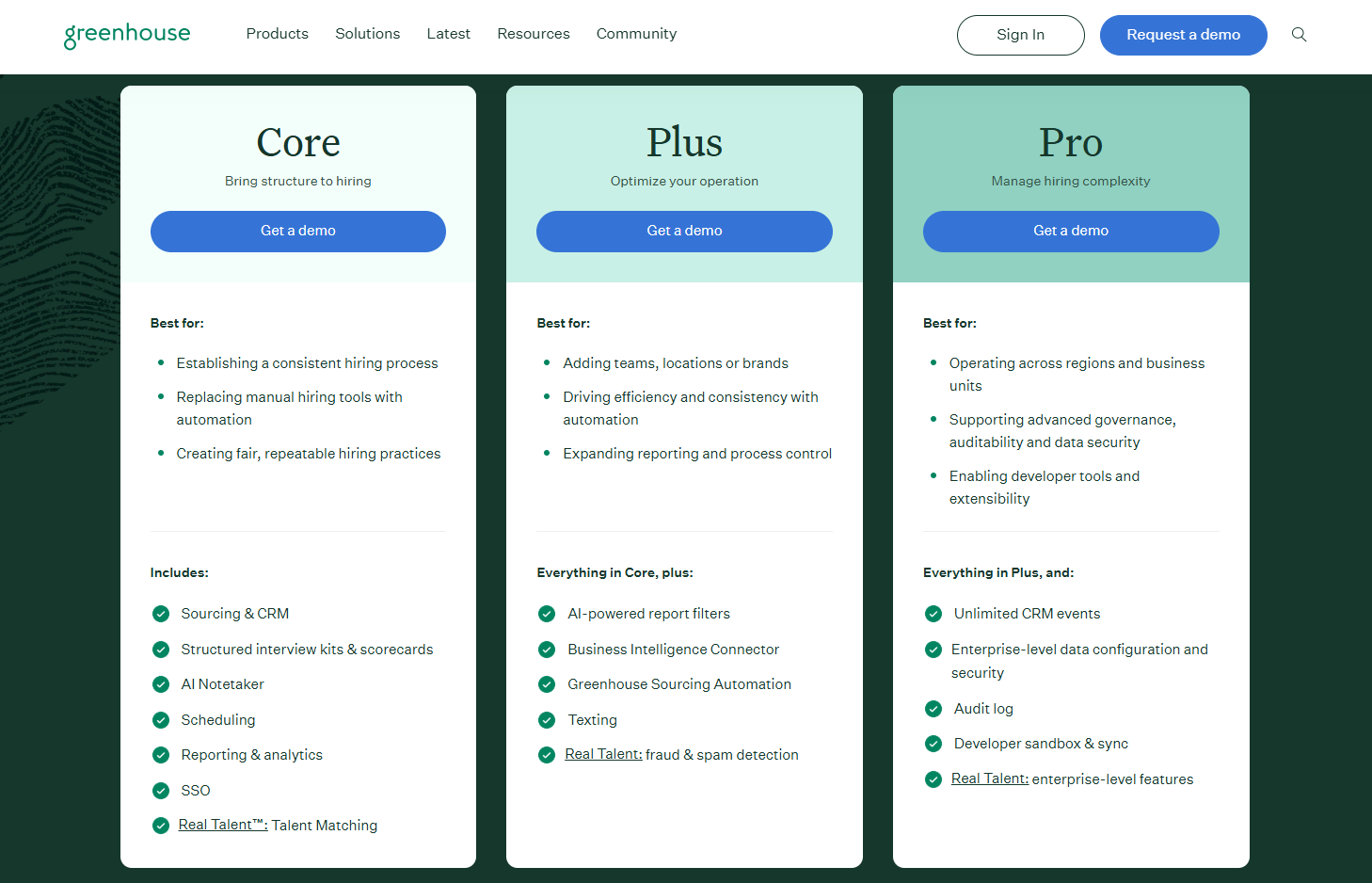
Greenhouse is the default choice for mid-market and enterprise teams that want structured, consistent hiring practices across a large organisation.
Its pricing page describes three plans, Core, Plus and Pro, and prices none of them, which puts it firmly in the “contact sales” category of procurement.
Anonymised contract data puts the typical spend well above the “$5,000 a year” figure that circulated through 2025 round-ups.
Vendr’s February 2026 guide, drawn from 876 purchases, puts the median Greenhouse contract at $26,570 a year, ranging from $10,159 to $75,125, so the floor is lower for smaller teams.
The quote is built around company size, and the demo form asks for headcount before anything else. Expect the bill to grow as the company grows, whatever your hiring volume.
Greenhouse’s AI additions focus on reducing administrative drag rather than automating the hiring decision. Core includes an AI Notetaker and Real Talent candidate matching.
Plus adds AI-powered report filters, sourcing automation and Real Talent fraud and spam detection. The core product is still built around human-led interview kits and scorecards.
For an AI first-round interview, Greenhouse now sells its own Voice AI, a structured voice screen scored against the questions and rubric your team sets.
It is sold as a separate solution alongside Onboarding, and Greenhouse positions it as a replacement for the resume screen, not for human interviews.
- Best for: companies that prioritise structured hiring and have the budget for a mature, enterprise-grade ATS.
- Where it struggles: transparency. You cannot price it without a sales call, fraud detection sits in Plus and above, and Voice AI and Onboarding are separate solutions.
- Price: not published; custom quote based on company size. Median signed contract $26,570 a year.
4. Juicebox: sourcing search, priced in seats and credits
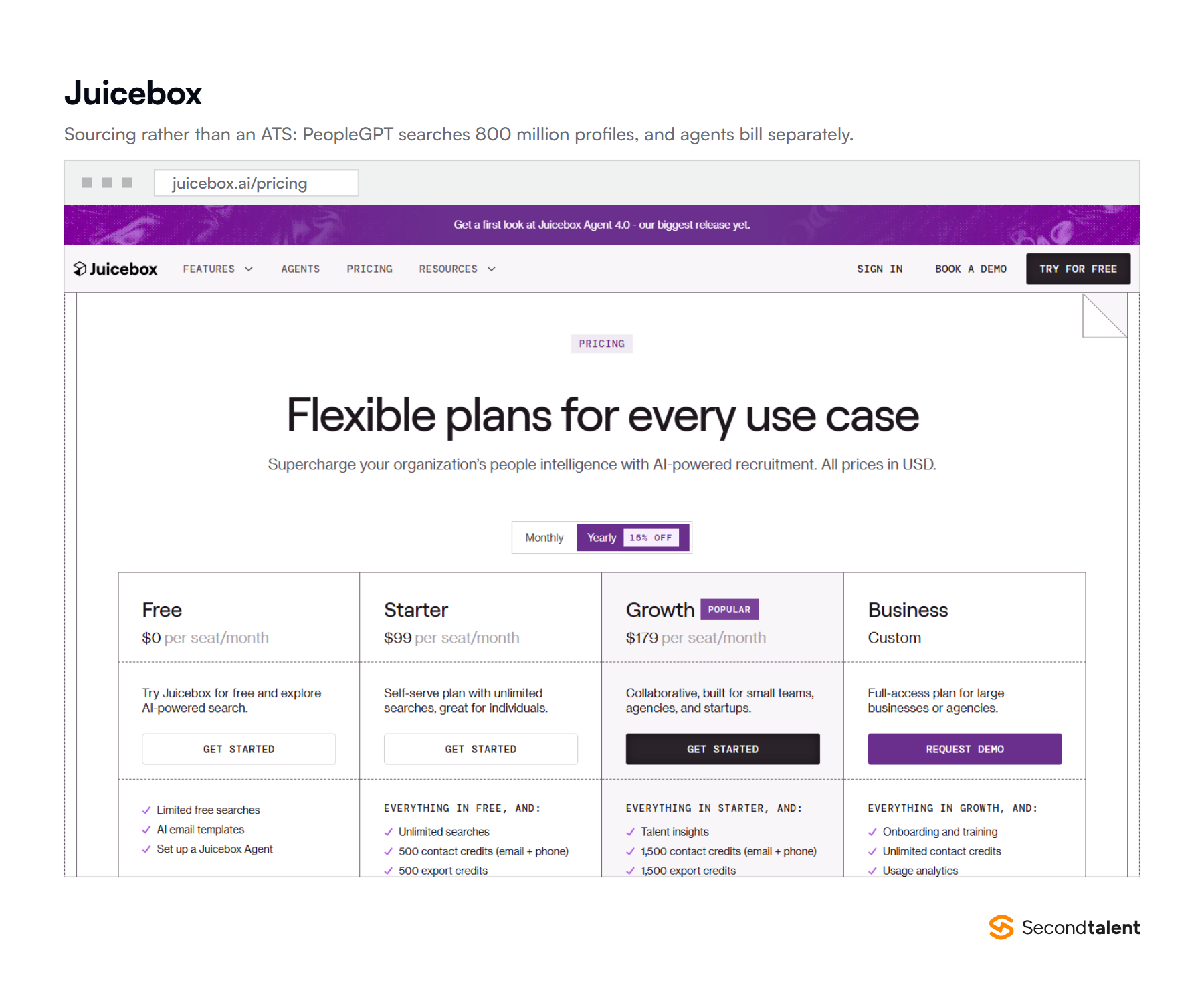
Juicebox is not an ATS and does not belong in a comparison against one.
It is a search layer over roughly 800 million public profiles drawn from dozens of sources, driven by PeopleGPT, which turns a plain-English brief into a candidate query without Boolean strings.
AI Spotlight then explains why each result matched, which is the part that saves the reading time.
Pricing runs Free, Starter at $99 per seat per month, Growth at $179 and a custom Business tier, all at the annual rate. Month to month costs $119 and $199 for the same two plans.
Contact credits decide your real cost, not the seat. Starter gives one seat 500 contact and 500 export credits a month. Growth raises both to 1,500 per seat and allows up to five seats.
Free gets five one-off contact credits, which is enough to test the search and nothing else. Run out mid-month and the fix is a bigger plan, not a top-up.
Juicebox Agents, which run outreach sequences on their own, cost a separate $199 per agent per month on every paid plan. Model that line first: two agents cost more than the seat they sit on.
For outbound work in a competitive market the maths still holds against a contingency fee. For filling inbound applications it is the wrong purchase.
- Best for: outbound sourcing where the candidate will never apply on their own.
- Where it struggles: credit ceilings, and agents billed at twice the price of a Starter seat.
- Price: $0, $99 or $179 per seat per month annual, plus $199 per agent.
5. Fetcher: sourcing sold by lead volume, with humans attached
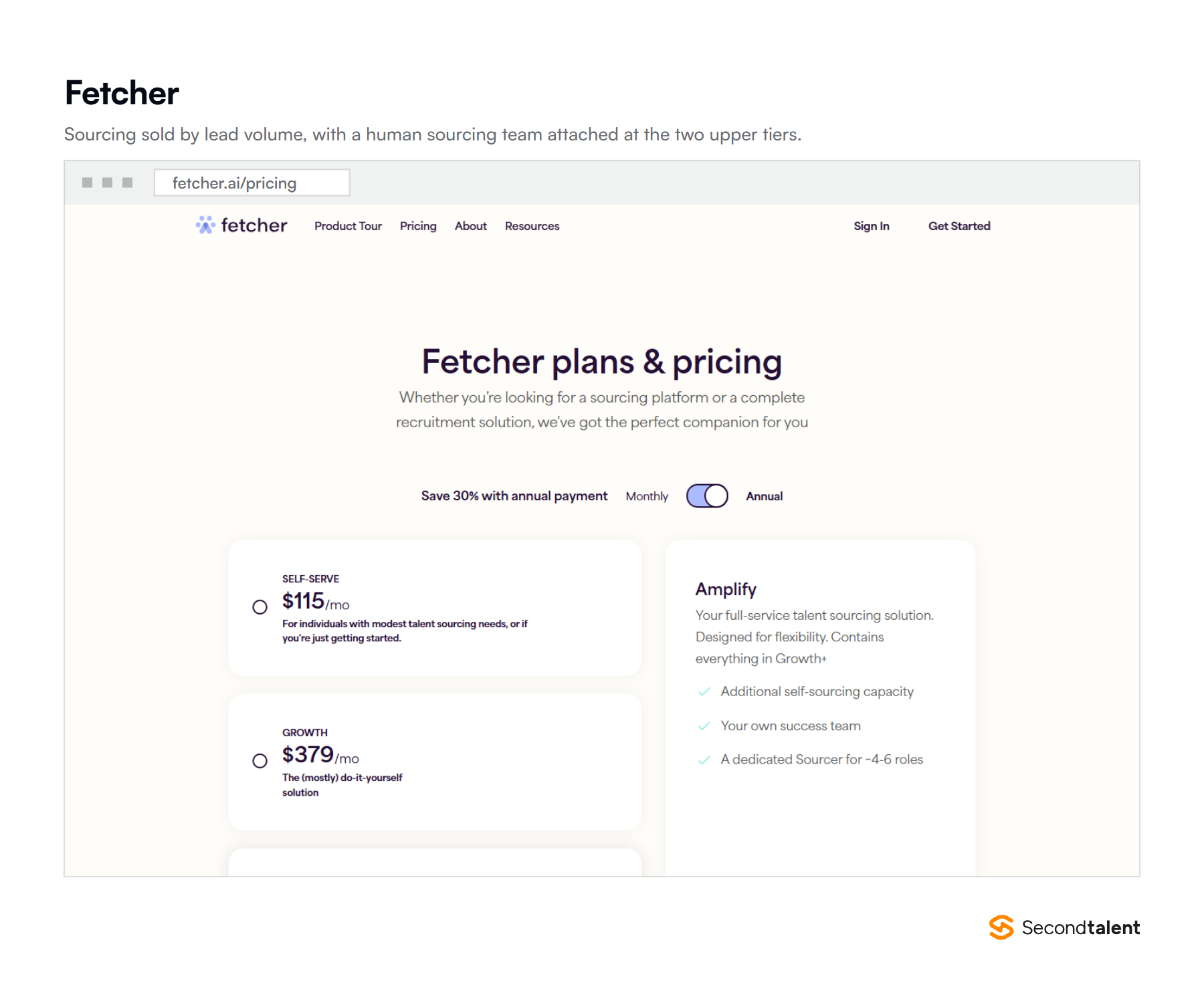
Fetcher solves the same problem as Juicebox and meters it differently. You buy candidate leads per month rather than searches per seat, and at the upper tiers a Fetcher sourcer works the roles alongside the software.
A browser plugin pulls candidates in from LinkedIn, and the analytics include diversity breakdowns on the sourced pipeline rather than only on applicants.
The published ladder is Self-serve at $115 a month, Growth at $379, Amplify at $649 and a custom Enterprise tier, all on annual billing against a stated 30% saving on monthly.
Self-serve includes one seat, 300 leads a month and up to 500 Fetcher-sourced candidates a year. Growth keeps the single seat but lifts the annual allowance to around 5,000 leads and 1,000 sourced candidates.
Amplify includes two seats, 10,000-plus leads and a dedicated Fetcher sourcer covering four to six roles.
That top tier prices a service, not a licence, which makes it the one worth costing properly.
A dedicated sourcer on four to six roles at $649 a month undercuts a junior sourcing hire in most Western markets and sits close to one in Manila or Ho Chi Minh City.
The same arithmetic sends companies to staff augmentation, and the fair comparison is against a person rather than against another tool.
- Best for: teams that want sourcing output without hiring a sourcer.
- Where it struggles: one seat on both lower tiers, so a second recruiter means Amplify.
- Price: $115, $379 or $649 a month on annual billing.
6. Workable: recruiting plus HR, with AI billed in credits
Workable fits the company that wants one subscription covering hiring and the HR admin that follows it, without running two vendors to get there.
The HR half is not a token module: onboarding, time off, time tracking, e-signatures and payroll preparation all sit in the same plan as the ATS, with job posting in nine languages on the recruiting side.
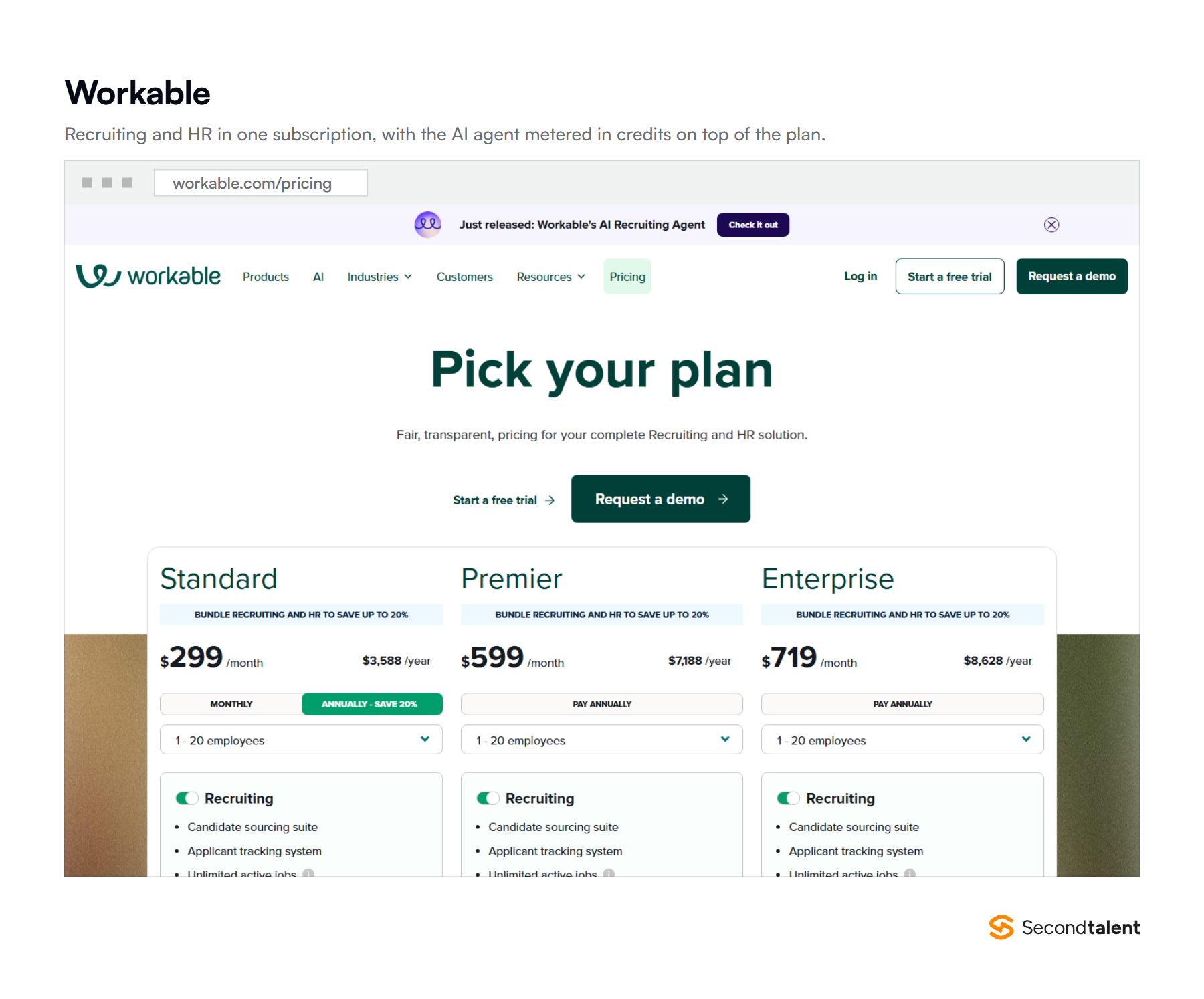
Three plans: Standard at $299 a month or $3,588 a year, Premier at $599 or $7,188, Enterprise at $719 or $8,628. Those are the 1 to 20 employee figures.
The pricing page carries a headcount selector and every number moves with it, which makes “Workable costs $299” the most repeated wrong sentence about this product.
One improvement since 2025: Standard now includes unlimited active jobs, so the old two-job Starter trap is gone.
AI metering is the 2026 change to budget for. Every plan ships 3,000 free credits for the Workable Agent, and past that Workable sells blocks of 5,000 at $0.12 a credit, 10,000 at $0.10 and 50,000 at $0.095.
A team leaning on the agent daily can spend more on credits than on the subscription.
Texting, video interviews and assessments are add-ons on Standard at $89, $109 and $59 a month. Premier folds all three in, which beats Standard on price the moment you want two of them.
- Best for: growing companies that want an ATS and an HRIS on one invoice.
- Where it struggles: two meters at once, headcount band and AI credits, so the bill is hard to forecast.
- Price: from $299, $599 or $719 a month at 1 to 20 employees.
7. Ashby: an enterprise ATS that still shows you the number
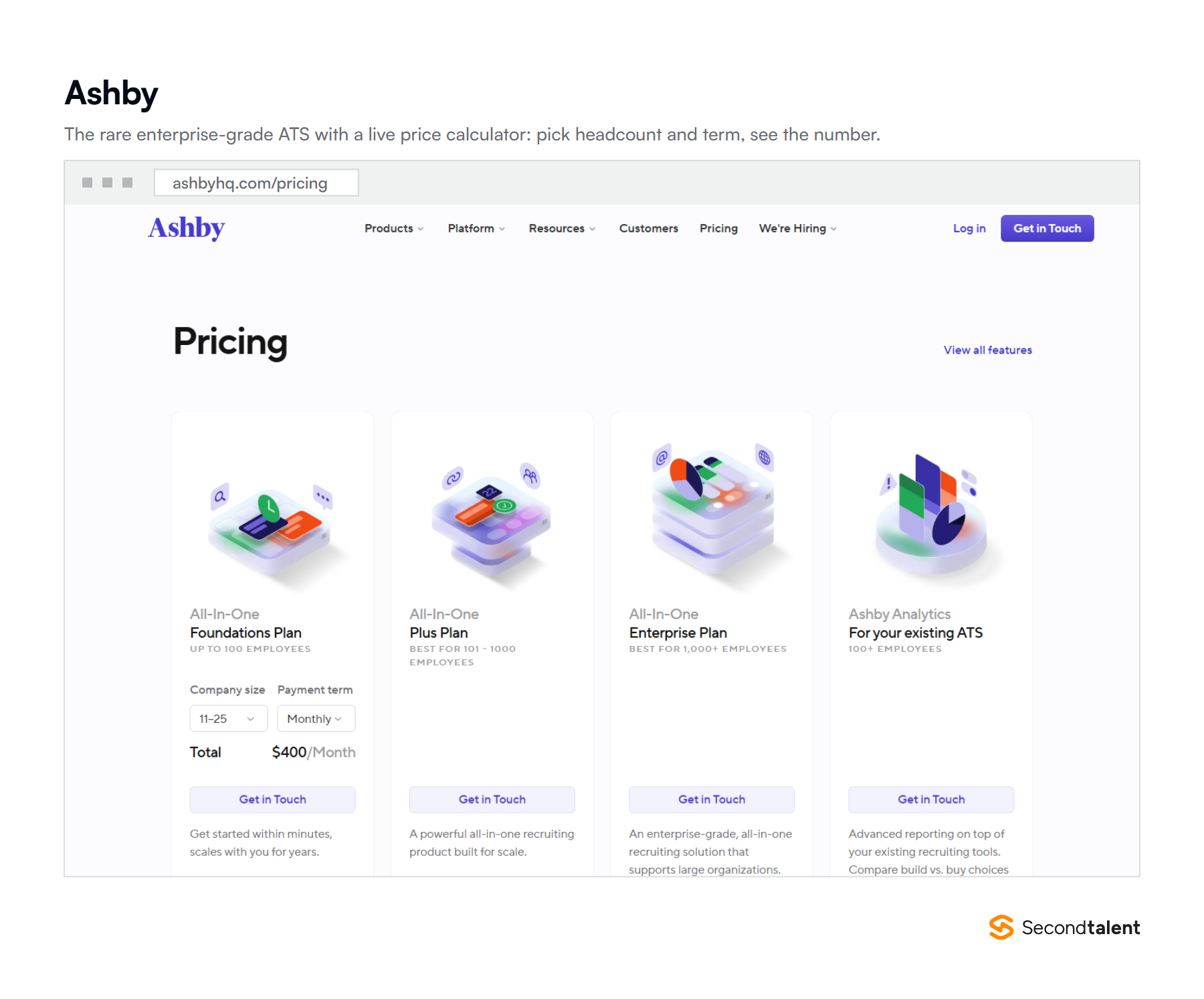
Ashby is the newest entry on this list and earns the place on one behaviour: it puts a company-size dropdown and a payment-term dropdown on the pricing page and shows a total.
At 11 to 25 employees on monthly terms, Foundations reads $400 a month. No other vendor at this end of the market does that.
Foundations covers organisations up to 100 employees, with Plus aimed at 101 to 1,000 and Enterprise above that, both on quote.
Ashby also sells its Analytics product on its own, for teams that want the reporting layer over an ATS they already run. That is an unusual and useful way to buy, and no other vendor here offers it.
Ashby meters AI as well, and the allowances differ enough to check before committing: 1,500 credits a month on Foundations, 2,500 per seat per year on Plus, 12,500 per seat per year on Enterprise.
They cover AI candidate search, application review, notetaking, auto-scheduling, talent rediscovery and custom agents.
Vendr’s anonymised contract data, last updated February 2026, puts the median Ashby deal at $22,896 a year with a high of $119,207 across 59 deals, and buyers taking about 21% off list.
So $400 is the first step of a long ladder rather than the price of the product, and the discount at the top of that ladder is the largest in this comparison.
- Best for: in-house teams that want reporting depth and a price before the demo.
- Where it struggles: everything above 100 employees goes back to quote.
- Price: $400 a month at 11 to 25 employees; median signed contract $22,896 a year.
8. BambooHR: the ATS is free, the platform is not
BambooHR is the choice when hiring is one job among many and you would rather run one HR platform than stitch an ATS to a payroll system. The 2025 version of this guide listed it as custom pricing. It now publishes rates.
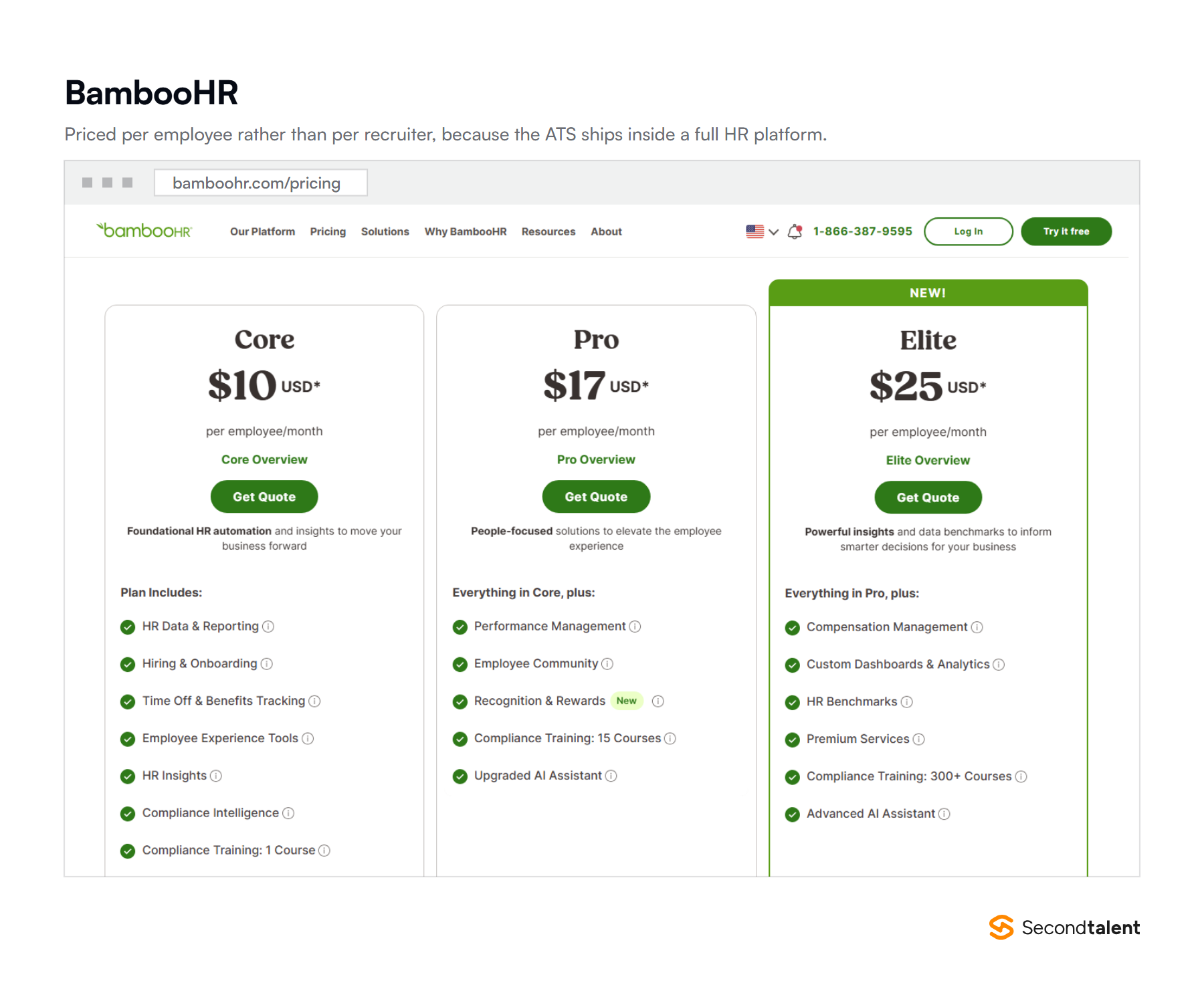
Core is $10 per employee per month, Pro is $17 and Elite is $25, with a flat rate starting at $250 a month for companies of 25 or fewer. Volume and non-profit discounts apply above that.
Watch the meter: BambooHR charges per employee, not per recruiter. A 400-person company pays around $4,000 a month on Core whether it hires four people that year or forty. That is the opposite exposure to every seat-priced tool above.
Applicant tracking comes with every tier, capped at 5 open jobs on Core, 25 on Pro and 50 on Elite.
The AI assistant climbs the same ladder: policy questions from your own company data on Core, company documents on Pro, benchmark questions and analysis on Elite.
Compliance training scales the same way, from a single course on Core to more than 300 on Elite, which is the tier’s real justification for most buyers.
Vendr puts the median BambooHR contract at $16,197 a year across 114 deals, in a band from $9,490 to $78,783. Run that against your own headcount before you assume the per-employee rate is the whole bill.
- Best for: 25 to 500-person companies that want HR and hiring in one system.
- Where it struggles: per-employee pricing is poor value if you hire rarely.
- Price: $10, $17 or $25 per employee per month; from $250 a month under 25 staff.
9. SmartRecruiters: one public figure, at $14,995
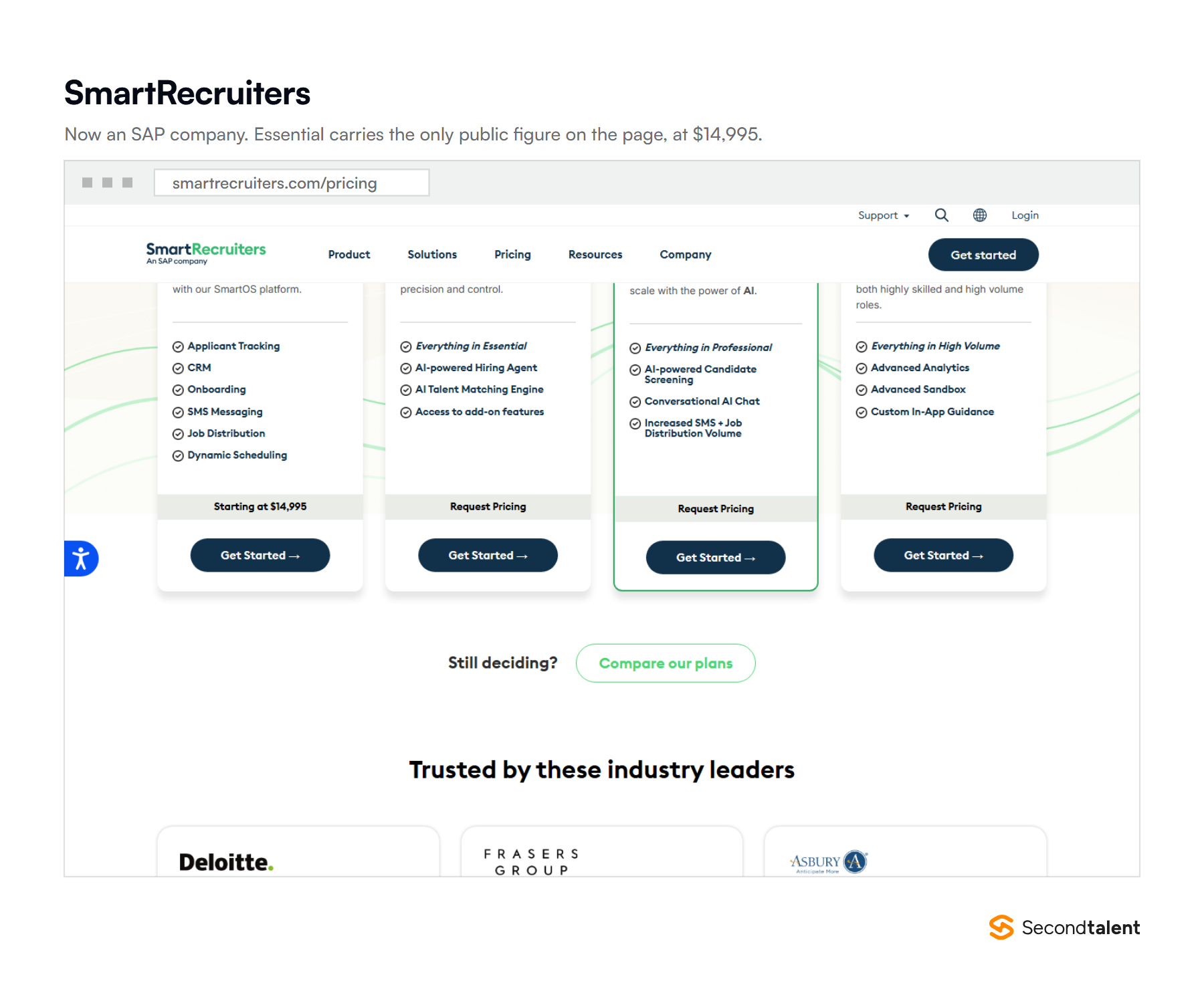
SmartRecruiters is built for high-volume enterprise hiring, and since its acquisition it carries “An SAP company” under the logo.
That matters if you already run SAP or SuccessFactors and care about where the integration roadmap points, and it is the single biggest change to this entry since 2025.
The tiers are described by company type rather than headcount, running from startups and small teams at the bottom to global and specialised enterprise at the top, so the fit question is volume and complexity rather than employee count.
Four tiers: Essential, Professional, High Volume and Complete. Only the first is costed, starting at $14,995, and the other three say Request Pricing.
Essential covers applicant tracking, CRM, onboarding, SMS messaging, job distribution and dynamic scheduling.
Everything branded Winston sits above it. Professional adds the Winston Companion hiring agent and the Winston Match talent matching engine.
High Volume adds AI candidate screening and Winston Chat, plus higher SMS and job distribution volumes. Complete adds advanced analytics and a sandbox.
So the entry price buys an ATS and the AI arrives one tier up.
Vendr’s February 2026 data puts the median SmartRecruiters buyer at $33,507 a year against a range of $15,250 to $51,561, which puts most buyers above Essential rather than on it.
Budget for the tier that carries the agent, not the one on the card.
- Best for: high-volume hiring at enterprise scale, especially in SAP estates.
- Where it struggles: the published $14,995 does not include any Winston AI feature.
- Price: from $14,995 a year. Median signed contract $33,507.
10. HireVue: the most expensive way to interview at scale
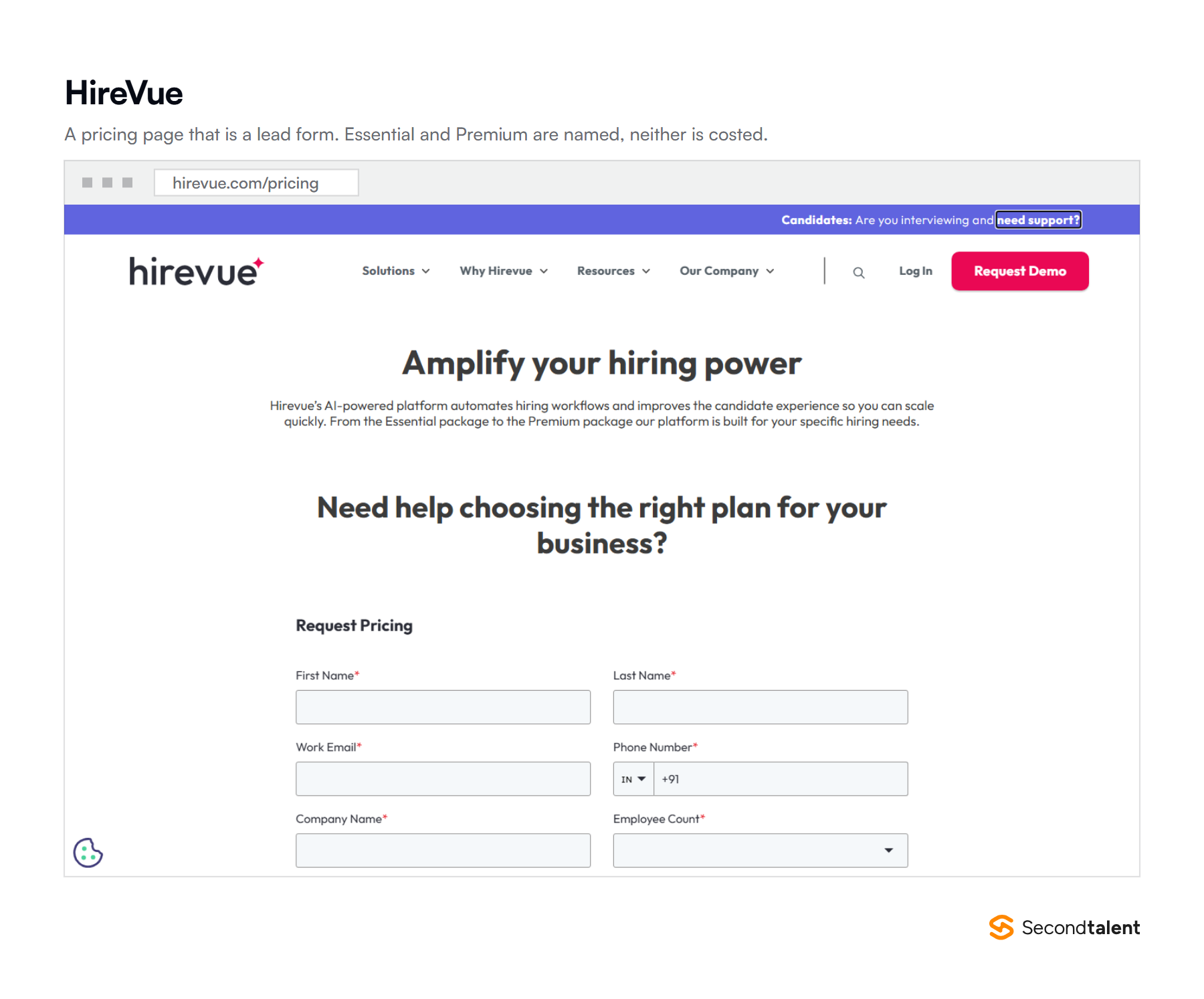
HireVue sells assessment and structured interviewing rather than an ATS, aimed at organisations screening thousands of candidates for the same role.
Its pricing page names an Essential and a Premium package, prices neither, and gives you a Request Pricing form. It sits alongside an ATS rather than replacing one, so the cost lands on top of whatever you already run.
The 2026 product line runs wider than the video interviewing HireVue is known for: skill validation, an assessment builder, Virtual Job Tryout, game-based and technical assessments, language proficiency testing, interview insights, plus an AI Interviewer and an AI Hiring Agent.
HireVue’s own site claims 92% candidate satisfaction, 60% less time screening, 90% faster time to hire and a 50% cut in cost per interview.
Those are vendor figures on self-selected customers with no methodology attached, so read them as marketing rather than as a benchmark.
On cost, the only independent figure is Vendr’s average HireVue contract of $49,855, with a maximum near $145,000, drawn from more than five deals across three purchasers.
That sample is thin enough that it deserves naming, and it is still the best public evidence available.
The 2025 version of this guide put HireVue at $35,000 a year, sourced from other round-ups. No vendor page supports it, so it is gone.
- Best for: graduate, retail and contact-centre hiring where one role takes thousands of applicants.
- Where it struggles: anything under a few hundred hires a year, where the fixed cost never amortises.
- Price: quote only. Average signed contract $49,855 a year.
What the published prices and the signed contracts actually show
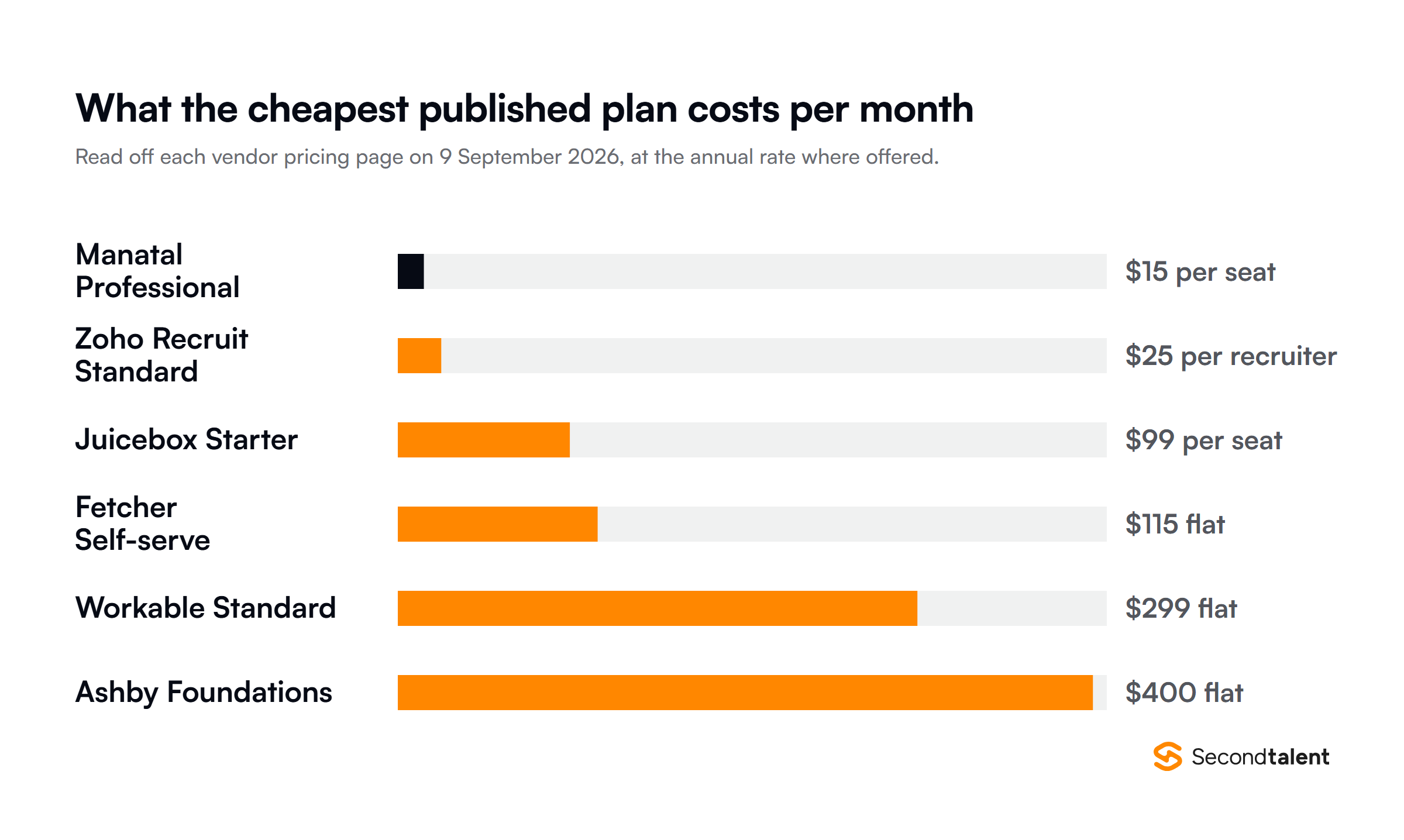
Put the six published entry prices in one column and the gap is wider than any feature difference: $15 a month at Manatal against $400 at Ashby, a factor of 27 before anyone has hired anyone.
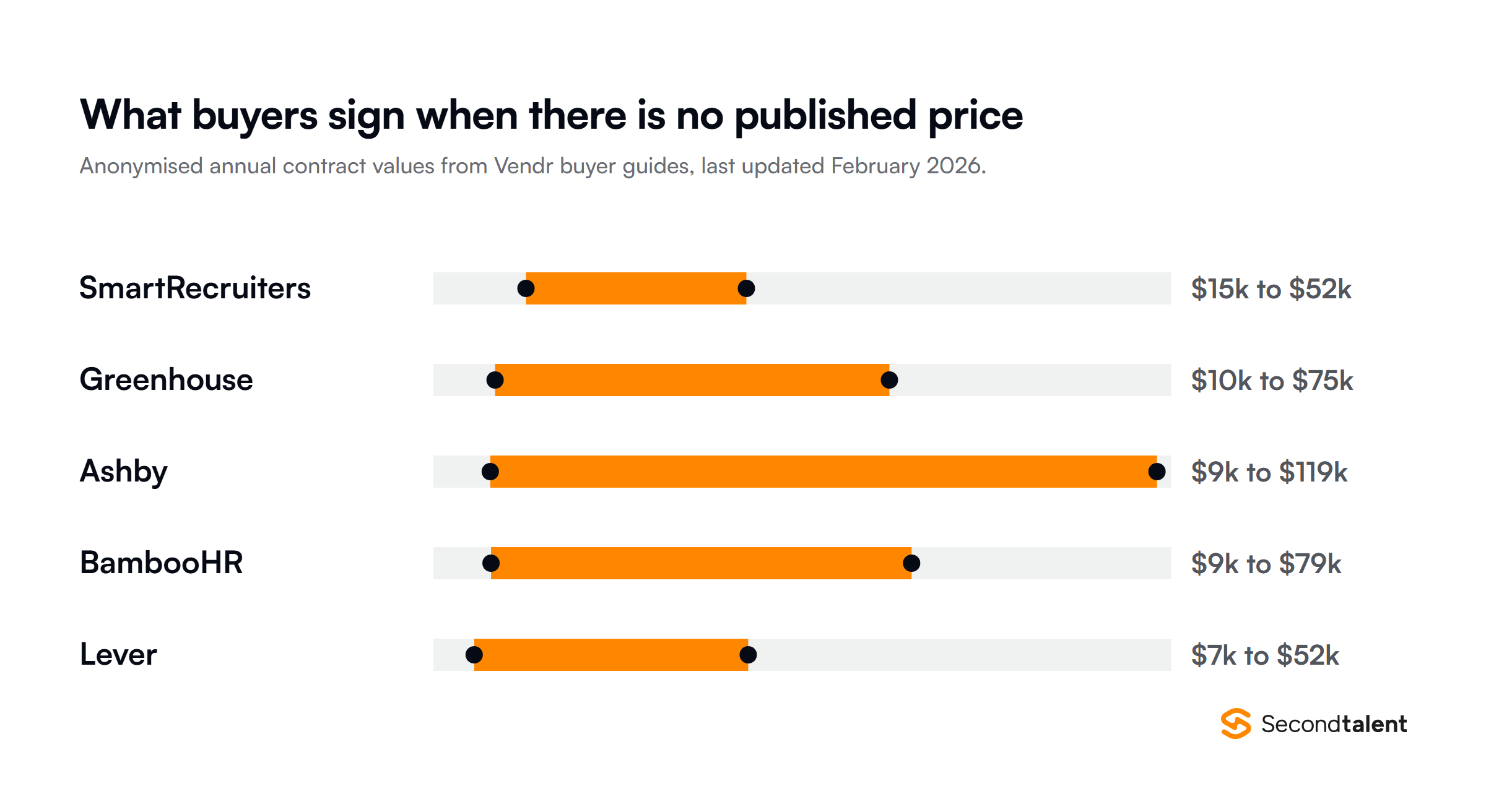
The quote-only platforms tell a different story.
Vendr aggregates anonymised deals its customers signed, and every spread is wide enough that a single “starting at” figure would mislead: Greenhouse $10,159 to $75,125, Ashby $9,366 to $119,207, Lever $6,714 to $51,864.
Two caveats belong with those numbers. They come from one buying platform’s customer base, which skews to funded technology companies, and Vendr publishes a low and a high without the distribution between them.
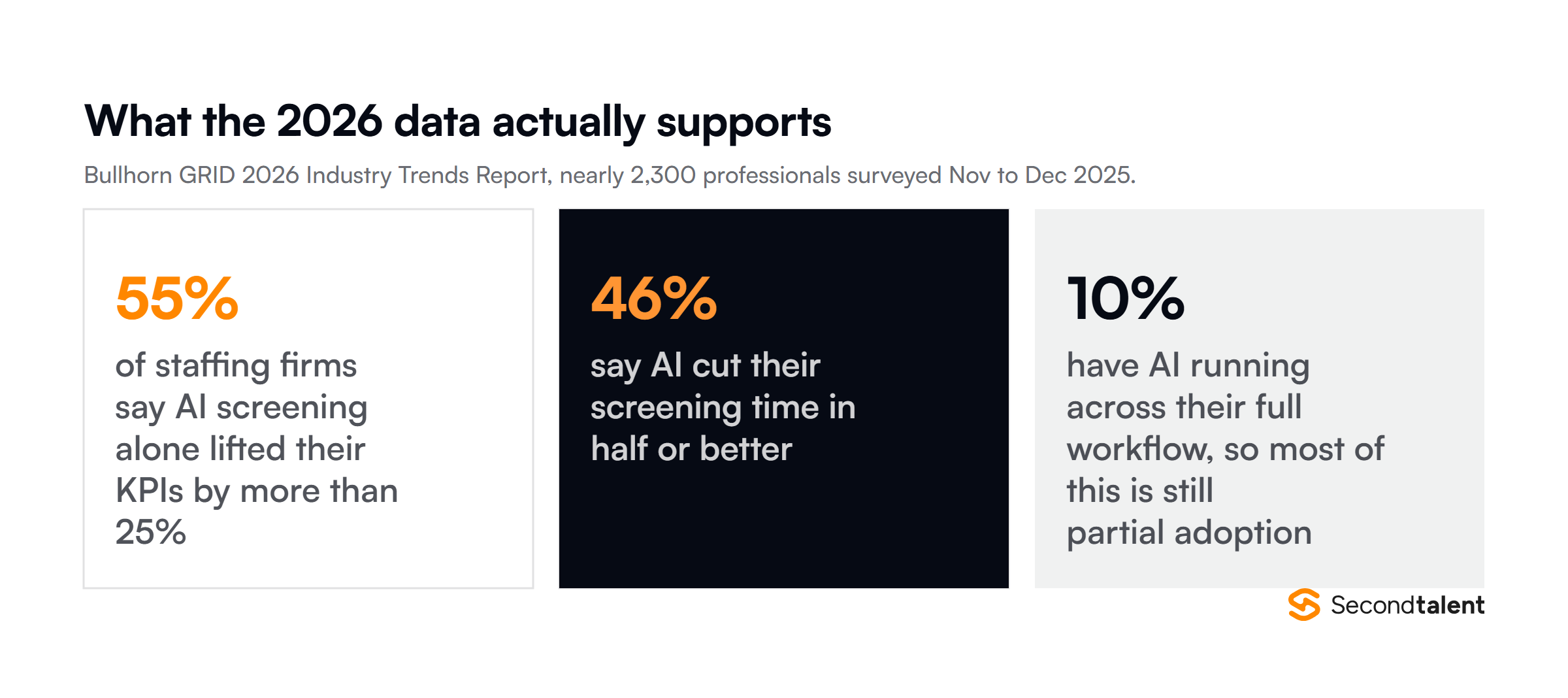
On whether any of it works, the most useful 2026 evidence comes from Bullhorn’s GRID 2026 Industry Trends Report, which surveyed nearly 2,300 recruitment professionals in November and December 2025.
It found 55% of firms saying AI screening alone lifted KPIs by more than 25%, 46% saying it halved screening time or better, and only 10% running AI across a full workflow.
Separately, LinkedIn told HR Dive in January 2026 that 93% of talent acquisition professionals planned to grow their AI use this year, while 34% said most of their team were power users. Intent runs well ahead of practice.
How to choose without overbuying
Start from the meter, because the meter decides the bill more than the tier does.
- Priced per seat (Manatal, Zoho Recruit, Juicebox): cheap for a small team, expensive for an agency where every consultant needs a licence.
- Priced per employee (BambooHR): predictable, and poor value for a large company that hires occasionally.
- Priced by headcount band (Workable, Ashby): the published figure is the smallest band, so price your actual headcount before comparing.
- Priced by volume (Fetcher, Juicebox credits): model your monthly candidate volume first, then read the allowance.
- Quote only (Greenhouse, SmartRecruiters, HireVue, and Recruitee since its move to Tellent branding): assume the contract-data median, ask for the tier that includes the AI feature you came for, and negotiate.
Then check one thing before signing: whether the AI feature you are buying the tool for sits in the tier you are pricing. It usually does not.
Winston sits above SmartRecruiters Essential, Zia’s matching sits above Zoho Standard, and Workable’s agent runs on credits that are not in the subscription at all.
Tooling is the cheap half of the problem
A $26,570 ATS is a rounding error next to the salaries flowing through it. Where you hire moves the number far more than what you screen with, and no platform above touches that.
Second Talent places pre-vetted engineers, designers and operators across nine Asian markets for a flat monthly fee rather than a percentage of salary.
Our Philippines and India cost analysis and the guide to evaluating engineering talent remotely cover both halves of that decision. When you are ready to hire rather than shop, tell us what you need.
Frequently asked questions
What is the cheapest AI recruitment tool in 2026?
Manatal, at $15 per user per month on annual billing, including AI enrichment, recommendations and the Copilot assistant, capped at 15 jobs. Zoho Recruit’s free tier costs nothing but allows one active job per recruiter licence.
Why do Greenhouse and HireVue hide their pricing?
Both price on hiring volume and module mix rather than seats, so one figure would be wrong for most buyers. The effect is that you cannot compare them without a sales call.
Contract aggregators fill the gap: Vendr’s February 2026 data puts the median Greenhouse deal at $26,570 a year and the average HireVue deal at $49,855.
Is AI included in these subscriptions, or billed separately?
Increasingly separately. Workable meters its agent in credits beyond a 3,000-credit allowance, at $0.095 to $0.12 each. Juicebox charges $199 per agent per month on top of the seat. Ashby grants credits by tier.
Manatal sells its AI Interviewer as an add-on. Only the older ATS features, such as resume parsing and candidate matching, are reliably inside the base plan.
Does an AI recruiting tool reduce cost per hire?
The evidence is directional rather than a clean saving. Bullhorn’s GRID 2026 report found 46% of staffing firms saying AI halved screening time or better, and 55% reporting KPI gains above 25% from AI screening.
Neither is a cost-per-hire figure, and only 10% of firms run AI across a full workflow, so treat any payback-in-months claim with suspicion.
What happened to Recruitee’s published pricing?
Recruitee now trades as Tellent Recruitee. Its pricing page still lists Start, Advance and Optimize with their AI allowances and a 20% annual discount, but the currency symbols now sit next to blanks.
For a figure you have to request a demo.
Should a small company buy an ATS at all?
Under about ten hires a year, the free tiers cover it. Zoho Recruit and Juicebox both run usable free plans, and Manatal at $15 a user costs less than an hour of a recruiter’s time.
Spend the budget on sourcing reach instead, which is the real constraint at that size.


![Countries With the Highest Software Engineer Salaries. Top 10 Countries With the Highest Software Engineer Salaries [2026], by Second Talent.](https://www.secondtalent.com/wp-content/uploads/2026/09/countries-with-highest-software-engineer-salaries-featured-v2-768x403.jpg)