TL;DR: Most developers now use AI to write code, but few trust it with the riskier end of the lifecycle. Stack Overflow's 2025 survey found 84% of developers using or planning to use AI tools, while 76% have no plans to use AI for deployment and monitoring. Veracode's 2026 tests found AI models still introduce a known vulnerability in about 44% of coding tasks.
In METR’s early-2025 trial, 16 experienced open-source developers took 19% longer to close real issues with AI allowed, yet believed AI had sped them up by 20%. METR’s attempt to repeat the study in late 2025 broke down: 30% to 50% of developers said they held back tasks they did not want to do without AI.
- 1Google says 75% of its new code is AI-generated and approved by engineers, up from more than a quarter in October 2024.
- 2DORA’s 2025 research links AI adoption to faster software delivery, reversing its 2024 finding, but still to less stable releases.
- 3At one company told to double output, merged pull requests per engineer reached 2.09 times the old baseline, and the review load per reviewer roughly doubled.
- 4The US Bureau of Labor Statistics projects 10% growth in software developer jobs from 2025 to 2035, and a 7% fall for computer programmers.
How Many Developers Use AI Tools?
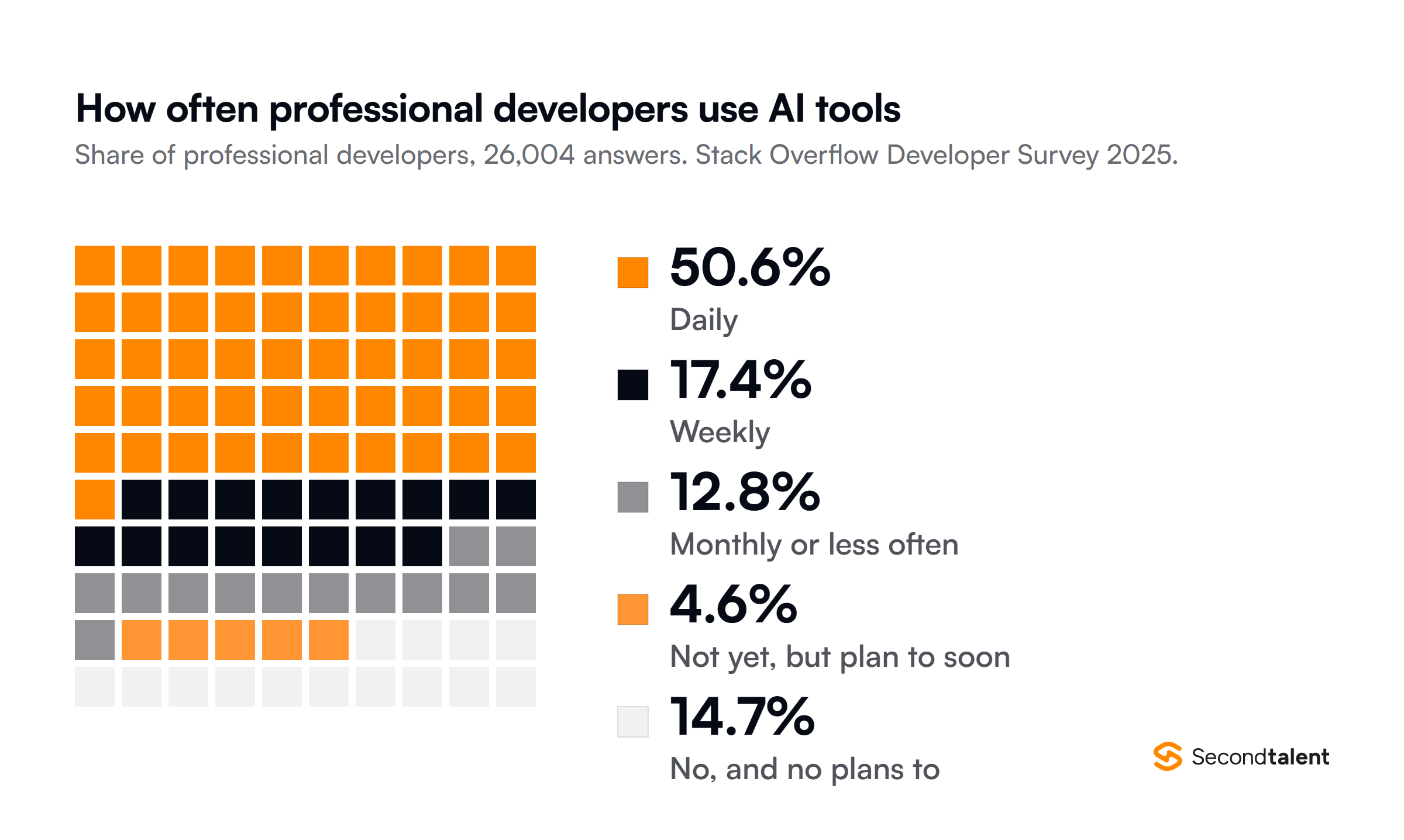
Half of professional developers use AI tools daily. The Stack Overflow Developer Survey 2025, with 49,009 responses from 177 countries, put that share at 50.6%, with another 17.4% using them weekly. Across all respondents, 84% use or plan to use AI in their development process, up from 76% a year earlier.
Use went up while approval went down. Positive sentiment toward AI tools fell to 60%, from above 70% in 2023 and 2024. More respondents distrust the accuracy of AI output (46%) than trust it (33%), and only 3.1% say they highly trust it. The top complaint, from 66%, is answers that are “almost right, but not quite.”
Google’s DORA program reached a similar number from a different sample. Its 2025 State of AI-assisted Software Development report surveyed nearly 5,000 technology professionals between June and July 2025. 90% use AI at work, with a median of two hours of AI interaction on their most recent workday.
Reaching for AI first is still rare. Only 7% of DORA’s AI users “always” turn to it when they hit a problem, and 39% do so only “sometimes.” Agents are further behind: 61% of DORA respondents “never” use AI in agent mode, and Stack Overflow found 37.9% of developers with no plans to use agents at work.
AI arrives in week one for new developers. GitHub’s Octoverse 2025 says nearly 80% of new developers on the platform use Copilot in their first week. More than 1.1 million public repositories now use an LLM SDK. Our AI coding assistant statistics break usage down tool by tool.
Which Parts of the Development Lifecycle Use AI Most?
Writing new code comes first in DORA’s 2025 data: 71% of respondents who write code use AI to help. Testing and review are not far behind. Among people whose job includes the task, 62% use AI to create test cases and 56% use it for code review.
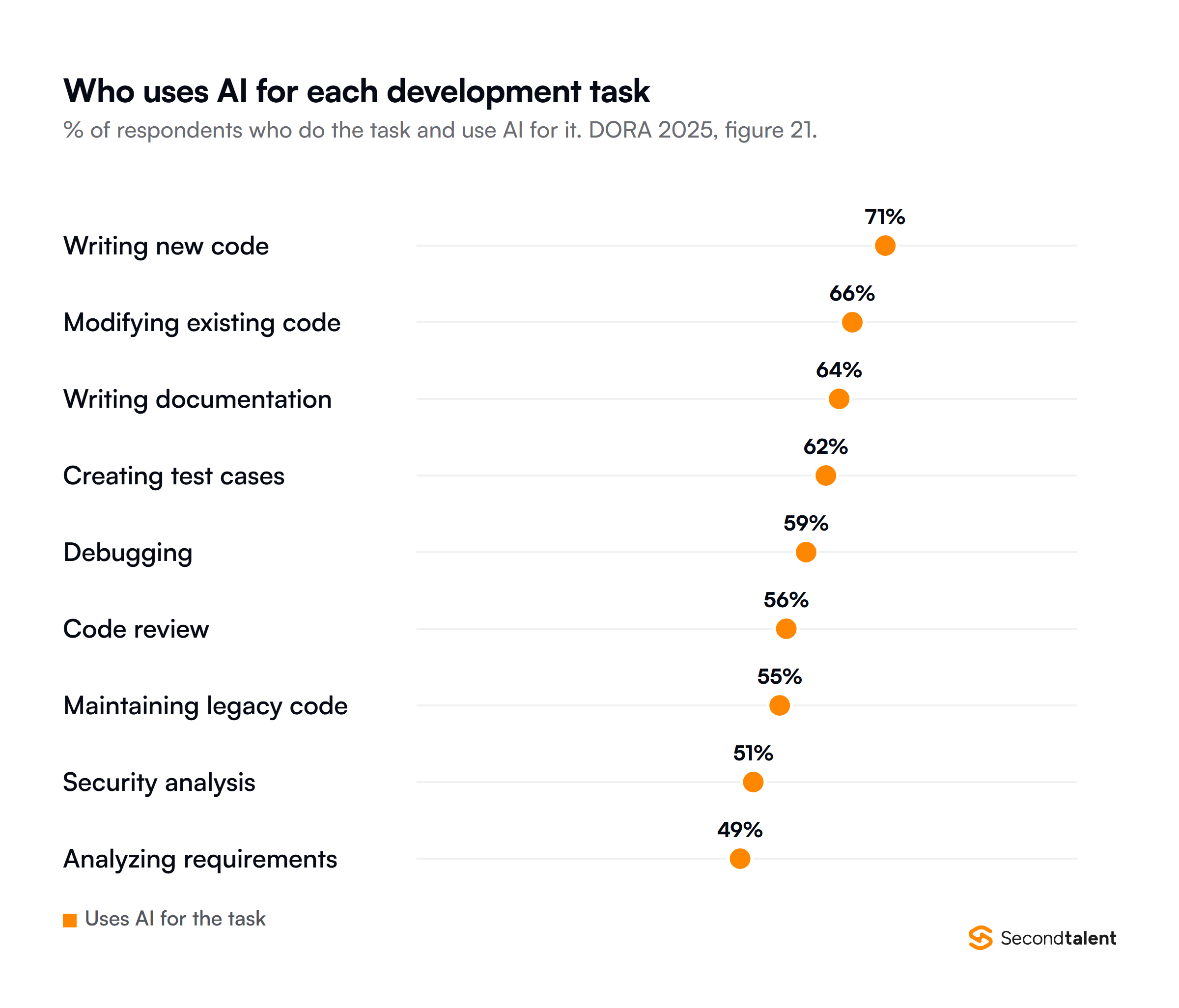
Security analysis (51%) and analyzing requirements (49%) sit at the bottom of the list. Chatbots remain the main way in. 55% of DORA respondents use a conversational AI tool, 41% use AI inside their IDE, and 18% meet it in an automated tool chain.
Stack Overflow asked the question the other way round: which tasks developers do not plan to hand to AI at all over the next three to five years. Deployment and monitoring topped that list, followed by project planning. Searching for answers came last.
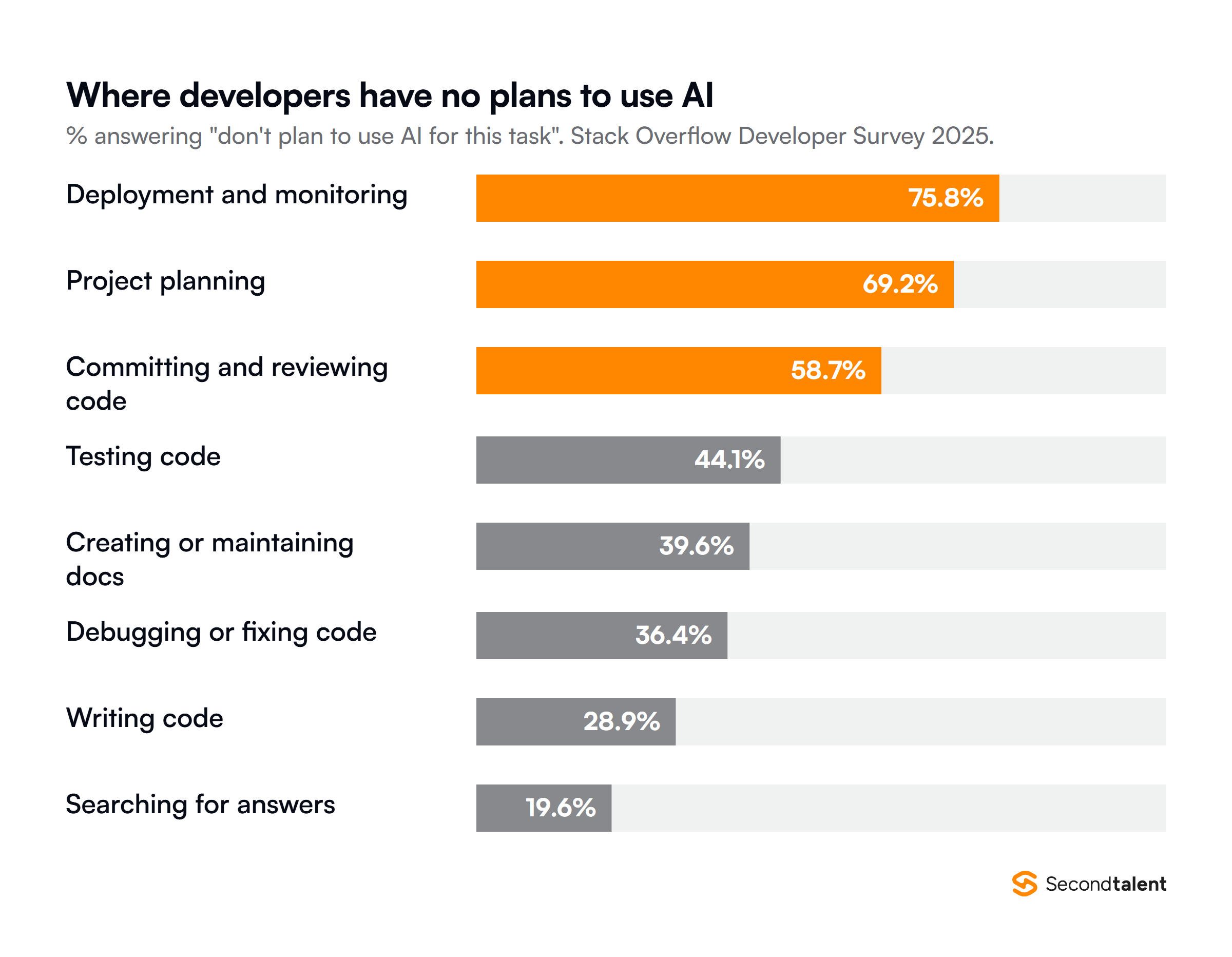
Among developers who already hand at least one task mostly to AI, 54.1% do so for search and 16.9% for writing code. Only 6.2% of that group let AI mostly handle deployment and monitoring.
Does AI Make Software Teams Faster?
At the team level, the answer changed between two DORA reports. In 2024, higher AI adoption came with an estimated 1.5% drop in delivery throughput and a 7.2% drop in delivery stability, Google Cloud reported. The 2025 report found throughput now rises with AI adoption. Instability still rises too.
- Delivery throughput down 1.5% as AI adoption rose
- Delivery stability down 7.2%
- Delivery throughput rises with AI adoption
- Delivery instability still rises
DORA’s authors read this as teams adapting for speed before their underlying systems have caught up. More than 80% of respondents say AI raised their productivity, although 41% call the gain “slight.” About 5% say it fell.
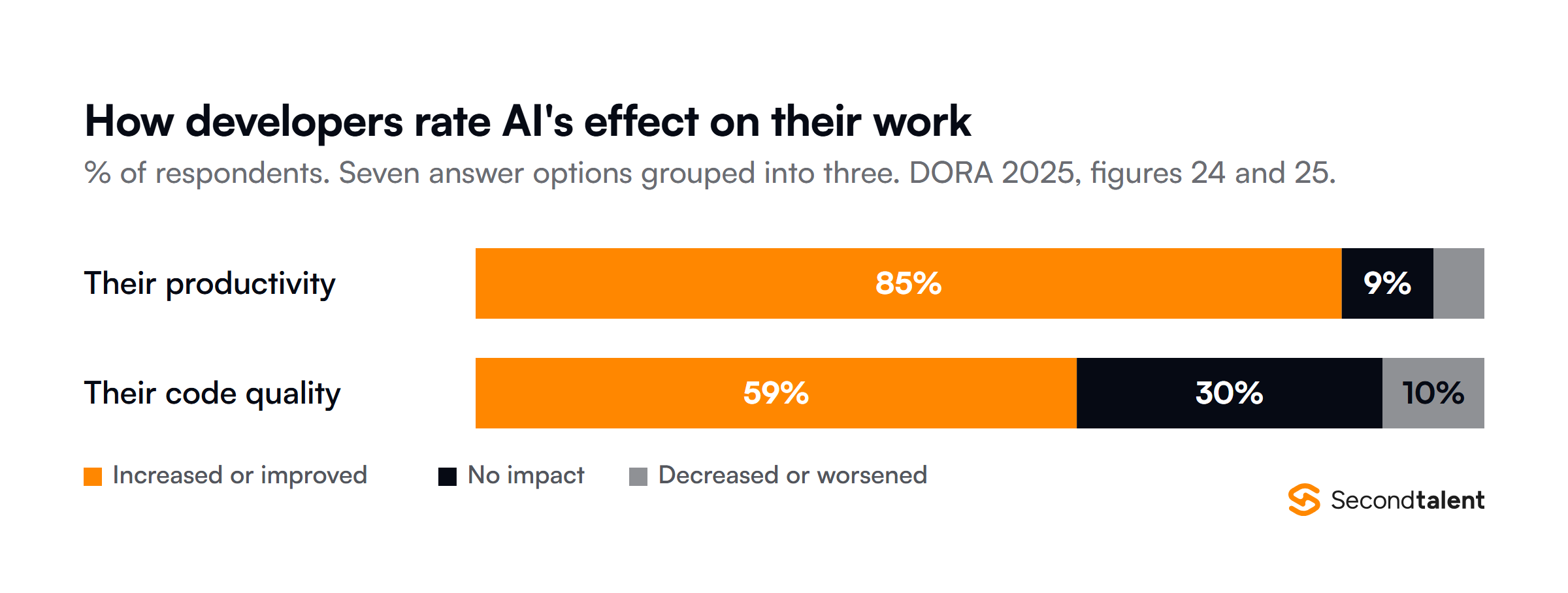
Trust in the output sits lower than either rating. 24% of DORA respondents trust AI-generated output “a great deal” or “a lot,” while 30% trust it “a little” or “not at all.”
What the controlled studies measured
Self-reports and stopwatch results disagree. METR’s first trial paid developers $150 an hour to work on their own repositories, which averaged more than 22,000 stars and a million lines of code. A random draw decided, issue by issue, whether AI was permitted. With AI, most developers used Cursor Pro with Claude 3.5 or 3.7 Sonnet.
The second round, with 57 developers and more than 800 tasks, hit a recruiting problem. More developers declined to take part because they did not want to work without AI, and METR’s February 2026 update says its new estimate is likely a lower bound. Pay had also dropped to $50 an hour.
“I’m torn. I’d like to help provide updated data on this question but also I really like using AI!”
A developer from METR’s original study, asked to join the late-2025 round
The best-known speed figure is older and narrower. GitHub’s 2022 experiment timed 95 developers writing one HTTP server in JavaScript. The Copilot group finished 55% faster, in 1 hour 11 minutes against 2 hours 41 minutes.
How Much Code Does AI Write at Google and Microsoft?
Google’s own figure went from more than a quarter of new code to 75% in 18 months, on one definition: code generated by AI and then accepted by an engineer. Microsoft’s best-known figure is a range its chief executive gave on stage in April 2025.
Pichai gave the 75% figure in his Cloud Next 2026 keynote and said Google engineers were moving to “truly agentic workflows.” The October 2024 baseline comes from Alphabet’s third-quarter earnings remarks.
Nadella’s range was looser. “I’d say maybe 20%, 30% of the code that is inside of our repos today and some of our projects are probably all written by software,” he told Mark Zuckerberg at Meta’s LlamaCon, CNBC reported. Google counts new code and Nadella described code in repos, so the two figures are not a ranking.
GitHub activity also hit records in 2025. Developers merged 43.2 million pull requests a month on average in 2025, up 23%, and pushed nearly 1 billion commits, up 25.1%, according to Octoverse. For estimates across the wider industry, see how much software is written by AI.
How Is AI Used in Testing, QA and Code Review?
Quality engineering teams have tried generative AI far more than they have scaled it. The World Quality Report 2025-26 from OpenText, Capgemini and Sogeti found 89% of organizations piloting or deploying it, but only 15% running it enterprise-wide.
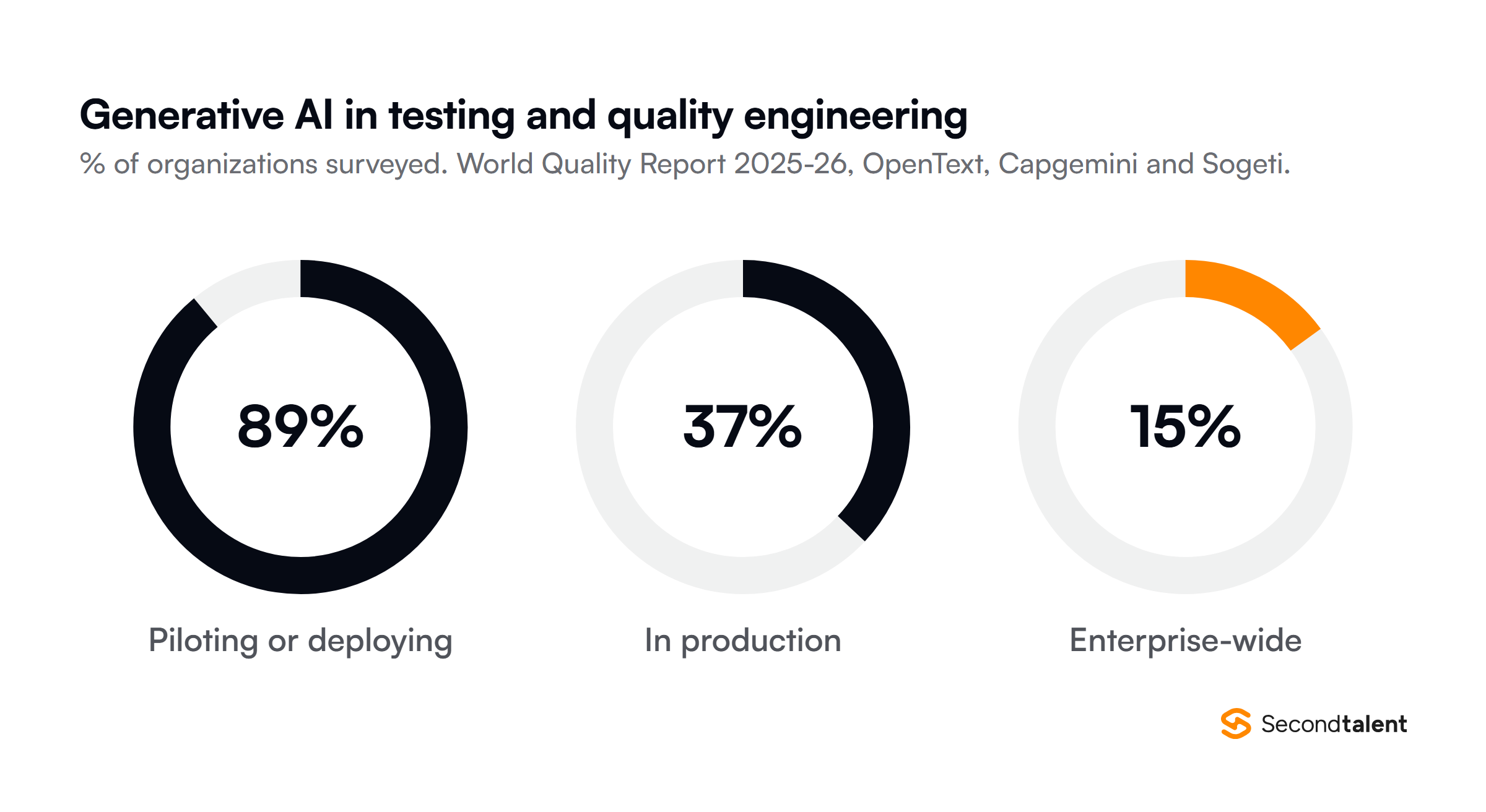
The share of non-adopters rose to 11%, from 4% in 2024. Organizations report an average productivity boost of 19%, while a third have seen minimal gains. The top barriers are data privacy risks (67%), integration complexity (64%) and hallucination and reliability concerns (60%). Half say they lack AI and machine learning skills.
For teams using AI to write tests, our guide to Claude for test case generation and QA automation walks through the workflow.
Review became the bottleneck
A July 2026 study on arXiv followed 802 developers and 196,212 pull requests at a mid-sized company that set out to double merged pull requests per engineer. By April 2026 output reached 2.09 times the pre-mandate baseline. Load per reviewer roughly doubled, automated review overtook human review, and merge and revert rates held steady.
Vendors report their own review numbers. In GitHub’s interviews, 72.6% of developers who use Copilot code review said it made them more effective. Qodo, which sells AI code review, surveyed 609 developers for its State of AI Code Quality 2025 report.
Among teams with considerable productivity gains, 81% of those using AI review reported better code quality, against 55% of teams without it. Context is the complaint: 65% of developers using AI for refactoring say the assistant “misses relevant context.”
How Secure Is AI-Generated Code?
Newer models write code that compiles, not code that is safer. Veracode tests models on 80 coding tasks in Java, JavaScript, Python and C#, and has tracked more than 100 of them. Its 2026 GenAI Code Security Report puts the average security pass rate at 56%, while syntax passes 99.9% of the time.
The spread between models is wide. OpenAI’s GPT-5.5 led the summer 2026 group at 68%, while six of the 11 new models scored between 50% and 53%. Models built for coding averaged 51%, one point behind general-purpose models at 52%.
Java is the weak language, with a mean pass rate of 30%, though it is also the only one with a clear upward trend. In the 2025 edition, 45% of code samples failed security tests and Java failed 72% of the time.
GitHub sees the pattern in real repositories. Broken access control overtook injection as the most common CodeQL alert in 2025, flagged in more than 151,000 repositories, up 172%. Octoverse ties much of it to CI/CD permission mistakes and AI-generated scaffolds that skip auth checks.
Fixes got faster at the same time. Average fix time for critical vulnerabilities fell from 37 days to 26, and 26% fewer repositories received critical alerts. Our AI-generated code quality statistics cover duplication, churn and maintainability.
How Much Are Companies Spending on AI?
Gartner’s own estimate of 2025 AI spending jumped between two forecasts. Its September 2025 forecast put worldwide AI spending near $1.5 trillion. The May 2026 update lists 2025 at $1.76 trillion and forecasts $2.59 trillion for 2026, up 47%.
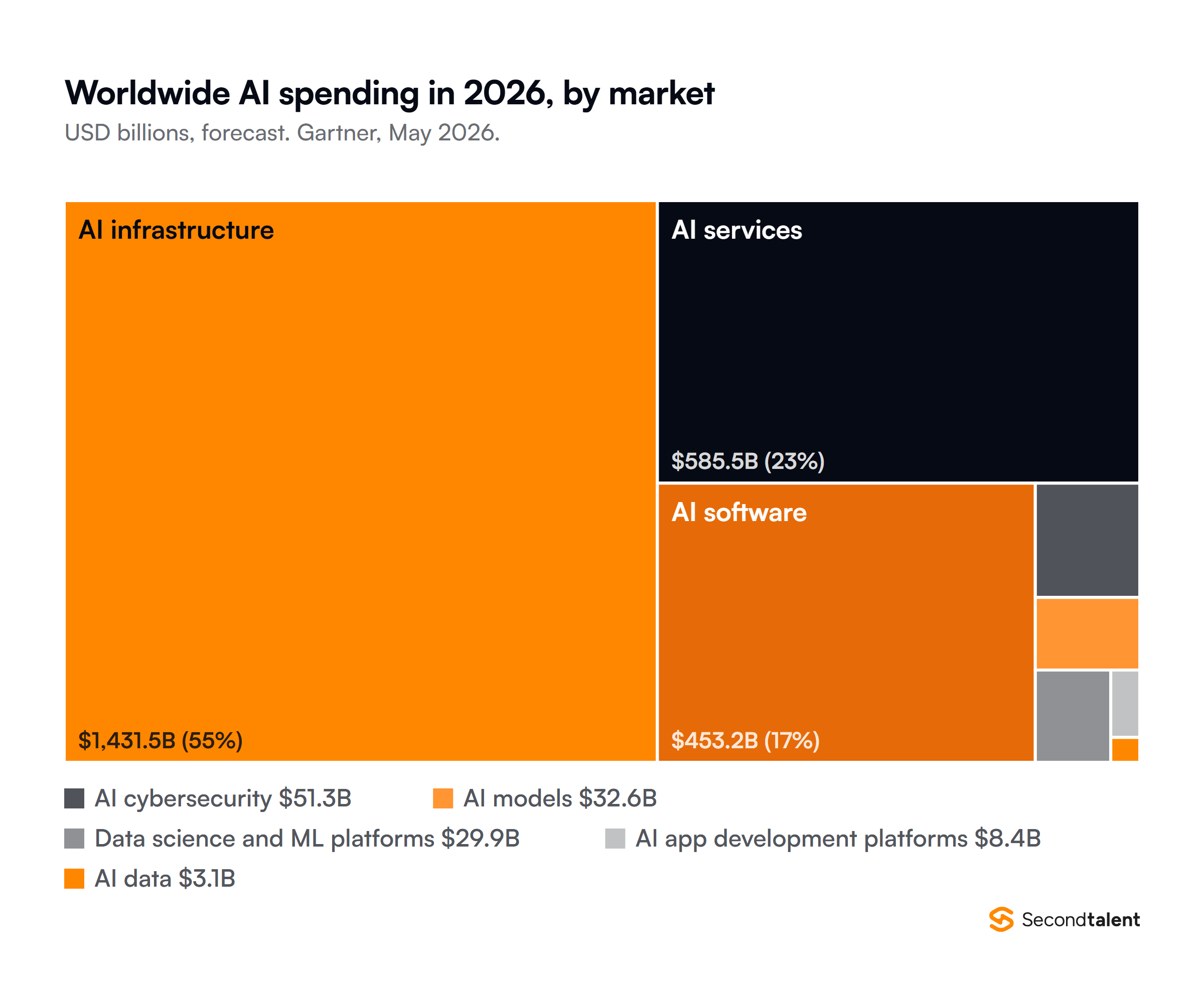
Infrastructure takes more than half. The market closest to software teams is small: AI application development platforms, forecast at $8.4 billion in 2026 and $10.9 billion in 2027. AI software grows from $282.9 billion in 2025 to $453.2 billion.
Services outrank software in the same table, at $585.5 billion in 2026. Some teams build AI skills in house, while others bring in a firm that delivers AI solutions in software projects.
Gartner also tracks how fast coding tools spread. In July 2025 it predicted 90% of enterprise software engineers will use AI code assistants by 2028, up from less than 14% in early 2024.
By May 2026 Gartner had renamed its code assistant category “enterprise AI coding agents.” It predicts that by 2027 over 65% of engineering teams using agentic coding will treat the IDE as optional.
What Is AI Doing to Software Developer Jobs?
The Bureau of Labor Statistics names AI as a reason one programming job is shrinking. Its handbook entry for computer programmers projects a 7% fall in employment from 2025 to 2035, as companies use AI “to automate repetitive programming tasks” and higher-level work moves to software developers.
Developers and testers together are projected to add 185,400 jobs, with about 106,100 openings a year. BLS expects demand to hold up as software development for AI, IoT and robotics keeps expanding. Testers earn less, with a May 2025 median wage of $104,300.
The projections release sets out both sides: “Although the growing adoption of AI is expected to support demand for some occupations, associated productivity gains may dampen employment demand for others.” Data scientists, at 34.6%, are among its ten fastest-growing occupations.
Our look at the future of software engineering jobs covers what hiring managers are changing, and which engineering skills are declining fastest tracks the tasks losing demand.
Hiring Engineers Who Can Review What AI Writes
The data above moves the pressure from writing code to reviewing and securing it. Second Talent matches companies with pre-vetted engineers across Asia, including AI agent developers and QA automation engineers in India.
Tell us the role you need to fill and we will send matching profiles.
Frequently Asked Questions
Does AI make developers more productive?
Developers say yes; the measurements disagree. Most survey respondents report a gain, while METR’s controlled trial found a slowdown in early 2025 and a possible speedup in late 2025 that its own study design could not pin down. Team-level data from DORA shows faster delivery alongside more unstable releases.
Is there a 2026 Stack Overflow Developer Survey yet?
Not as of September 14, 2026. The 2025 survey, fielded from May 29 to June 23, 2025, is the latest edition with published AI results.
Is AI-generated code safe to ship without review?
Not on current evidence. Even the best model in Veracode’s summer 2026 tests failed about one security task in three, and those tests ran on raw models without review tools. Stack Overflow found 75% of developers would still ask a person when they do not trust an AI answer.
Will AI replace software developers?
Official projections do not show it. The BLS still expects software developer employment to grow over the decade to 2035, even as it projects fewer computer programmers, the role whose routine tasks it says AI is automating.





![Singapore AI Companies Leading Southeast Asia. Top 10 Singapore AI Companies Leading Southeast Asia [2026], by Second Talent.](https://www.secondtalent.com/wp-content/uploads/2026/09/singapore-ai-companies-featured-v2-768x403.jpg)