TL;DR: Recruiting is the most common use of AI inside HR: 27% of organizations in SHRM's 2026 survey use it there. Only 26% of job candidates trust AI to evaluate them fairly, a 2025 Gartner survey found. EU rules for AI hiring tools now apply from December 2, 2027, after a delay agreed in 2026.
Four in ten US job seekers in Greenhouse’s 2025 AI in Hiring survey admitted hiding text in their applications to steer an AI screener.
Hiring managers are adding friction back: 39% of them said they now run more in-person interviews to check that candidates are real.
- 163% of US job seekers have now sat an AI interview, and most were never clearly told AI would judge them.
- 2In a University of Washington test, AI resume rankers favored white-associated names 85% of the time.
- 3Gartner predicts that by 2028, 1 in 4 candidate profiles worldwide will be fake.
- 4Colorado scrapped its original AI Act. The replacement law lets a rejected applicant ask for a human to review the decision.
How Many Employers Use AI in Hiring?
About four in ten organizations use AI somewhere in HR, and recruiting is the most common place. SHRM’s State of AI in HR 2026, based on 1,908 HR professionals, found 39% have put AI to work in HR.
Recruiting leads at 27% of organizations, ahead of HR technology at 21% and learning at 17%.
The trend is still up. In SHRM’s 2025 Talent Trends research, 43% of HR professionals used AI for HR tasks in 2025, up from 26% in 2024.
Most teams are not checking the payoff: 56% of HR functions do not formally measure their AI’s success, and only 16% track return on investment.
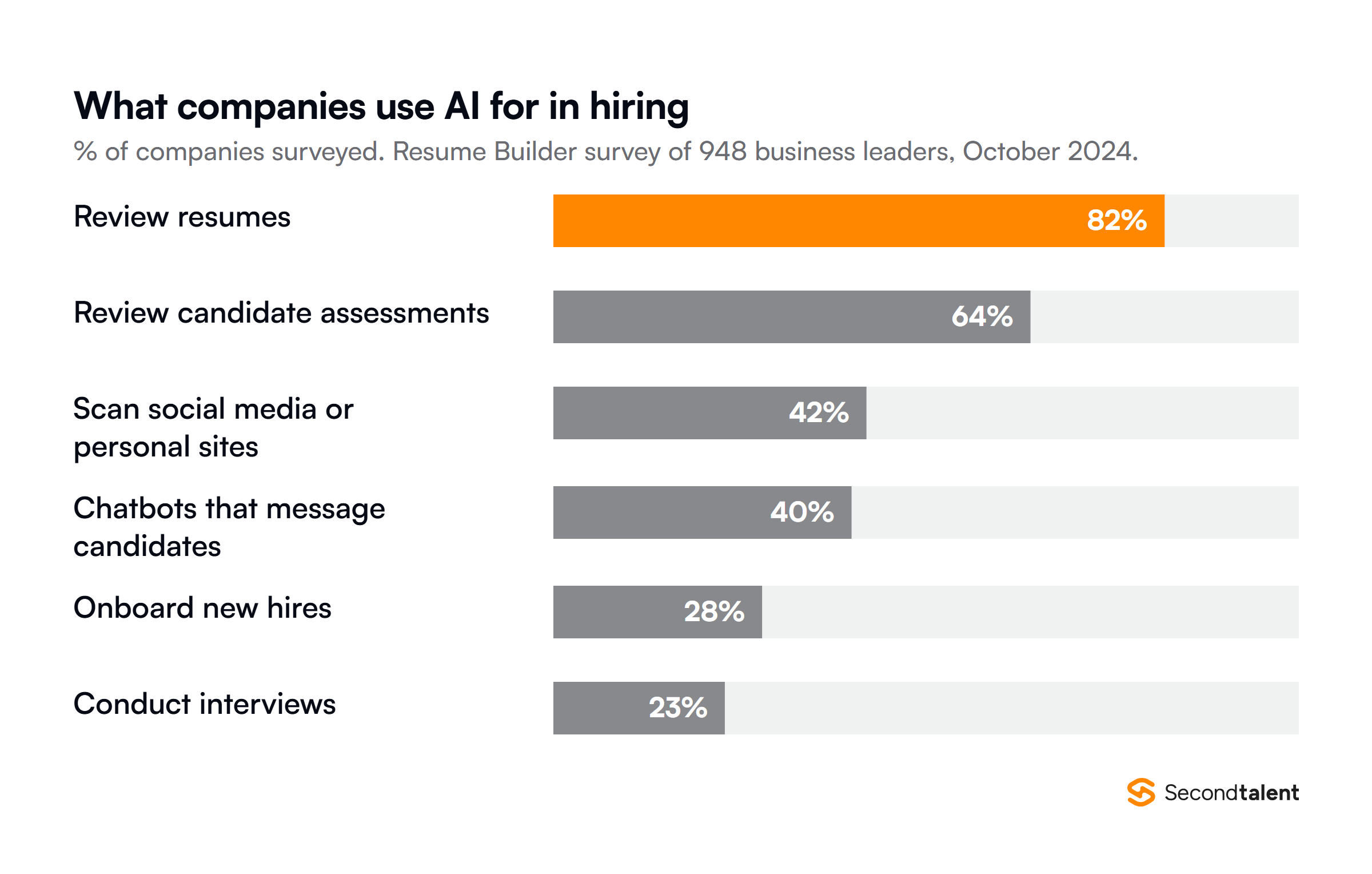
Resume screening is the main job. In the Resume Builder survey, 82% of companies used AI to review resumes and 64% to review candidate assessments. Only 0.2% said they used no AI at any step.
Recruiting platforms now ship AI agents
LinkedIn said in September 2025 that its Hiring Assistant agent would be available globally in English by the end of that month.
In LinkedIn’s own account of the limited launch, recruiters saved over four hours per role and reviewed 62% fewer profiles before reaching a shortlist. InMail acceptance improved 69%.
These are LinkedIn’s own early-customer figures, not an independent test.
For a look at what these products charge, see our AI recruitment tools cost comparison, or the AI recruiting startups in the US building them.
How Much of the Hiring Decision Does AI Make?
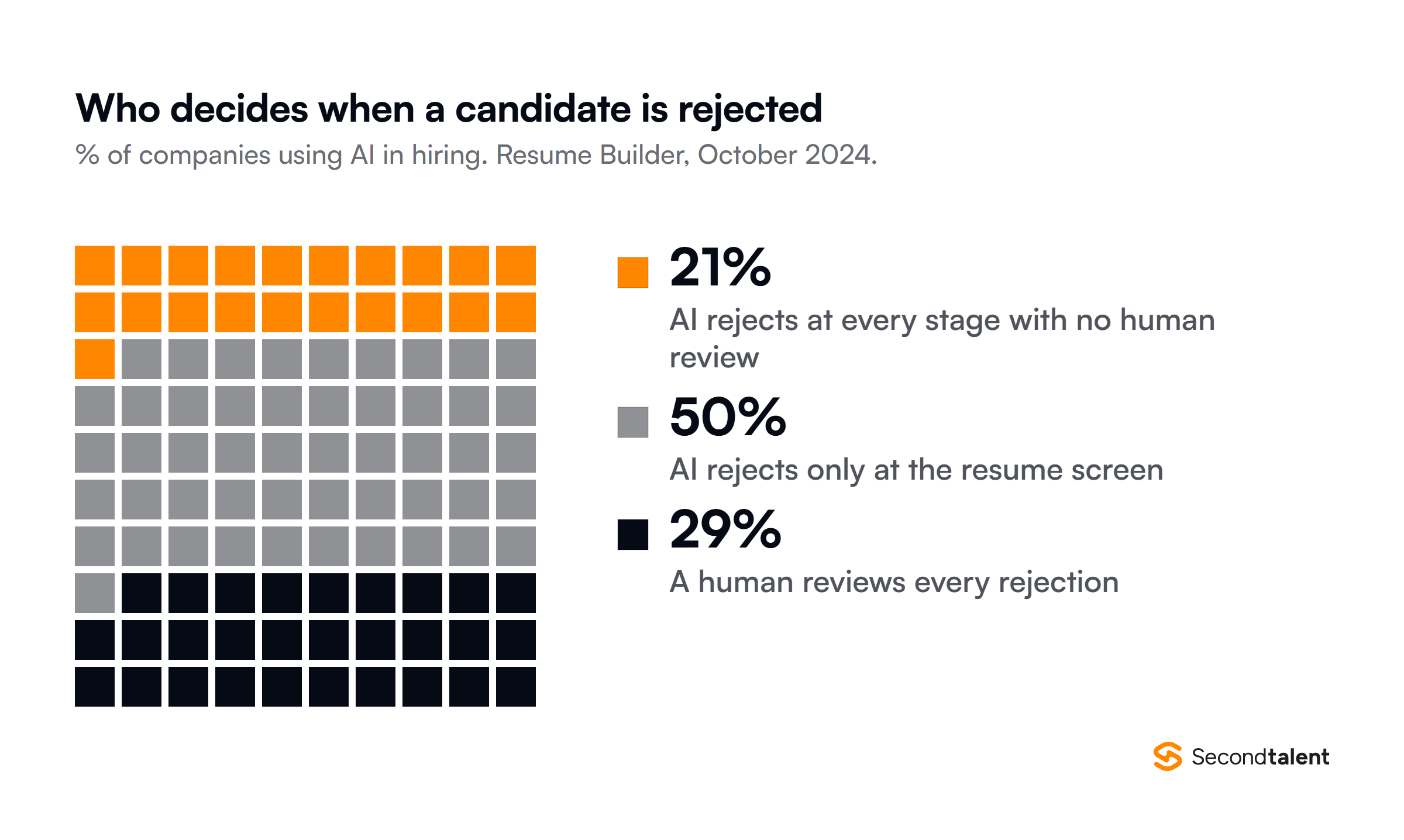
At one company in five, AI can turn down a candidate at any stage with no person checking. Resume Builder found 21% of companies using AI let it reject applicants throughout the process.
Half allowed it only at the resume screen, and 29% had a human review every rejection.
The same survey found 24% of companies letting AI run the whole interview. Among companies using AI in interviews, 81% had it ask the questions and 60% had it transcribe answers and assess tone or body language.
More than half, 52%, said they collected facial recognition data.
Candidates are meeting these interviews in large numbers. Greenhouse’s 2026 Candidate AI Interview Report, published May 1, 2026, surveyed 1,200 US job seekers. After finishing one, candidates reported these outcomes:
In the European Union, the AI Act has banned AI that recognizes emotions in the workplace since February 2, 2025. The regulation section below covers the rest of its timeline.
How Do Job Candidates Feel About AI in Hiring?
Most assume a machine reads their application, and few trust it. A Gartner survey of 2,918 job candidates in early 2025 found 52% believe AI screens their information.
A third, 32%, worried AI would fail their application, and 25% trust an employer less if it uses AI to evaluate them.
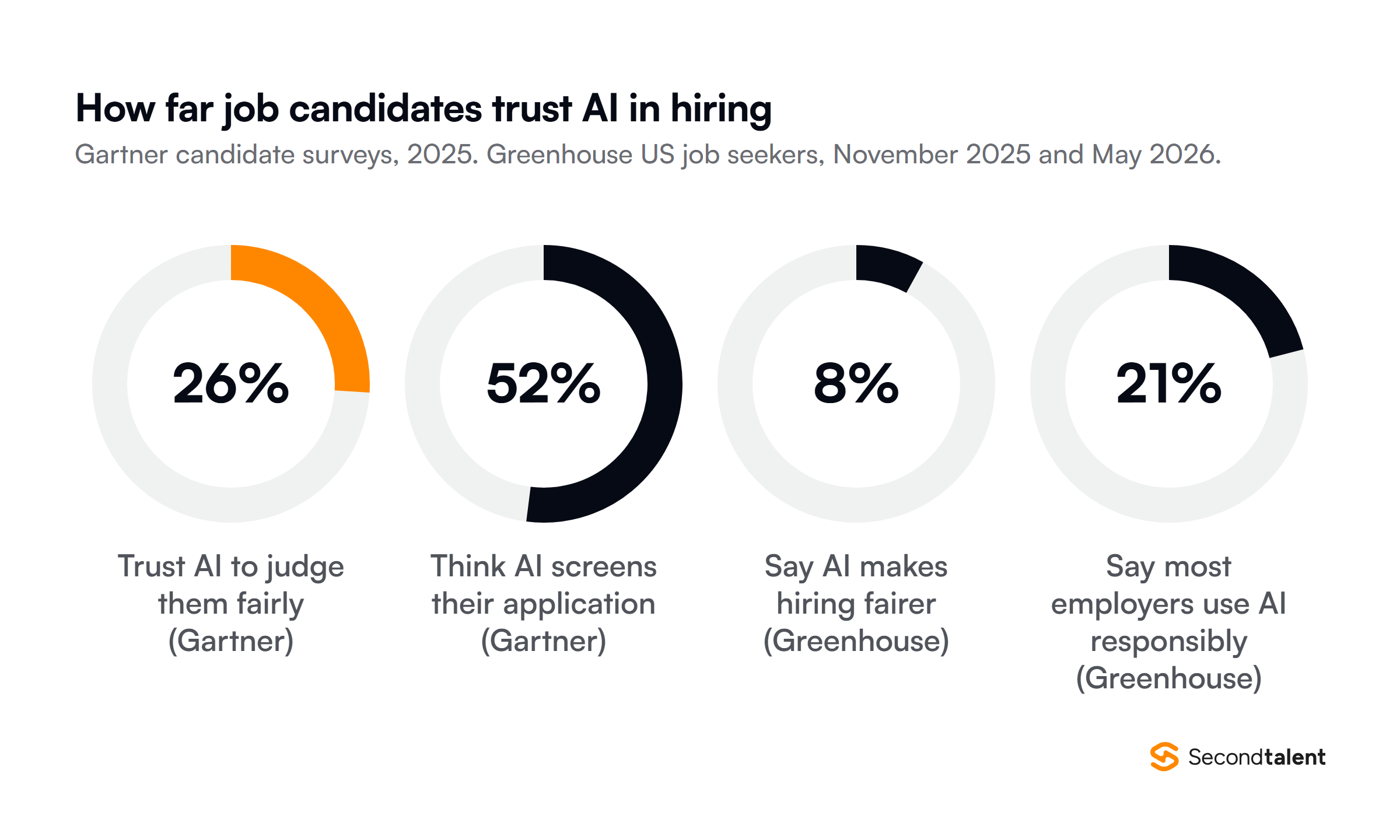
Greenhouse’s 2025 US numbers are harsher. Only 8% of job seekers said AI makes hiring fairer, 46% said their trust in hiring had fallen over the past year, and 42% blamed AI directly. Among Gen Z entry-level workers, 62% had lost trust.
Hiring teams read the same tools differently.
- 70% of hiring managers say AI helps them make faster, better decisions
- 50% of recruiters say AI has improved hiring overall
- Only 21% of recruiters are very confident their systems are not rejecting qualified people
- 87% say employers should be open about their AI use
- 35% think AI moved bias from humans to algorithms
- 18% say AI made bias worse by learning from past hiring
AI interviews drive candidates away
Candidate experience is where AI interviews cost employers applicants. In Greenhouse’s May 2026 report, 38% of job seekers had walked away from a hiring process because it included an AI interview, and another 12% said they would.
For 70%, nobody clearly said upfront that AI would evaluate them.
The top reason for quitting was a pre-recorded video scored by AI with no human present (33%). Next came no disclosure of how AI would be used (27%) and AI monitoring (26%). Only 19% want less AI in hiring.
Nearly half, 46%, want the option of a human interview instead.
The unease predates generative AI. Pew Research Center surveyed 11,004 US adults in December 2022: 66% said they would not apply to an employer that used AI to help make hiring decisions.
Yet 47% thought AI would beat humans at treating every applicant the same way.
How Are Candidates Using AI, and How Common Is Fraud?
Most job seekers now use AI themselves. Three in four US job seekers (74%) in Greenhouse’s 2025 survey used AI in their search. And 36% had used it to change their appearance, voice or background in a video interview.
Of those who had not tried hidden prompts in a resume, 52% were considering it.
Gartner asked a narrower question, about the application itself. In a late 2024 survey of 3,290 candidates, 39% said they used AI during the application itself.
They used it most to write resume text (54%) and cover letters (50%), then writing samples (36%) and answers to assessment questions (29%).
Deepfakes were the least common of the three tricks. The hiring managers who caught deceptive AI use most often saw candidates reading AI-written scripts (32%) or hiding prompt injections in resumes (22%).
Some 74% said they worry more about fake credentials and misrepresented experience than a year earlier.
“Candidate fraud creates cybersecurity risks that can be far more serious than making a bad hire.”
Jamie Kohn, Senior Research Director, Gartner HR practice, July 31, 2025
Candidates are also saying no more often. Gartner found 51% accepted a job offer in their most recent application process in the second quarter of 2025, down from 74% in the same quarter of 2023.
In another Gartner survey, 62% said they are more likely to apply when an employer requires in-person interviews.
For teams hiring remotely, where in-person rounds are not an option, our guide on how to evaluate engineering talent remotely covers the checks that still work.
Is AI in Hiring Biased?
A large academic test found clear bias by race and gender. University of Washington researchers swapped 120 first names across more than 550 real resumes.
They had three open large language models, from Mistral AI, Salesforce and Contextual AI, rank them against 500+ job listings. That came to more than three million comparisons.
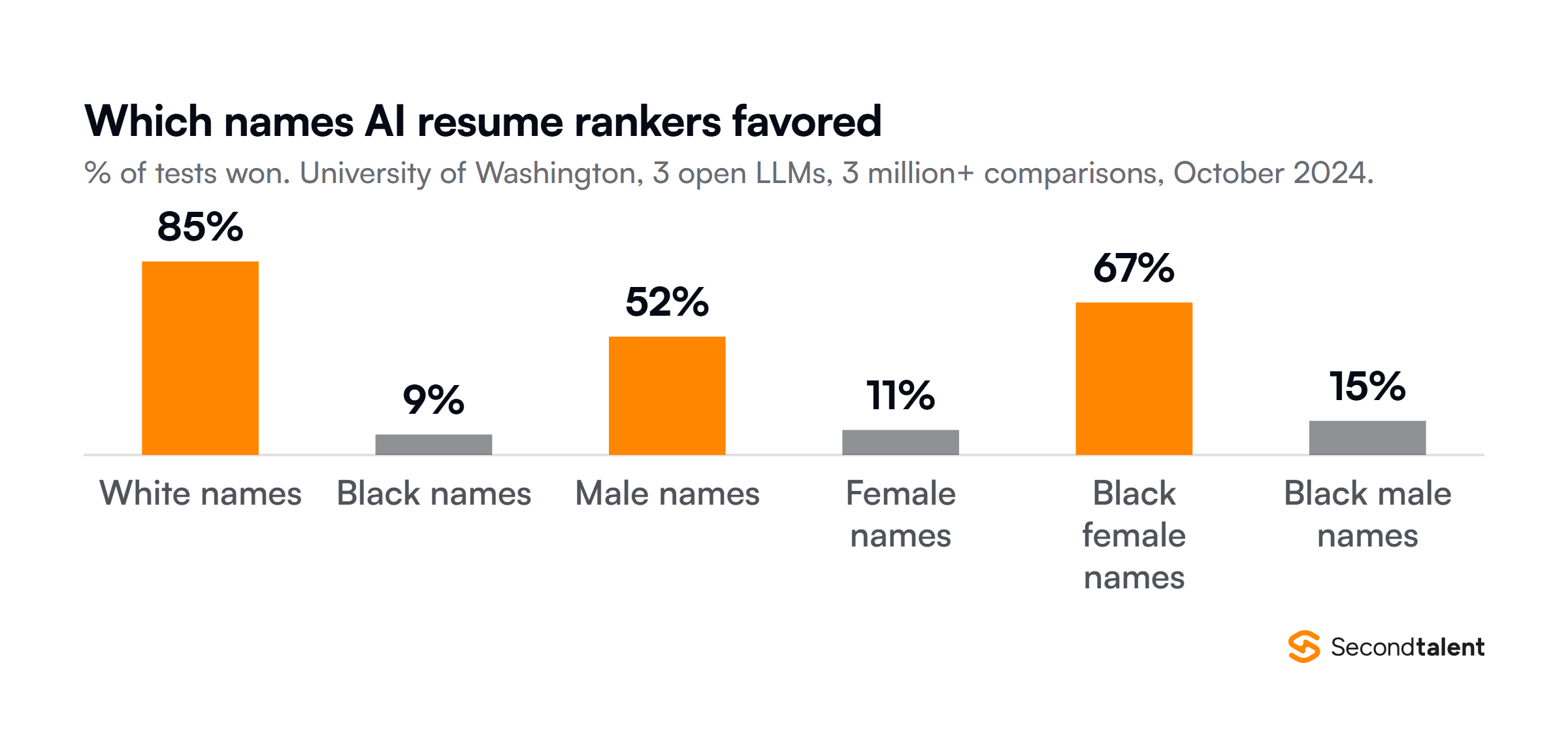
The models favored white-associated names 85% of the time and Black-associated names 9% of the time. They never preferred names read as Black and male over names read as white and male.
The study, presented in October 2024, used open models that approximate commercial screeners, not the vendors’ own products.
Employers see bias in their own tools too. In Resume Builder’s survey, 9% of companies using AI said it always produces biased recommendations, 24% said often and 34% said sometimes. Only 4% said never.
Age bias was the most common worry at 47%, then socioeconomic bias at 44%.
Humans do not come out ahead in candidates’ eyes. In Greenhouse’s 2026 report, 36% of job seekers felt age bias from both AI and human interviewers, and 27% felt race or ethnicity bias from both.
For a wider view of how screening decisions get made, see how employers select candidates with AI screening.
The court cases
Mobley v. Workday asks whether a software vendor can be liable as an employer’s agent.
Derek Mobley says he applied to more than 100 jobs through employers using Workday’s screening since 2017 and was rejected every time, Norton Rose Fulbright summarizes.
In May 2025 the court preliminarily certified an age discrimination collective of applicants aged 40 and older.
Discovery is now testing what vendors must hand over. On May 29, 2026, a magistrate judge shielded Workday’s bias-testing data under attorney-client privilege.
The judge did order Workday to produce its EEO-1 and federal contractor filings, Duane Morris reported. There has been no finding of liability.
The earlier case was simpler. The EEOC said iTutorGroup programmed its tutor application software to reject women aged 55 or older and men aged 60 or older. The settlement set aside $365,000 for those applicants.
What Laws Regulate AI in Hiring?
The rules differ sharply by place, and the largest rulebook has pushed its deadline back.
The EU’s AI Omnibus entered into force on July 27, 2026, moving the high-risk rules for employment AI, such as CV-sorting software, from August 2026 to December 2, 2027.
New York City: the first law, and little compliance
Local Law 144 bars employers from using an automated decision tool unless it has had a bias audit within the past year, a summary is public, and candidates get notice.
The city told employers that notice must come 10 business days before the tool is used.
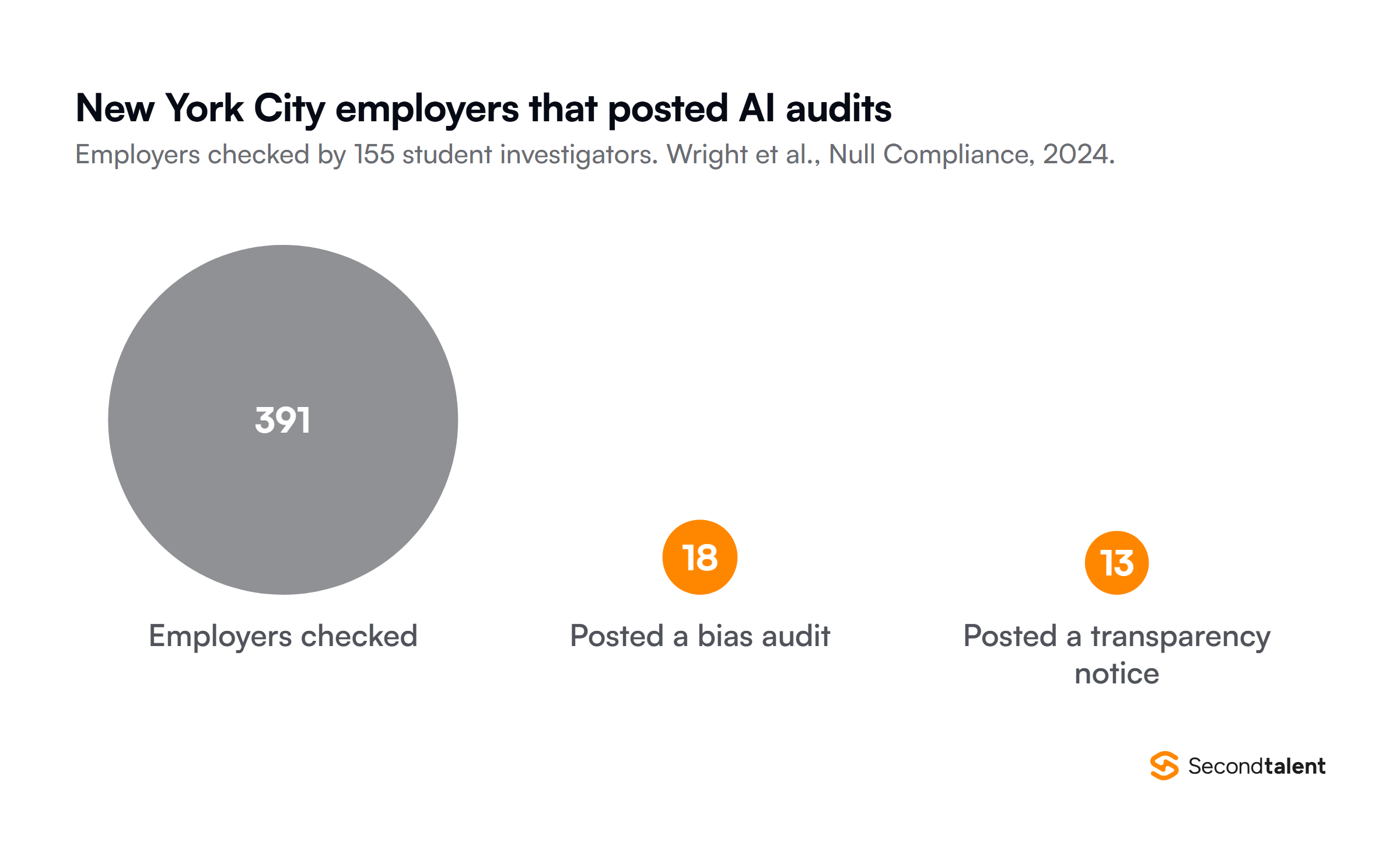
Few employers posted anything. A 2024 study by Lucas Wright and colleagues had 155 student investigators check 391 employers. They found 18 audit reports and 13 transparency notices.
The law lets each employer decide whether its tool is covered, which the authors call “null compliance”.
Colorado, Illinois and California
Colorado’s first AI Act never took effect. After X.AI sued in April 2026 and the federal government moved to join the case, the state agreed to pause enforcement.
Weeks later it passed a narrower law, SB 26-189, which drops impact assessments in favor of notices.
Under the new law, an employer must tell applicants before automated technology helps decide on them. After a rejection, it has 30 days to explain in plain language what role the technology played.
Applicants can correct wrong data and ask for human review. Skadden notes penalties of up to $20,000 per violation.
Illinois took effect first. Its law requires notice when AI is used in recruitment, hiring and other job decisions, and bans zip codes as a proxy for protected classes, Seyfarth Shaw reports.
California’s Civil Rights Council rules make employers keep automated decision data for at least four years.
Many HR teams have not caught up. SHRM found 57% of HR professionals in states with workforce AI rules were not aware of them, and only 49% of organizations have policies on AI use.
Our HR industry statistics track the wider changes in the function.
Hiring Engineers With People Doing the Screening
If resume filters and AI interviews are costing you strong candidates, a vetted shortlist is another route. Second Talent screens vetted developers in Asia before you see a profile, and you run the interviews yourself.
Browse our AI engineers or an AI and ML technical recruiter.
Tell us who you need to hire and we will send matching profiles.
Frequently Asked Questions
Is it legal to use AI to screen job applicants?
In the US and EU, generally yes, but anti-discrimination law still applies to the outcome. New York City adds an audit and notice duty, Illinois a notice duty, and Colorado will add notice and human review from 2027.
In the EU, emotion recognition at work is banned outright.
Do employers have to tell candidates they use AI?
Only in some places. New York City, Illinois and, from 2027, Colorado require notice. Elsewhere in the US there is usually no general duty. In Greenhouse’s 2026 survey, 70% of job seekers were never clearly told AI would evaluate them.
Can AI in hiring get a company sued?
Yes. iTutorGroup settled with the EEOC over software that rejected older applicants, and Mobley v. Workday is testing whether the vendor itself can be liable.
In both, the claim runs under ordinary age discrimination law, not an AI-specific statute.