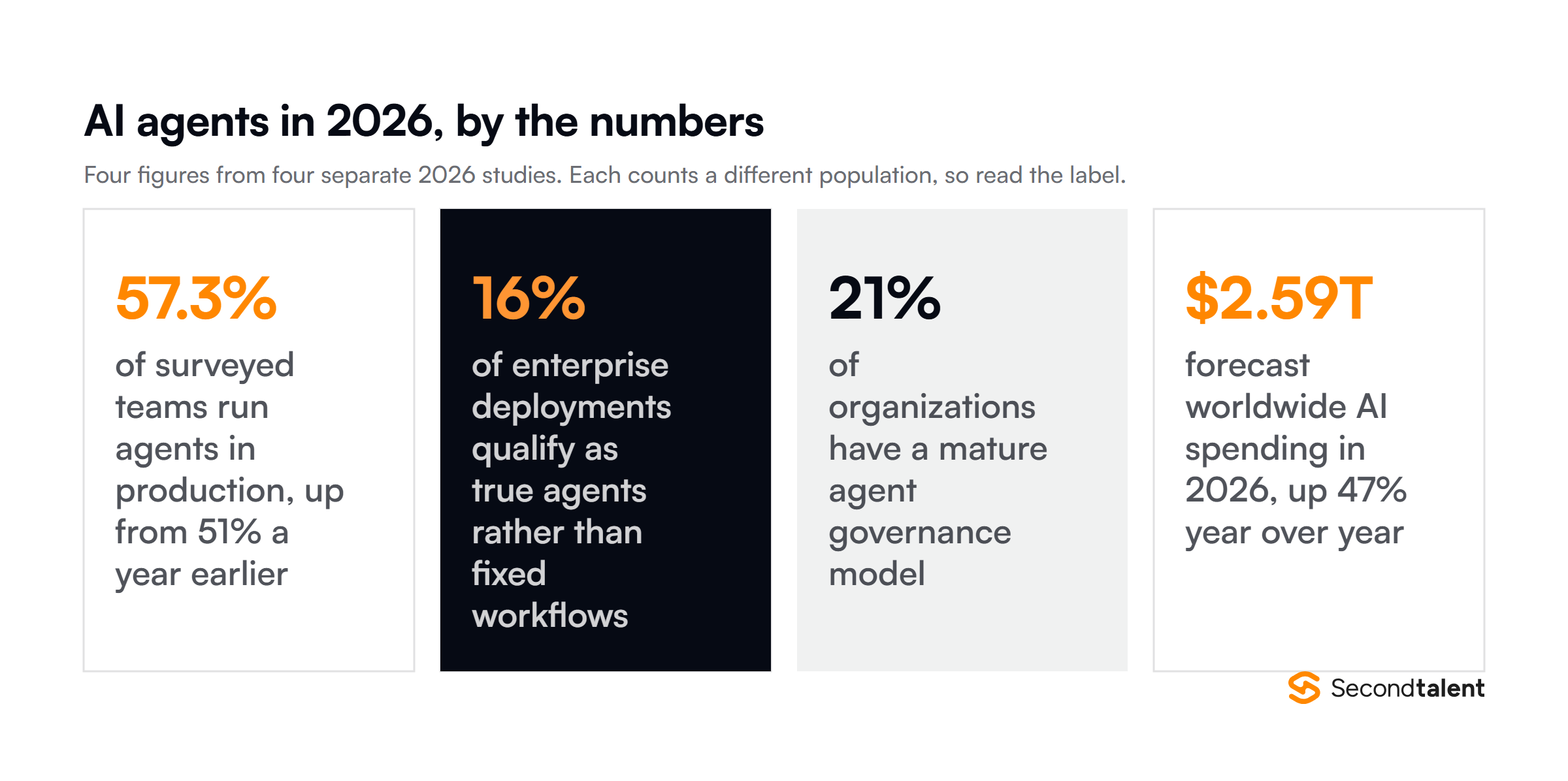
TL;DR. Somewhere between 54% and 88% of organizations say they use AI agents, depending on which 2026 survey you read and how it defines the word. Only 16% of enterprise deployments meet a strict definition of an agent, 21% of companies have mature agent governance, and about half of production agents run with no security monitoring.
I run product and operations at Second Talent, so most of what follows I first met as a staffing question: which of these numbers should change who we hire next quarter.
Five things to take away
- Always pair a loose adoption number with a strict one. 88% and 16% are both true and measure different things.
- Production is the real threshold, and 57.3% is the best-sourced figure for it.
- Quality blocks shipping, not cost. Falling token prices moved the bottleneck to evaluation.
- Governance maturity at 21% against 54% incident rates is the single widest gap in this dataset.
- Singapore and Hong Kong lead the world in AI skill demand as a share of postings. The talent map is not the investment map.
Why AI agent statistics disagree with each other
AI agent statistics disagree because each survey counts a different population and uses a different definition of “agent”. There is no shared standard for what qualifies.
Gartner has a name for the loosest end of this: agentwashing, the rebranding of assistants, chatbots and robotic process automation as agents without the underlying capability. Menlo Ventures applies the strictest test in the set, counting only systems where a model plans, executes, observes feedback and adapts. Under that test the adoption number collapses from 88% to 16%.
So before quoting any figure in this article, check three things: who was surveyed, when, and what the study counted as an agent. Each entry below states all three.
Adoption: who is actually running agents (1 to 10)
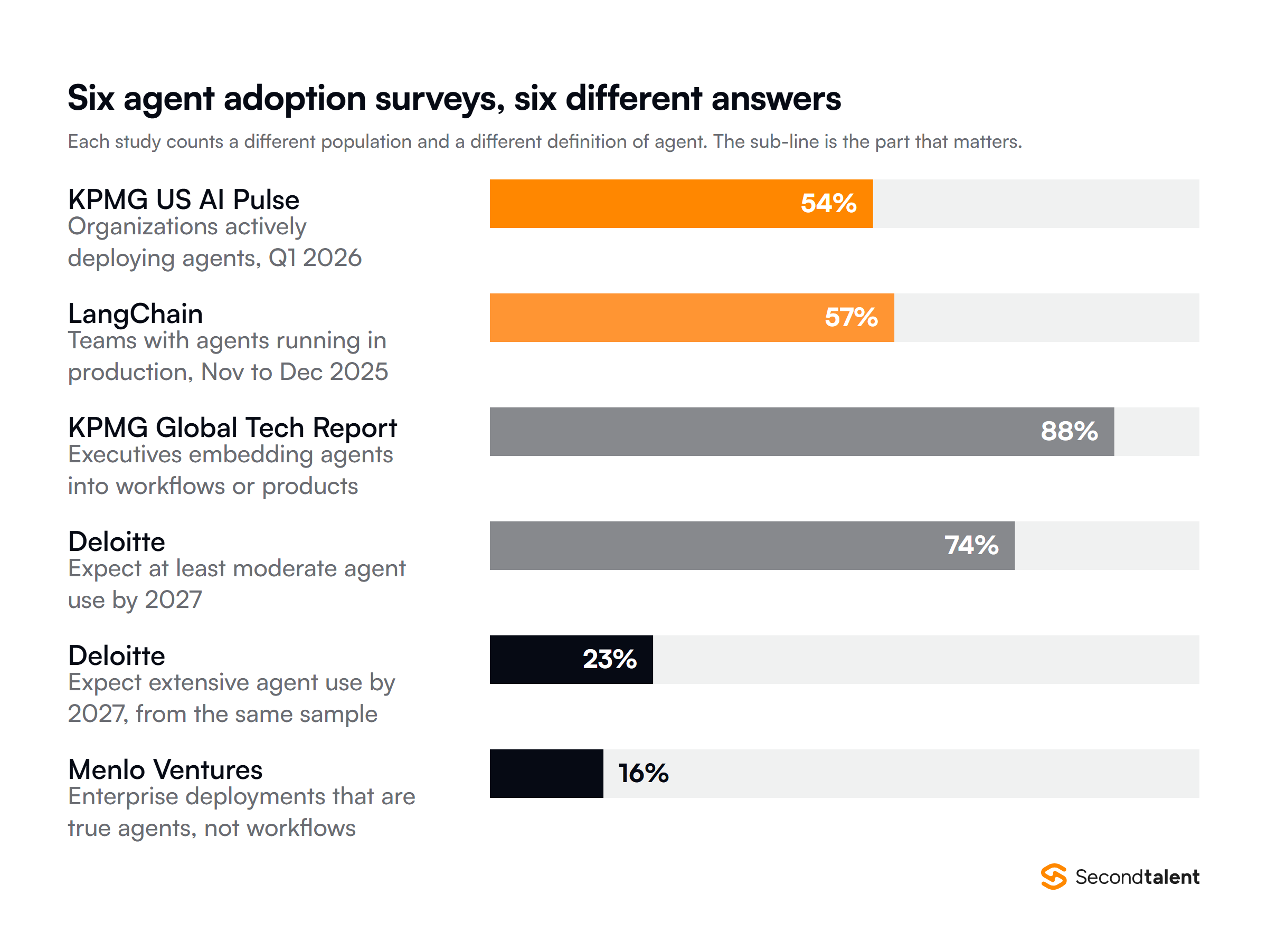
- 54% of organizations are actively deploying AI agents, up from 33% in mid-2024 and 12% in 2024, per the KPMG US AI Quarterly Pulse Survey for Q1 2026.
- 88% of technology executives are embedding agents into workflows, products or value streams, from the KPMG Global Tech Report 2026, a survey of 2,500 executives across 27 countries.
- Only 16% of enterprise deployments qualify as true agents under Menlo Ventures’ definition, with the rest being fixed-sequence or routing workflows around a single model call. Startups fare better at 27%. Source: Menlo Ventures, December 2025.
- AI agent deployment is still in single digits across nearly all business functions, even though 88% of surveyed organizations report using AI somewhere, per the Stanford AI Index 2026 economy chapter.
- Generative AI is used in at least one business function at 70% of organizations, with China and Europe posting the highest year-over-year increases (Stanford AI Index 2026).
- 74% of companies expect at least “moderate” agent use by 2027, 23% expect “extensive” use and 5% expect agents fully integrated as a core part of operations, per a Deloitte survey of 3,235 IT and business leaders across 24 countries.
- Operations (79%) and technology (78%) lead agent deployment by function, and 73% of organizations use agents to automate workflows spanning multiple functions (KPMG US AI Pulse, Q1 2026).
- 97% of organizations globally are exploring agentic strategies, according to the OutSystems 2026 State of AI Development report, covered by Tech Wire Asia in April 2026. “Exploring” is doing a lot of work in that sentence.
- 55% of employees report some level of agent adoption or integration in their own work, against 57% of leaders who expect people to manage and direct agents (KPMG US AI Pulse, Q1 2026).
- 84% of Baby Boomers had not used an AI agent in the previous 12 months, against 57% of Gen Z workers, from the World Economic Forum’s Artificial Intelligence and the Future of Entry-Level Work, 2026.
The one number to carry into a meeting
If you quote a single adoption figure, quote two: the loose one and the strict one. “88% of executives say they are embedding agents, and 16% of enterprise deployments meet a strict definition of one” is defensible. Either number on its own is not.
Pilot to production: where projects actually sit (11 to 20)
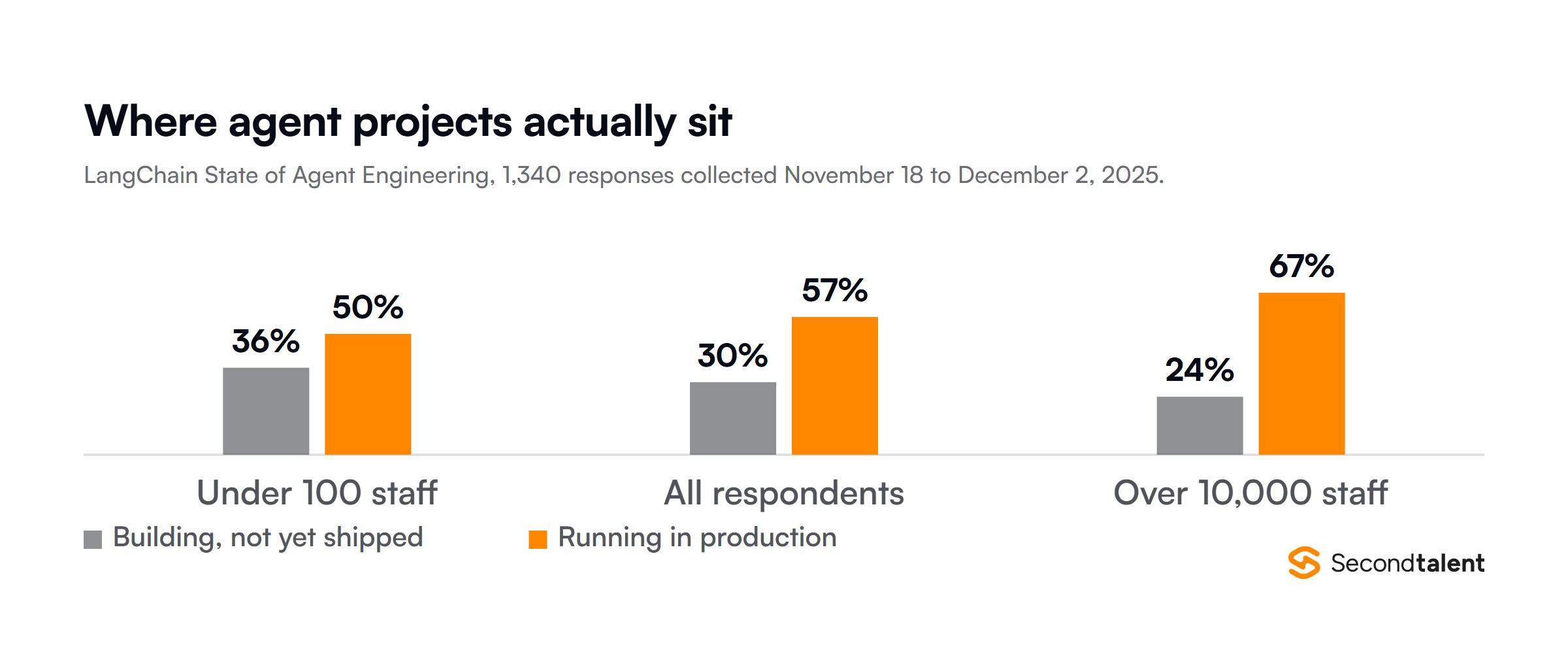
- 57.3% of surveyed teams have agents running in production, up from 51% a year earlier, with another 30.4% actively building toward deployment. From LangChain’s State of Agent Engineering, 1,340 responses collected between 18 November and 2 December 2025.
- Large organizations ship more, not less: 67% of organizations above 10,000 staff have agents in production, against 50% of those under 100 (LangChain, 2026).
- Only 25% of companies have moved 40% or more of their AI pilots into production, though 54% expect to reach that level within three to six months, per Deloitte’s State of AI in the Enterprise 2026.
- 49% of enterprises globally have moved more than half their agentic projects into full production (OutSystems 2026, via Tech Wire Asia).
- Over 40% of agentic AI projects will be canceled by the end of 2027, on escalating costs, unclear business value or inadequate risk controls, per Gartner.
- Gartner estimates only about 130 of the thousands of self-described agentic AI vendors are real, with the rest engaged in agentwashing (Gartner, June 2025).
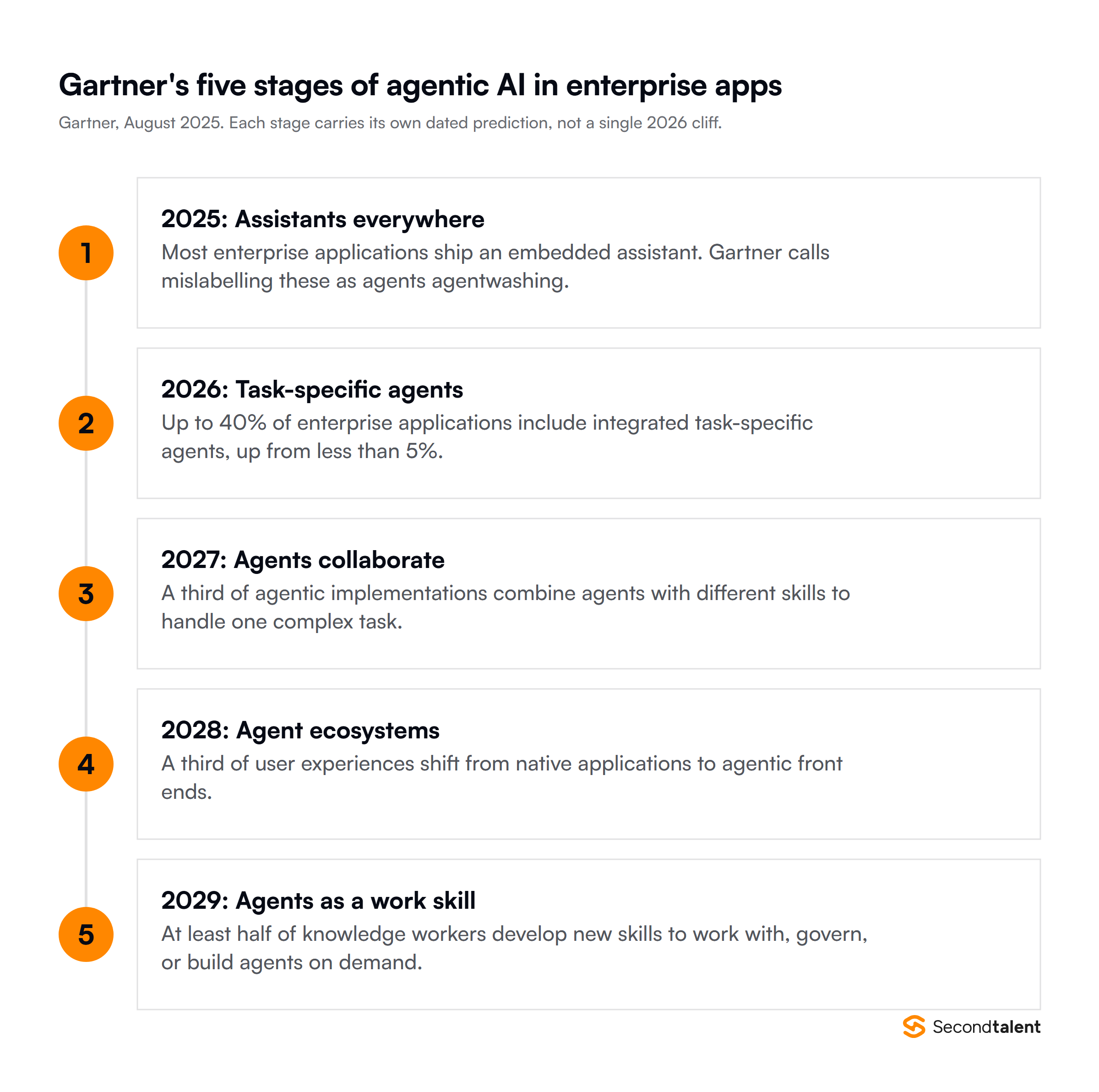
- 40% of enterprise applications will include task-specific agents by the end of 2026, up from less than 5%, per Gartner’s five-stage agentic roadmap.
- By 2027, one-third of agentic implementations will combine agents with different skills to manage a single complex task (Gartner, August 2025).
- By 2028, a third of user experiences will shift from native applications to agentic front ends, and 33% of enterprise software applications will include agentic AI, up from under 1% in 2024 (Gartner).
- By 2028, at least 15% of day-to-day work decisions will be made autonomously through agentic AI, up from 0% in 2024 (Gartner, June 2025).
Gartner’s roadmap is the one most vendor decks quote without naming. It is worth reading in full, because the 40% figure sits at stage two of five, each stage with its own date.
What blocks agents from shipping (21 to 30)
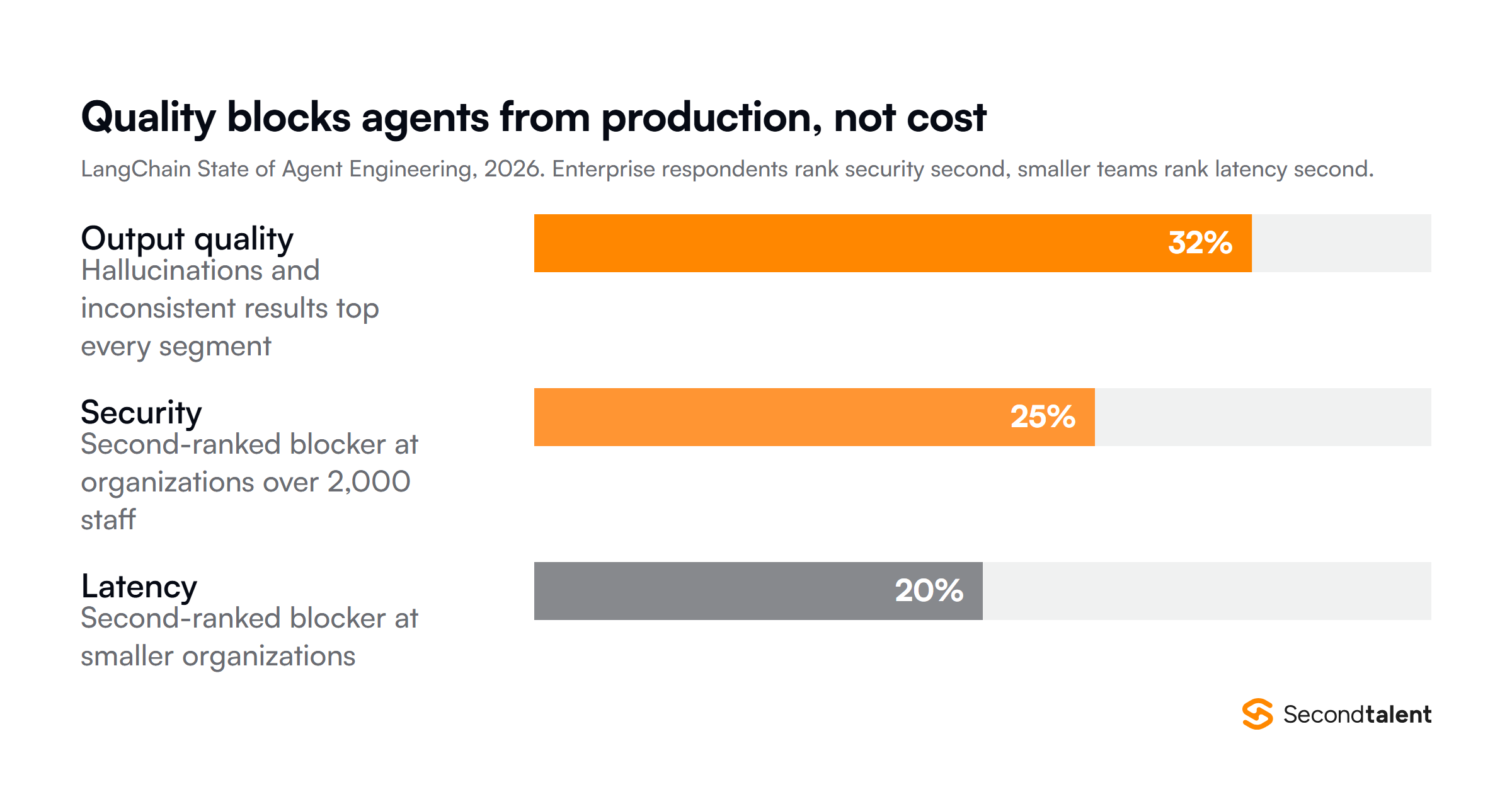
- Quality is the top production blocker at 32%, cited above latency, security and cost. Write-in answers at large organizations point to hallucinations and inconsistent outputs (LangChain, 2026).
- Latency ranks second at 20% overall, but at organizations above 2,000 staff security takes second place at 24.9% (LangChain, 2026).
- Cost has fallen down the list of concerns compared with previous years, as falling model prices shifted attention toward making agents work well and fast (LangChain, 2026).
- 89% of organizations have implemented some form of agent observability, and 62% have detailed tracing that lets them inspect individual steps and tool calls (LangChain, 2026).
- Observability outpaces evaluation by a wide margin: 89% have observability, but only 52.4% run offline evaluations on test sets and 37.3% run online evals (LangChain, 2026).
- Teams that already run agents in production evaluate more: 94% have observability, 71.5% have full tracing, and online eval adoption rises to 44.8% (LangChain, 2026).
- Human review remains the dominant evaluation method at 59.8%, with LLM-as-judge approaches at 53.3% used to scale breadth (LangChain, 2026).
- Legacy fragmentation and integration difficulty is the top blocker for over 40% of leaders, and 38% name legacy systems as the primary reason agentic projects stalled out entirely (OutSystems 2026, via Tech Wire Asia).
- 65% of leaders cite difficulty scaling use cases, up from 33% one quarter earlier, and 62% cite skills gaps, up from 25% (KPMG US AI Pulse, Q1 2026).
- Only 30% of organizations are redesigning key processes around AI, and 37% report using AI at a surface level with little or no change to underlying processes (Deloitte, 2026).
Capability and reliability benchmarks (31 to 40)
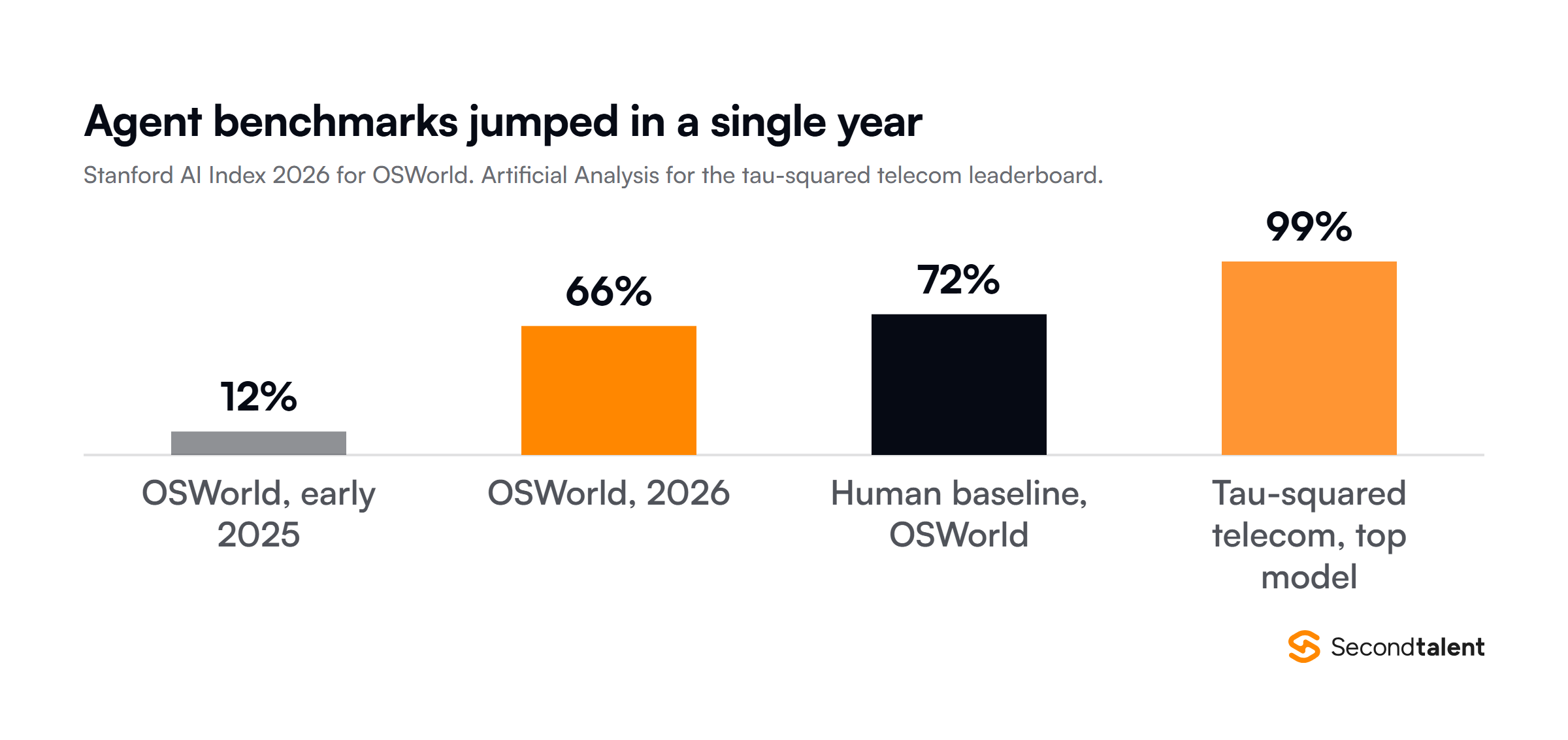
- Agent accuracy on OSWorld rose from roughly 12% to 66.3% in a year, putting agents within 6 percentage points of human performance on real computer tasks, per the Stanford AI Index 2026 technical performance chapter.
- Agents still fail roughly one attempt in three on structured benchmarks (Stanford AI Index 2026).
- SWE-bench Verified performance rose from 60% to near 100% in a single year (Stanford AI Index 2026).
- The top model on the tau-squared telecom benchmark scores 99.1%, on a dual-control test where both agent and user hold tools, per the Artificial Analysis leaderboard. Saturation on a benchmark is not the same as reliability in production.
- The 50% task-completion time horizon has doubled roughly every 7 months for six years, and every 4 months when fitted to 2024 and 2025 data alone, per METR.
- Frontier agents now clear coding tasks that take a human expert over fourteen hours, at 50% reliability, on the AI Digest tracker built on METR’s data. METR is explicit that its tasks are self-contained, so read this as what a contractor with no prior context could do, not what a tenured engineer does.
- Benchmark reliability is itself contested, with invalid question rates ranging from 2% on MMLU Math to 42% on GSM8K (Stanford AI Index 2026).
- Capability is jagged: Gemini Deep Think won gold at the 2025 International Mathematical Olympiad, while the top model reads an analog clock correctly 50.6% of the time against 90.1% for humans (Stanford AI Index 2026).
- Professional-domain evaluations land between 60% and 90% across tax, mortgage processing, corporate finance and legal reasoning, with the top 15 models separated by as little as 3 percentage points (Stanford AI Index 2026).
- Four labs now sit within 25 Elo points of each other on human-voted arena ratings as of March 2026, shifting competition toward cost, reliability and domain fit rather than raw capability (Stanford AI Index 2026).
Spending and unit economics (41 to 50)
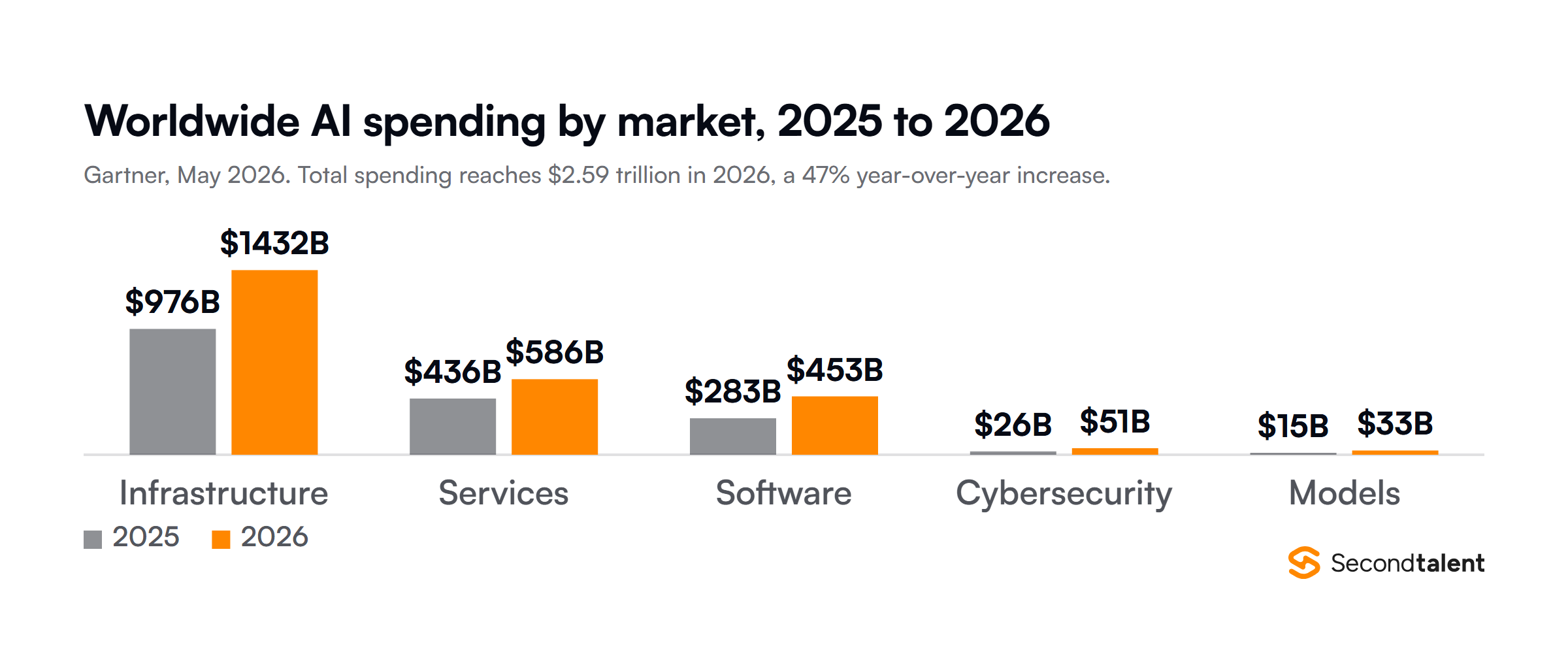
- Worldwide AI spending reaches $2.59 trillion in 2026, a 47% year-over-year increase, per Gartner’s May 2026 forecast.
- AI infrastructure alone accounts for over 45% of that spend, rising from $976 billion in 2025 to $1.43 trillion in 2026 (Gartner, May 2026).
- Spending on AI models grows 110% in 2026, the fastest growth rate of any segment in Gartner’s table, off a small base of $15.5 billion in 2025.
- AI inference costs per agentic workflow will rise more than fivefold through 2028, per Gartner, August 2026. Gartner calls this the Inference Paradox: unit prices fall while total cost climbs.
- Routing one task to an agentic reasoning model costs at least 5 times a basic chatbot interaction, and often much more as task complexity grows (Gartner, August 2026).
- Enterprise AI spending tripled from $11.5 billion to $37 billion in one year, now roughly 6% of the global software market within three years of ChatGPT’s launch (Menlo Ventures, December 2025).
- Agent platforms account for 10% of the horizontal AI category, about $750 million, against 86% and $7.2 billion for copilots. Horizontal AI as a whole grew 5.3 times year over year to $8.4 billion (Menlo Ventures, 2025).
- Up to $234 billion of enterprise application spending is exposed to agentic arbitrage through 2030, roughly 20% of enterprise SaaS spend, per Gartner, July 2026.
- Deloitte predicts as many as 75% of companies will invest in agentic AI in 2026, and that up to half will put more than 50% of their digital transformation budgets toward AI automation, in its 2026 TMT Predictions.
- Agentic AI could drive roughly 30% of enterprise application software revenue by 2035, surpassing $450 billion, up from 2% in 2025, in Gartner’s best-case projection (August 2025).
ROI and business results (51 to 60)
- The top 20% of organizations capture 74% of AI-driven economic returns, from PwC’s 2026 AI performance study of 1,217 organizations across 25 sectors.
- AI leaders increase the number of decisions made without human intervention at 2.8 times the rate of their peers, and are 1.9 times as likely to run AI in autonomous, self-optimising ways (PwC, 2026).
- Those same leaders govern more, not less: 1.7 times as likely to have a Responsible AI framework and 1.5 times as likely to have a cross-functional AI governance board (PwC, 2026).
- 66% of agent adopters report increased productivity, 57% report cost savings, 55% faster decision-making and 54% improved customer experience, per PwC’s AI Agent Survey of 308 US executives fielded in April 2025.
- 88% of executives planned to raise AI budgets within 12 months because of agentic AI, with over a quarter planning increases of 26% or more (PwC, 2025).
- Salesforce delivered 2.4 billion agentic work units across Agentforce and Slack, growing 57% quarter over quarter, from nearly 20 trillion tokens consumed, per its Q4 FY26 results, February 2026.
- Agentforce annual recurring revenue reached $800 million, up 169% year over year, across more than 29,000 deals closed since launch (Salesforce, February 2026).
- Average agent creation time fell 53% over one fiscal year while the number of activated agents grew nearly threefold, per the Salesforce Agentic Enterprise Index.
- The average employee engaged with an agent 300% more often per week across the analysis period, which Salesforce reads as a trust signal rather than a usage mandate (Agentic Enterprise Index, 2026).
- 47% of AI deals reach production against 25% for traditional SaaS, and 76% of AI use cases are now bought rather than built, reversing the 53% purchased share of 2024 (Menlo Ventures, 2025).
A number to handle carefully
The claim that 95% of generative AI pilots fail comes from a preliminary MIT Project NANDA report built on 52 executive interviews, 153 survey responses and about 300 public deployments.
Its finding was “no measurable P&L impact”, which is not the same as failure. Quote it with the methodology attached or leave it out.
Security, governance and identity (61 to 70)
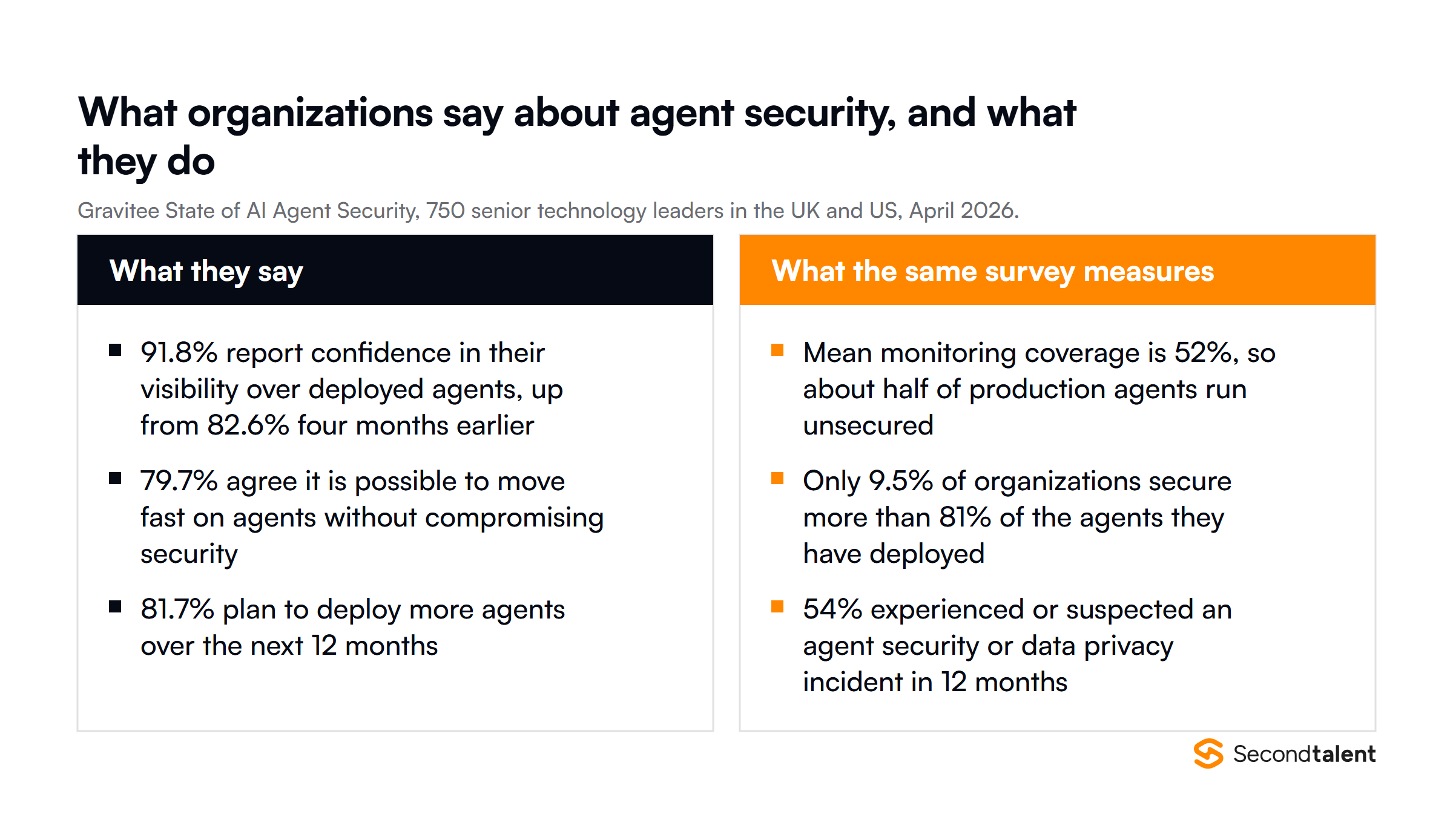
- 54% of organizations experienced or suspected an AI agent security or data privacy incident in the past 12 months, and 34.9% confirmed one, per Gravitee’s State of AI Agent Security, a survey of 750 senior technology leaders in the UK and US fielded in April 2026.
- Telecoms lead sector incident rates at 67.3%, followed by financial services at 54.7% (Gravitee, April 2026).
- Mean agent monitoring coverage is 52%, meaning roughly half of all production agents run with no security oversight or logging (Gravitee, April 2026).
- Only 9.5% of organizations secure more than 81% of the agents they have deployed, while 91.8% report confidence in their visibility, up from 82.6% four months earlier (Gravitee, April 2026).
- 81% of respondents feel pressure to deploy agents quickly even when security and governance are not in place, and 25.8% describe that pressure as significant (Gravitee, April 2026).
- Only 21% of organizations have a mature governance model for agentic AI, leaving roughly 80% without clear decision boundaries, real-time monitoring or complete audit trails (Deloitte, 2026).
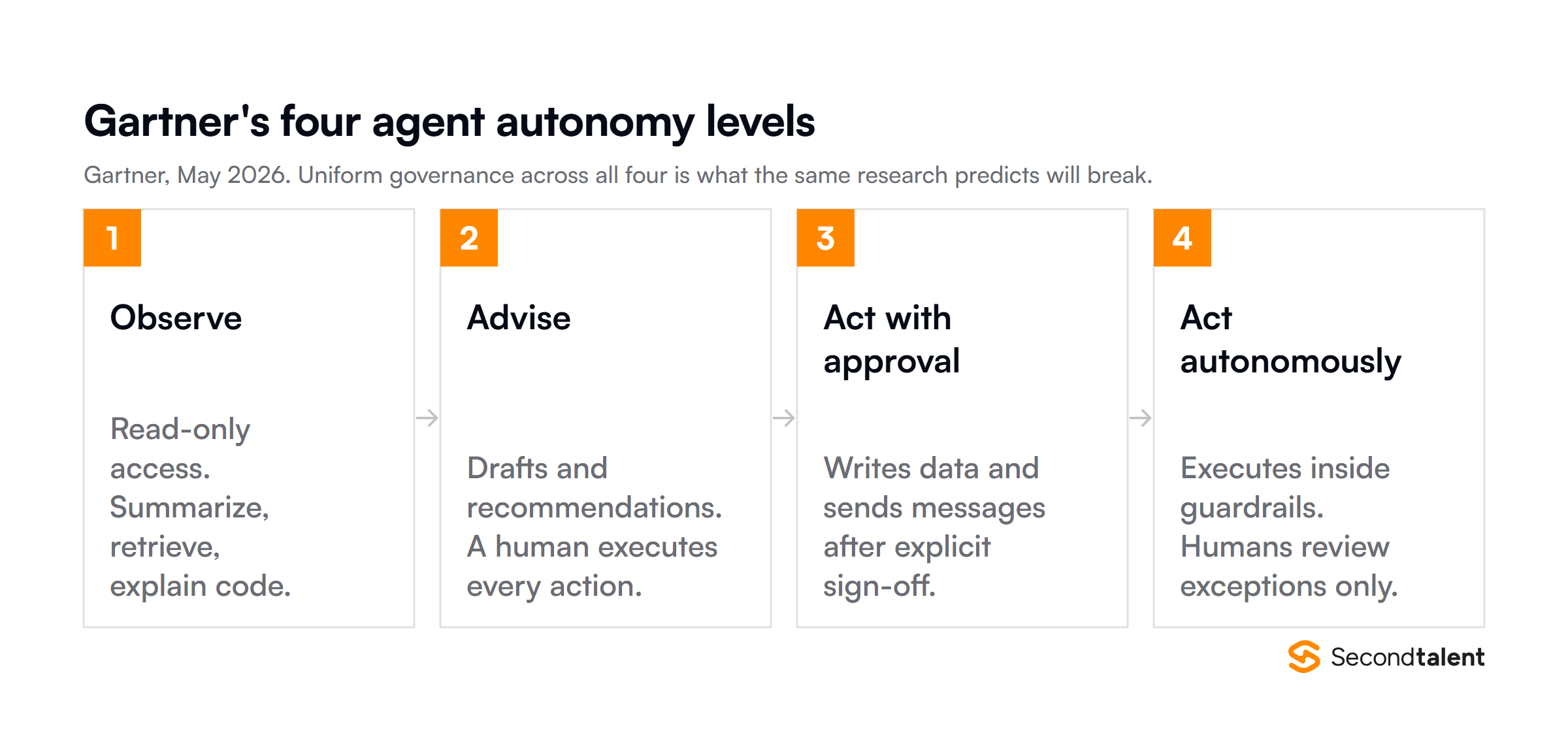
- By 2027, 40% of enterprises will demote or decommission autonomous agents because of governance gaps found only after a production incident, per Gartner, May 2026. The cause Gartner names is applying one uniform control set across every autonomy level.
- 63% of organizations now require human validation of agent outputs, up from 22% in Q1 2025 (KPMG US AI Pulse, Q1 2026).
- Prompt injection maps to six of the ten categories in OWASP’s Top 10 for Agentic Applications, and the 2026 edition catalogues real CVEs rather than the hypothetical threats of the 2025 edition, as reported by Help Net Security in June 2026.
- A backdoored LiteLLM package sat on PyPI for three hours in March 2026 and was downloaded nearly 47,000 times, reaching CrewAI, DSPy, Microsoft GraphRAG and other agent frameworks that depend on it (Help Net Security, June 2026).
Gartner’s recommended fix is proportional governance: classify agents by how much they can do, then match the control set to the level rather than applying one policy everywhere.
The agent stack: models, protocols and tooling (71 to 80)
- There are more than 10,000 active public MCP servers and over 97 million monthly SDK downloads across Python and TypeScript, per Anthropic’s December 2025 announcement.
- The Model Context Protocol now sits under the Linux Foundation, inside an Agentic AI Foundation co-founded by Anthropic, Block and OpenAI with support from Google, Microsoft, AWS, Cloudflare and Bloomberg (Anthropic, December 2025).
- More than two-thirds of organizations use OpenAI’s GPT models, and over three-quarters run multiple models in production or development, routing by complexity, cost and latency (LangChain, 2026).
- A third of organizations deploy their own models in-house, driven by cost at volume, data residency and regulatory constraints (LangChain, 2026).
- 57% of organizations do no fine-tuning at all, relying on base models with prompt engineering and retrieval instead (LangChain, 2026).
- Anthropic holds an estimated 40% of enterprise LLM spend, up from 24% a year earlier, against OpenAI at 27% and Google at 21%. Those three make up 88% of enterprise LLM API usage (Menlo Ventures, 2025).
- Open-source models hold 11% of the enterprise market, down from 19% a year earlier (Menlo Ventures, 2025).
- By 2027, over 65% of engineering teams using agentic coding will treat the IDE as optional, shifting control, governance and validation to automated platforms, per Gartner, May 2026.
- More than half of internet traffic is now non-human, and 52% of crawler requests are for AI training as of June 2026, up from 22% in spring 2025, per Cloudflare.
- Some heavily crawled site categories have seen human traffic fall as much as 40% in under a year, while Google still accounts for roughly 88% of referral traffic (Cloudflare, 2026).
Where agents are actually put to work
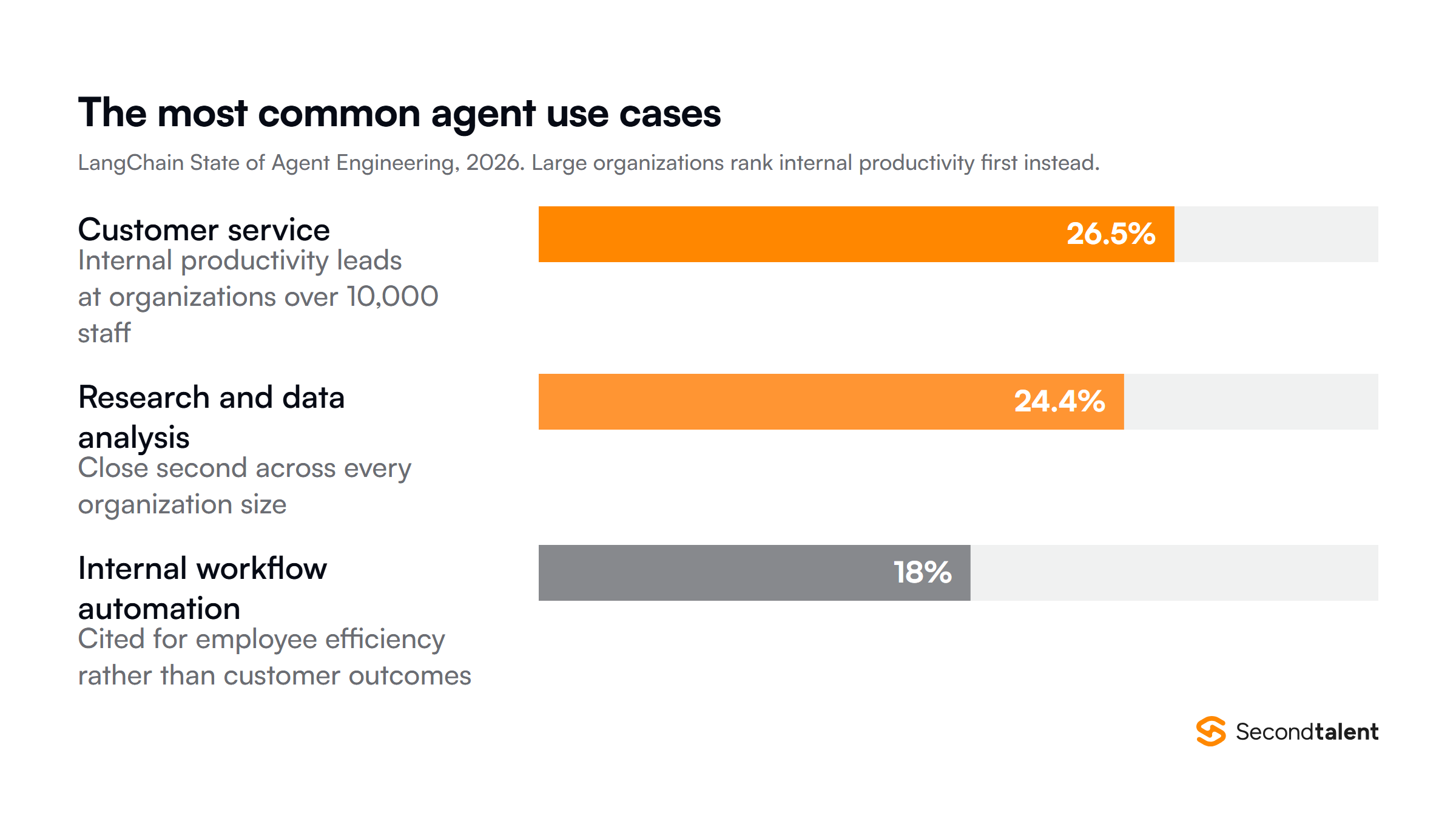
Customer service leads overall, but that flips at scale: organizations above 10,000 staff put internal productivity first at 26.8%, with customer service second at 24.7%.
Work, jobs and skills (81 to 90)
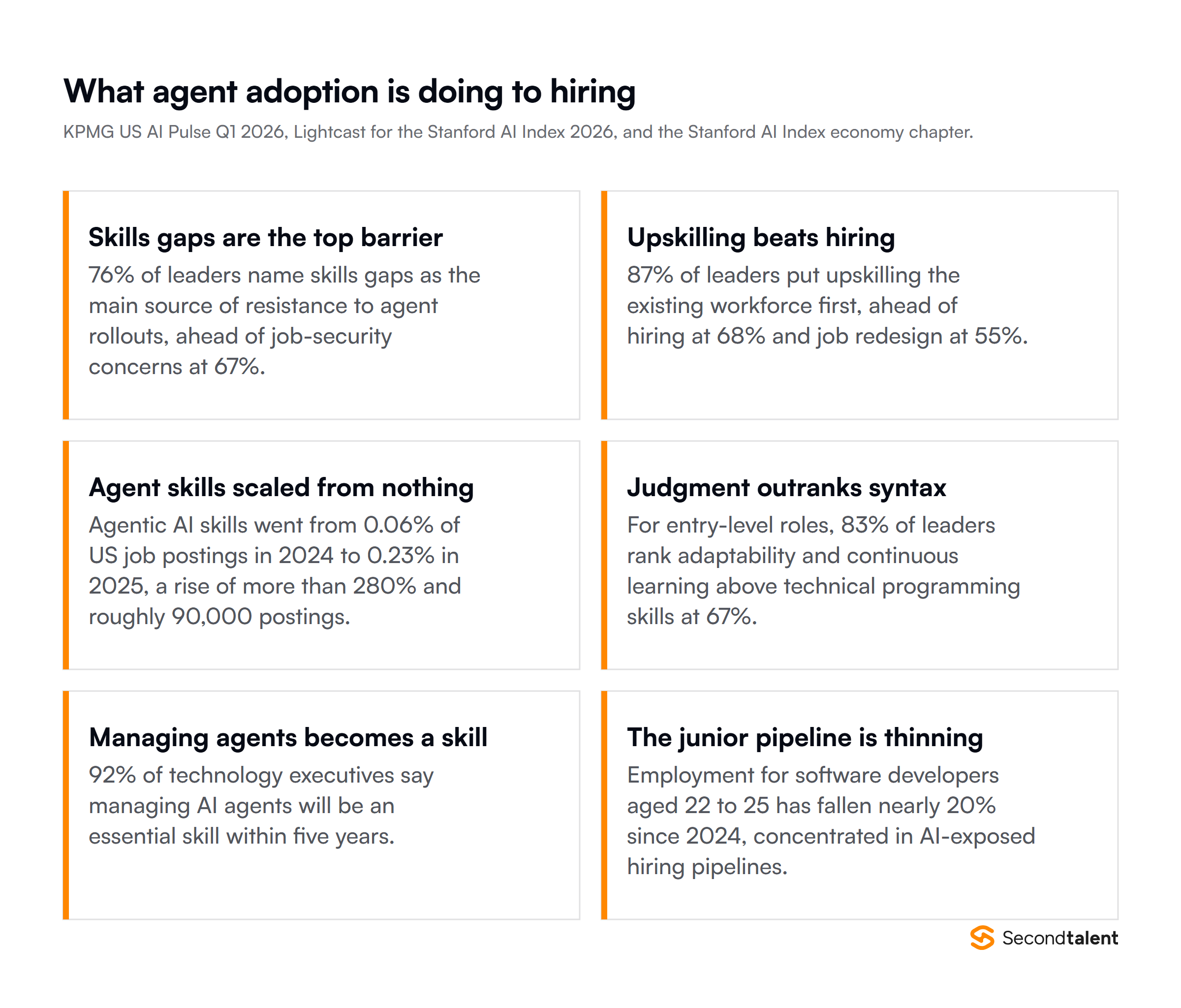
- Agentic AI skills went from 0.06% of US job postings in 2024 to 0.23% in 2025, a rise of more than 280% and roughly 90,000 postings, per Lightcast’s analysis for the Stanford AI Index 2026.
- Lightcast added Agentic AI as a new skill cluster for this edition, alongside AI Agents and LangGraph as individually tracked skills (Lightcast, 2026).
- 92% of technology executives say managing AI agents will be an essential skill within five years (KPMG Global Tech Report 2026).
- Skills gaps are the top source of resistance to agent rollouts at 76%, ahead of job-security concerns at 67% (KPMG US AI Pulse, Q1 2026).
- 87% of leaders name upskilling the existing workforce as their number one focus, ahead of hiring at 68% and job redesign at 55% (KPMG US AI Pulse, Q1 2026).
- For entry-level roles, 83% of leaders rank adaptability and continuous learning above technical programming skills at 67% (KPMG US AI Pulse, Q1 2026).
- Employment for software developers aged 22 to 25 has fallen nearly 20% since 2024, concentrated in hiring pipelines rather than in the existing workforce (Stanford AI Index 2026).
- One-third of organizations expect AI to reduce their workforce in the coming year, with anticipated reductions highest in service operations, supply chain and software engineering (Stanford AI Index 2026).
- 37% of young workers globally hold jobs with medium to high exposure to AI-driven task change, rising to 75% in Eastern Asia, 69% in North America and 63% in Europe (World Economic Forum, 2026).
- 90% of developers use AI at work and over 80% say it raised their productivity, but 30% report little or no trust in AI-generated code, per the 2025 DORA report from Google Cloud.
The DORA finding is the one I would put in front of any engineering manager planning an agent rollout. Its authors describe agentic AI as an amplifier: the same tools produce different outcomes depending on the discipline an organization already has.
We see the same pattern in placements. Teams with code review, tests and clear ownership compound their returns from agents. Teams without them get faster mess.
Asia Pacific (91 to 100)
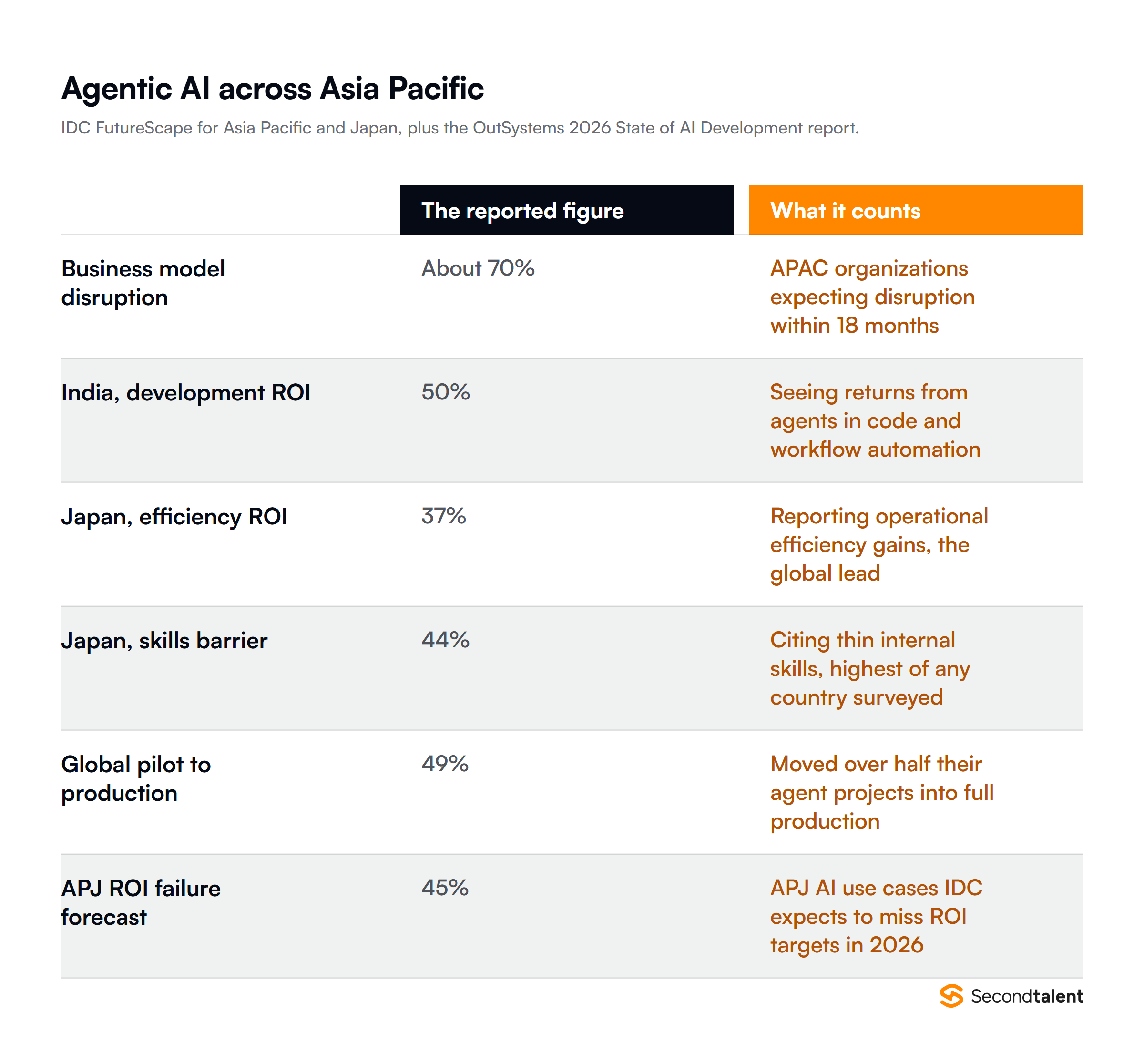
- About 70% of Asia Pacific organizations expect agentic AI to disrupt business models within 18 months, from an IDC survey of 300 organizations across the region.
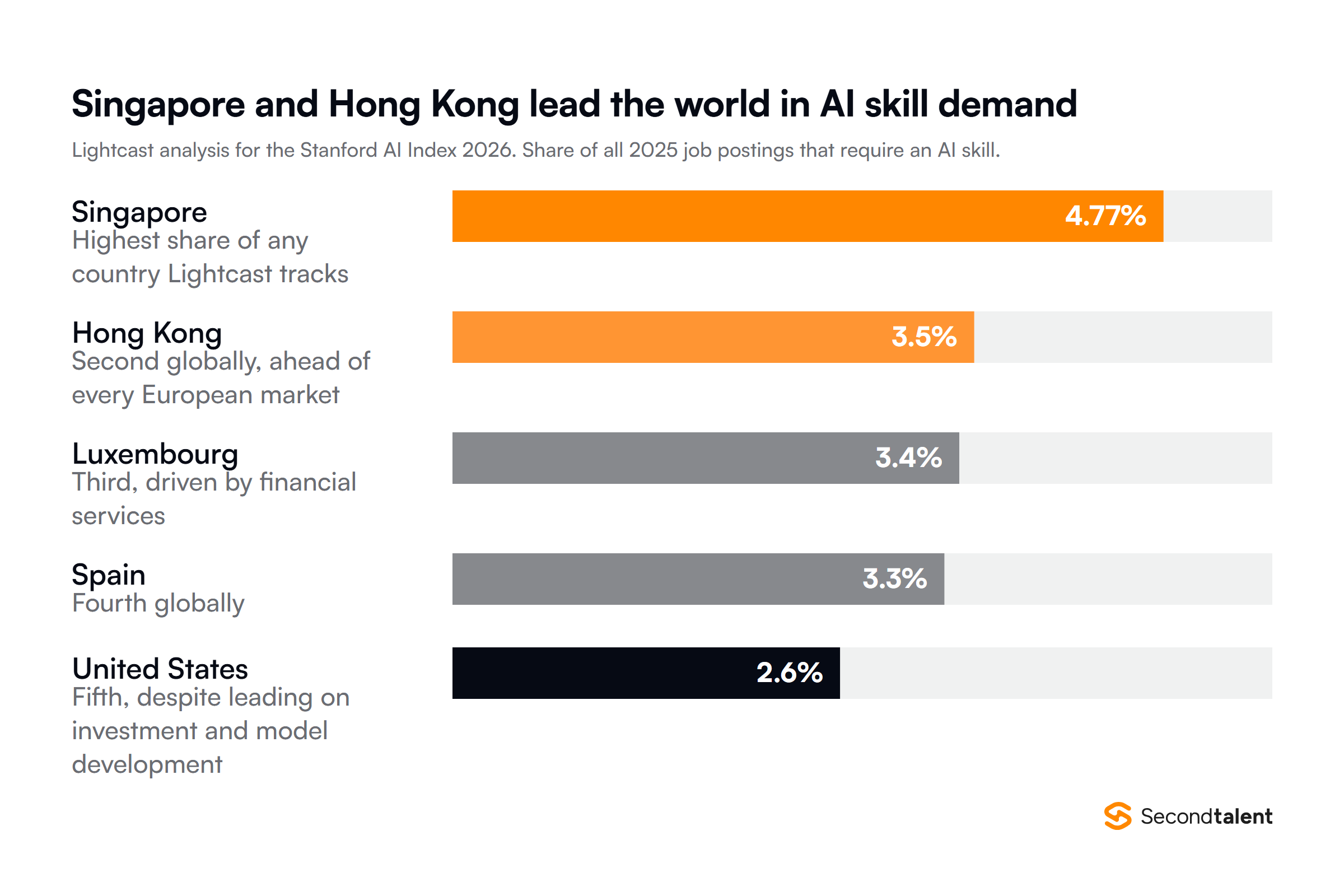
- Singapore leads the world with 4.769% of all job postings requiring an AI skill, ahead of Hong Kong at 3.5%, Luxembourg at 3.4%, Spain at 3.3% and the United States at 2.6% (Lightcast for the Stanford AI Index 2026).
- India leads all surveyed countries on development and productivity ROI from agents at 50%, meaning half of Indian respondents see returns from agents in code generation and workflow automation (OutSystems 2026, via Tech Wire Asia).
- Japan leads on operational efficiency ROI at 37%, a different profile from India’s but a real one (OutSystems 2026, via Tech Wire Asia).
- 44% of Japanese respondents cite insufficient internal skills as a barrier, the highest share of any country surveyed (OutSystems 2026, via Tech Wire Asia).
- Only 36% of organizations globally have a centralised approach to agentic AI governance (OutSystems 2026, via Tech Wire Asia).
- 45% of AI-fuelled digital use cases in Asia Pacific and Japan will miss ROI targets in 2026, on unclear gains and weak data foundations, per IDC’s FutureScape 2026 predictions for the region.
- By 2027, 60% of organizations will manage multi-agent experiences spanning multiple channels, applications and suppliers (IDC FutureScape, 2026).
- 66% of Asia Pacific and Japan CEOs believe AI will let them reinvent their business models within three to five years (IDC FutureScape, 2026).
- By 2030, half of all new economic value generated by Asia Pacific digital businesses will come from the organizations investing in and scaling AI today (IDC FutureScape, 2026).
The Lightcast geography is the finding I did not expect. Singapore and Hong Kong ask for AI skills in a larger share of job postings than the United States does, and both sit above the top European market.
If you had AI hiring filed as a Bay Area story, that data says otherwise. It lines up with what we see in country-level AI adoption rates.
What these numbers mean if you are hiring for agent work
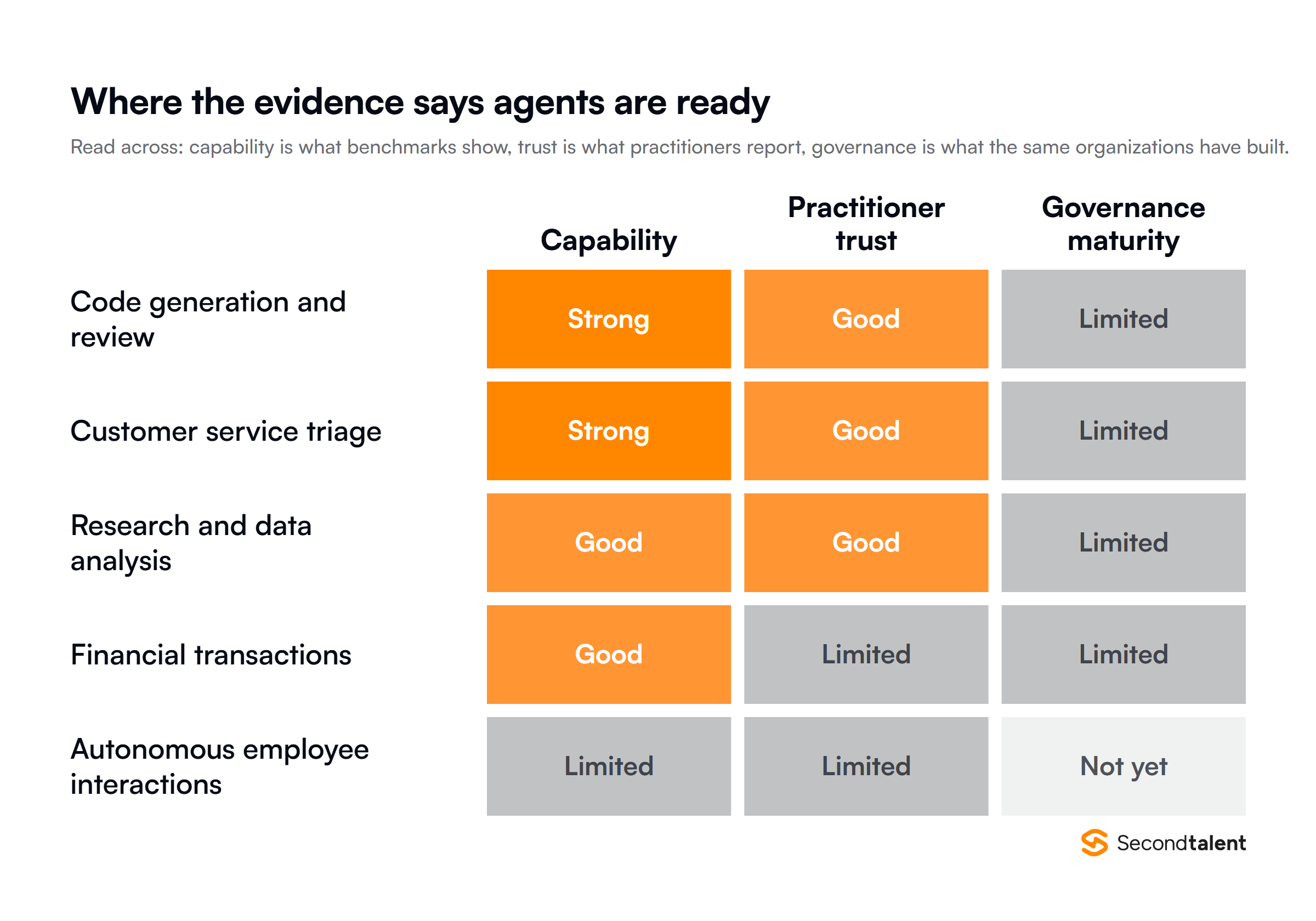
Read together, the hundred figures above point at one gap: capability is running ahead of operating discipline. Agents can now do more than most organizations can safely supervise.
Three of the constraints are staffing problems wearing other labels.
- Quality (32%) is an evaluation problem. Observability sits at 89% while offline evals sit at 52.4%. Someone has to build and own the eval suite, and that is a specific skill, not a side task for whoever shipped the agent.
- Governance (21% mature) is an ownership problem. Gartner’s four autonomy levels each need a different control set. That needs a named owner who can say which level an agent sits at.
- Scaling (65% cite difficulty) is an integration problem. 38% of stalled projects blame legacy systems. The work is plumbing into systems that predate the agent.
Those roles are what an AI agent developer and an agentic AI specialist do day to day: eval harnesses, tool integration, guardrails and rollback paths. It is closer to platform engineering than to prompt writing, which is why the profile we screen for on AI engineering roles looks more like a senior backend engineer with model experience than a research hire.
The KPMG split is the practical one. 87% of leaders put upskilling first and 68% put hiring first, and they are not alternatives. Most teams need a few people who have already shipped an agent to production, so the rest can learn from them rather than from a blog post.
That is the shape of most agent requests that reach us. It is also why we publish transparent rate cards for these roles instead of quoting per engagement.
Frequently asked questions
What percentage of companies use AI agents in 2026?
Between 54% and 88%, depending on the survey. KPMG’s Q1 2026 US pulse puts active deployment at 54%, while its global report of 2,500 executives puts embedding at 88%. LangChain, which asks about production specifically, reports 57.3%.
The spread is definitional, not contradictory. Strict definitions produce lower numbers.
What is the difference between an AI agent and a chatbot?
An AI agent plans a multi-step task, calls tools to act on the world, observes the result and adapts. A chatbot interprets a query and returns an answer.
The cost difference follows from that. Gartner puts a single agentic reasoning task at a minimum of five times the inference cost of a basic chatbot interaction, because the agent reasons, negotiates and re-checks itself throughout.
Are most agentic AI projects failing?
Gartner predicts over 40% of agentic AI projects will be canceled by the end of 2027, which leaves a majority that are not. The causes it names are escalating cost, unclear business value and inadequate risk controls, all of which are addressable before a project starts.
How reliable are AI agents right now?
On structured benchmarks they fail roughly one attempt in three. OSWorld accuracy reached 66.3% in 2026, within 6 points of human performance, up from about 12% a year earlier.
Some benchmarks are near saturation, with the top tau-squared telecom score at 99.1%. Treat a saturated benchmark as evidence the test has aged, not that the problem is solved.
How many MCP servers are there?
More than 10,000 active public Model Context Protocol servers, with over 97 million monthly SDK downloads across Python and TypeScript, as of Anthropic’s December 2025 figures. MCP is now governed by the Agentic AI Foundation under the Linux Foundation.
Will AI agents replace software developers?
The measurable effect so far is on hiring pipelines rather than on existing headcount. Employment for software developers aged 22 to 25 has fallen nearly 20% since 2024, while one-third of organizations expect AI to reduce their workforce in the coming year.
Meanwhile 90% of developers already use AI at work and 30% report little or no trust in the code it produces. Both things are true at once, which is a good description of the current state. For a longer look at the skill shift, see our comparison of AI-native and traditional engineers and the data on vibe coding adoption.
Which country has the highest demand for AI skills?
Singapore, at 4.769% of all job postings in 2025, followed by Hong Kong at 3.5%. The United States ranks fifth at 2.6% despite leading on private AI investment and model development.
Hire the people who have already shipped one
The gap in this data is not model capability. It is the eval suites, guardrails and integration work that turn a demo into something you can leave running. That work is done by people, and 62% of leaders now name skills gaps as the barrier to showing ROI.
Second Talent places vetted AI and agent engineers across nine markets in Asia Pacific, including Singapore, Vietnam and the Philippines, either as direct placements or through our EOR so you do not need a local entity. If you want to see how the wider shift is reshaping team structures, our analysis of AI workforce outsourcing shifts and enterprise AI adoption statistics covers it in depth, and our review of coding agents in VS Code covers the tooling side.
Tell us what you are building and we will shortlist engineers who have shipped agents to production.


![Singapore AI Companies Leading Southeast Asia. Top 10 Singapore AI Companies Leading Southeast Asia [2026], by Second Talent.](https://www.secondtalent.com/wp-content/uploads/2026/09/singapore-ai-companies-featured-v2-768x403.jpg)