TL;DR: 88% of organizations in McKinsey's 2025 survey used AI in at least one business function, but only 23.2% of all US firms used AI in a two-week window in August 2026, per the Census Bureau. Company size explains most of the gap: 38.4% of US firms with 250 or more employees use AI. About 6% of companies earn 5% or more of their profit from it.
Fewer than one in four US firms uses AI, yet 78% of the US workforce works at a company that does.
The Federal Reserve published that estimate in April 2026, and it resolves most of the confusion around enterprise AI adoption: large employers use AI more, and they employ most people.
- 1In McKinsey's 2026 survey, 44% of respondents say AI is scaling across their enterprise, up from 38% a year earlier.
- 2Gartner raised its 2026 forecast of worldwide AI spending to $2.67 trillion in September, 49.5% more than in 2025.
- 3In Europe, Danish firms lead at 42.0%, against an EU average of 20.0%.
- 4AI model and application development is now the hardest skill to hire for worldwide, per ManpowerGroup.
What Share of Enterprises Use AI in 2026
Between 20% and 88% of enterprises use AI in 2026, depending on who is counted. Surveys of large companies land near the top of that range. Government surveys of all firms, most of them small, land near the bottom.
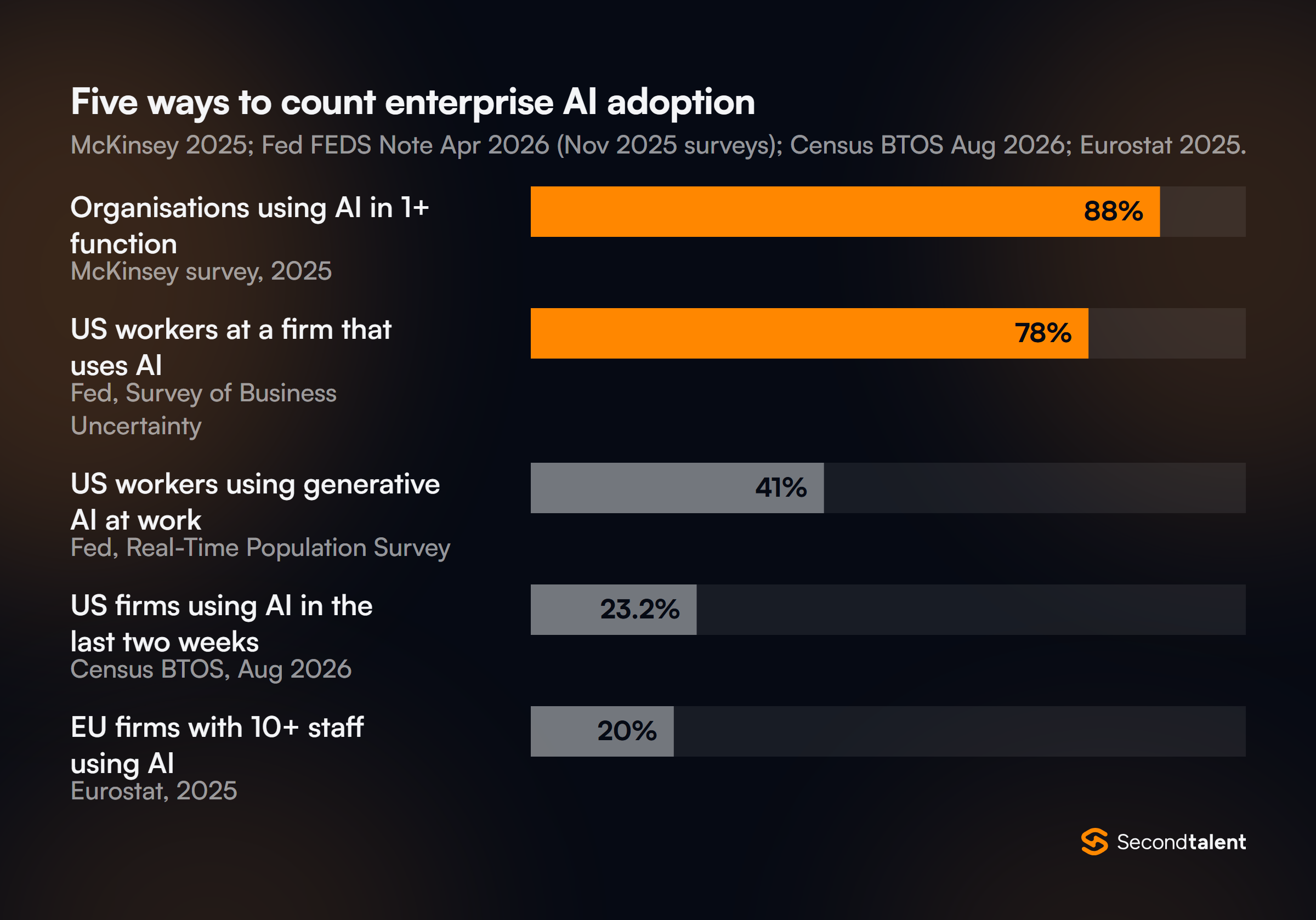
The 88% comes from McKinsey's State of AI survey of 1,993 respondents in mid-2025, reported in the Stanford AI Index 2026.
It asks whether an organization uses AI in at least one business function, a bar that one team running a chatbot clears. Adoption on that measure rose from 78% in 2024.
The Census Bureau's Business Trends and Outlook Survey asks a random sample of US employer firms whether they used AI in any business function in the last two weeks.
In the cycle covering 10 to 23 August 2026, 23.2% said yes, up from 17.3% when the question started in November 2025. Another 27.3% expect to use AI within six months.
A Federal Reserve note of 3 April 2026 bridges the two. Weighted by employment, its November 2025 Survey of Business Uncertainty found 78% of the labor force at firms that had adopted AI, and about 54% at firms using large language models.
In a separate survey of workers, about 41% used generative AI at work.
Enterprise AI Adoption by Company Size
US firms with 250 or more employees are the heaviest AI users, at 38.4% in the latest Census cycle. Firms with 100 to 249 staff follow at 34.5%. Below 100 employees, adoption sits between 20.8% and 25.8% whatever the size.
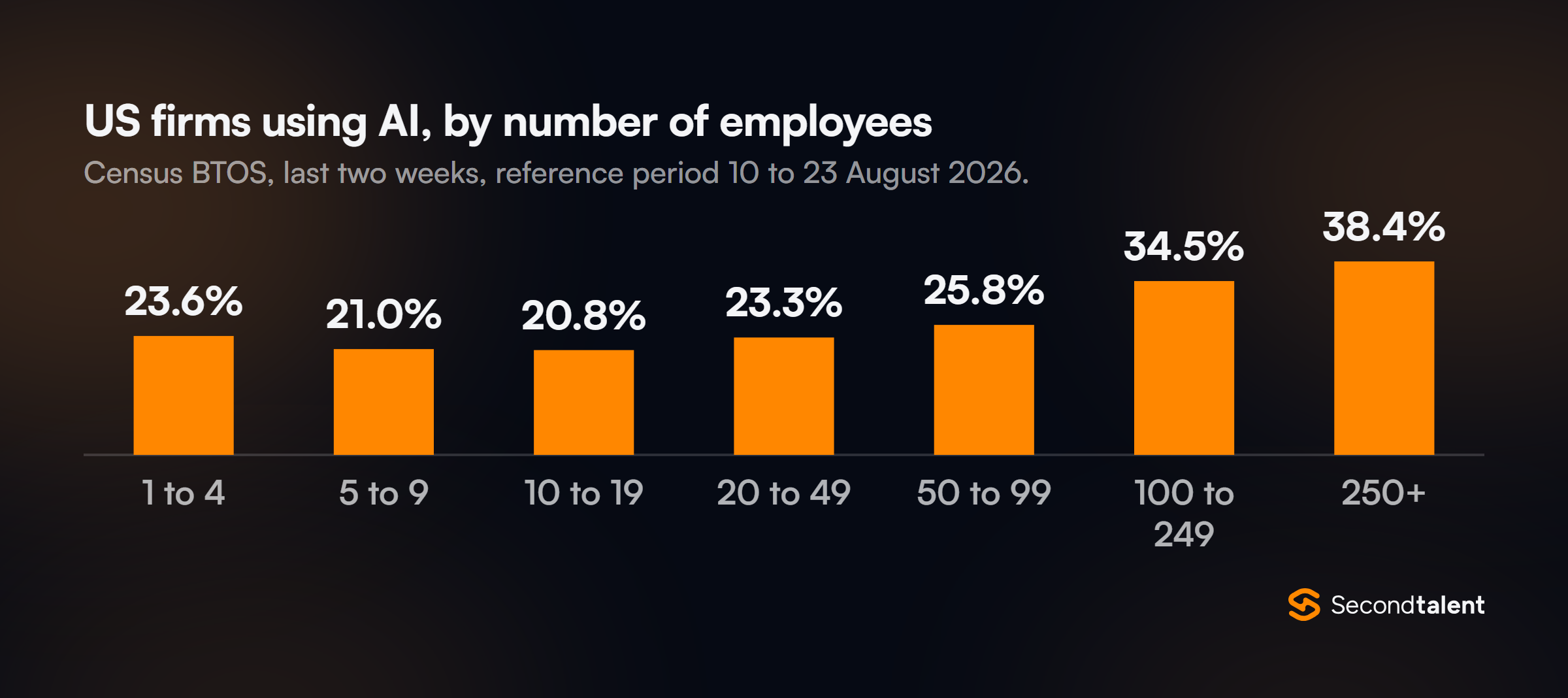
The smallest firms are the exception. Businesses with one to four employees report 23.6%, more than firms with 5 to 19.
The Fed note found the same thing: adoption "among the smallest firms is stronger than would be expected based on size alone".
Europe shows a steeper gradient. Eurostat counted 55.0% of EU enterprises with 250 or more staff using AI in 2025, against 30.4% of medium firms and 17.0% of small ones.
Depth also tracks size. In McKinsey's 2025 data, 10% of companies with $5 billion or more in revenue described their AI as fully scaled, against 3% to 5% of companies below $1 billion.
Enterprise AI Adoption by Industry
The information sector has the highest AI adoption among US firms, at 43.5% in August 2026. Professional, scientific and technical services is a close second at 43.3%, and finance and insurance third at 36.5%.
Accommodation and food services is lowest at 8.5%.
| Sector | Aug 2026 | Previous cycle |
|---|---|---|
| Information | 43.5% | 46.0% |
| Professional and technical services | 43.3% | 41.9% |
| Finance and insurance | 36.5% | 40.0% |
| Educational services | 35.5% | n/a |
| Real estate | 31.9% | n/a |
| Health care | 24.7% | n/a |
| Manufacturing | 23.4% | 20.3% |
| Construction | 16.0% | 14.3% |
| Retail trade | 15.5% | 15.2% |
| Accommodation and food | 8.5% | 8.6% |
| All sectors | 23.2% | 22.4% |
Single-cycle figures move a few points either way, so finance's drop from 40.0% is noise more than a trend. The Fed smooths the series over four cycles for that reason.
- Finance and insurance: 36.5%
- Professional services: 43.3%
- Finance: 63%
- Professional services: 62%
Ask employees instead of firms and the numbers jump. Workers in finance and professional services use generative AI well ahead of what their employers report, the pattern tracked in our shadow AI statistics.
The industries adopting AI fastest get their own ranking.
Enterprise AI Adoption by Country
Denmark has the highest enterprise AI adoption in Europe: 42.0% of Danish firms with 10 or more employees used AI in 2025. Finland (37.8%), Sweden (35.0%) and Belgium (34.5%) follow, and Romania is last at 5.2%.
The EU average rose from 13.5% in 2024 to 20.0%.
Outside the EU, 29% of UK firms used AI in June 2026, per the Office for National Statistics. Statistics Canada put Canadian businesses at 19.2% in the second quarter of 2026, and Australia's ABS counted 12% for 2024-25.
Each office asks a different question, so these sit side by side rather than in one ranking. Our ranking of countries by AI adoption covers both people and firms.
How Much Enterprises Spend on AI in 2026
Worldwide AI spending will reach $2.67 trillion in 2026, a 49.5% rise on 2025, according to Gartner's forecast of 16 September 2026.
The total covers all buyers, including the cloud providers building data centers, so it is far larger than corporate AI budgets.
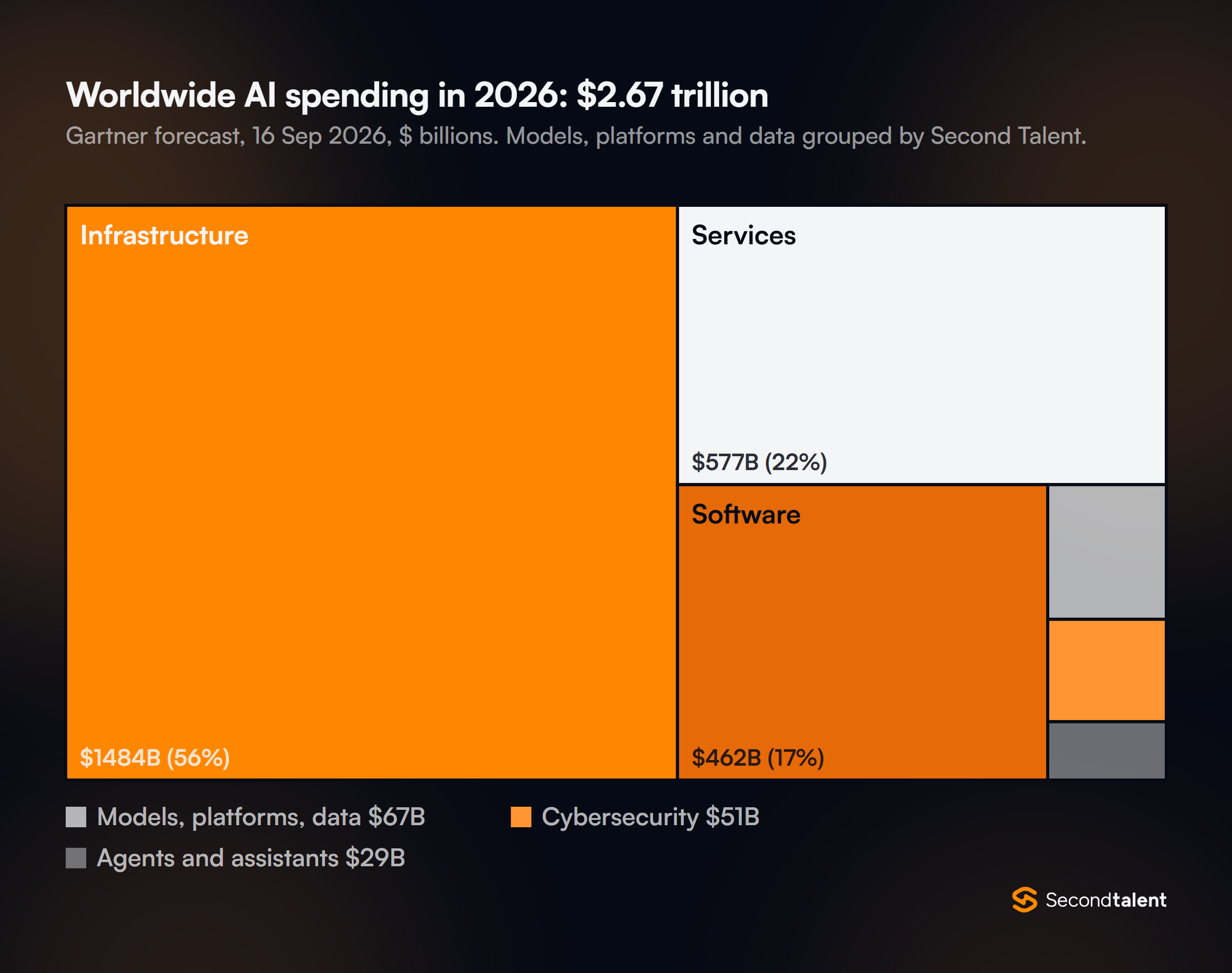
Infrastructure takes $1.48 trillion of it, and Gartner names AI-optimized servers bought by hyperscalers and service providers as the largest single item. It expects $3.64 trillion in 2027, and has raised the 2026 forecast twice this year:
Agent spending depends on the definition. The September table counts $29.2 billion for AI agents and assistants in 2026.
A separate Gartner release of 5 May 2026 sizes the wider AI agent software market at $206.5 billion in 2026 and $376.3 billion in 2027.
Company budgets for generative AI are much smaller. Menlo Ventures counted $37 billion of enterprise generative AI spending in 2025, up from $11.5 billion in 2024, with $12.5 billion on foundation model APIs.
Anthropic took 40% of enterprise LLM spend, OpenAI 27% and Google 21%. IDC expects AI infrastructure spending to pass $1 trillion a year by 2029.
The Scaling Gap: Agents and Profit
Most companies use AI, and a minority profit from it. In McKinsey's State of AI 2026, surveyed in May and June, 37% of respondents attribute any EBIT impact to AI.
The high performers, who get 5% or more of EBIT from AI, stayed flat at about 6%.
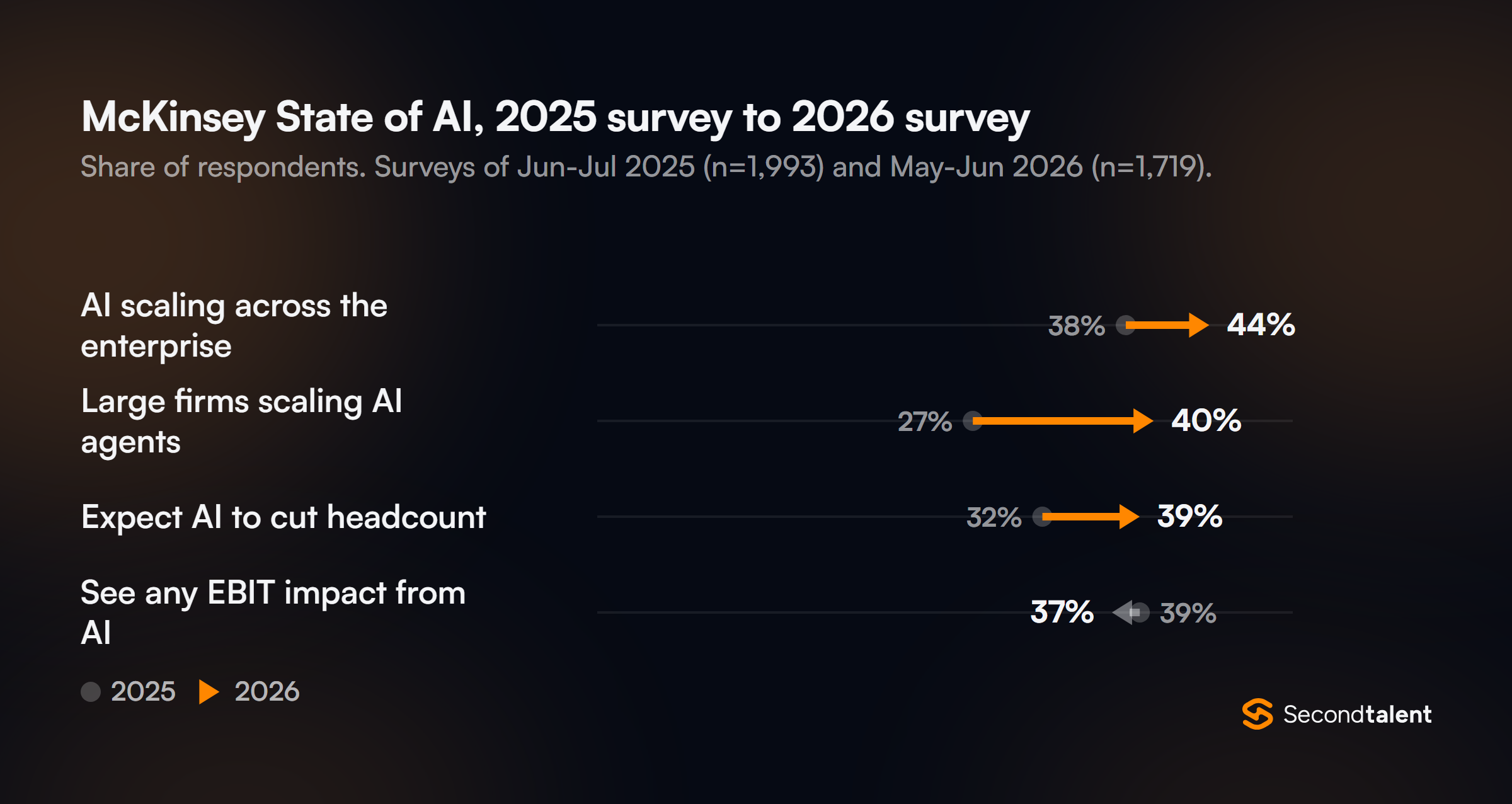
Agents are moving fastest at large companies. 40% of organizations with more than $1 billion in revenue are scaling AI agents, up from 27%, while smaller companies stayed at 22%.
32% of respondents decided against buying a piece of software because they could build it with AI coding tools.
A year earlier, McKinsey's 2025 survey found 23% of organizations scaling an agentic AI system somewhere and another 39% experimenting. In any given function, no more than 10% reported scaled agents.
For organizations moving beyond experimentation, human-AI collaboration can provide a practical model for integrating AI call agents into workflows while keeping human agents involved where their input is needed.
Plenty of projects will not make it. Gartner expects over 40% of agentic AI projects to be canceled by the end of 2027, citing cost, unclear value and weak risk controls.
MIT's Project NANDA reported in 2025 that "95% of organizations are getting zero return" from generative AI, based on 52 interviews, 153 leader surveys and more than 300 public deployments. Our AI agent statistics track deployment since.
The AI Skills Shortage
AI skills are the hardest capability to hire for worldwide in 2026, according to ManpowerGroup's Talent Shortage Survey of 39,063 employers in 41 countries.
AI literacy came second globally at 19%. In the ten APME markets, 71% of employers report difficulty hiring, led by Japan (84%) and India (82%).
The global AI talent shortage numbers go deeper, and we covered the demand side in how AI is changing engineering talent demand and the AI impact on the 2026 job market.
Enterprise AI Spending in Asia/Pacific
Asia/Pacific AI and generative AI investment will grow from $121.5 billion in 2025 to $555.2 billion by 2030, a 35.5% compound annual rate, according to an IDC forecast of 17 September 2026.
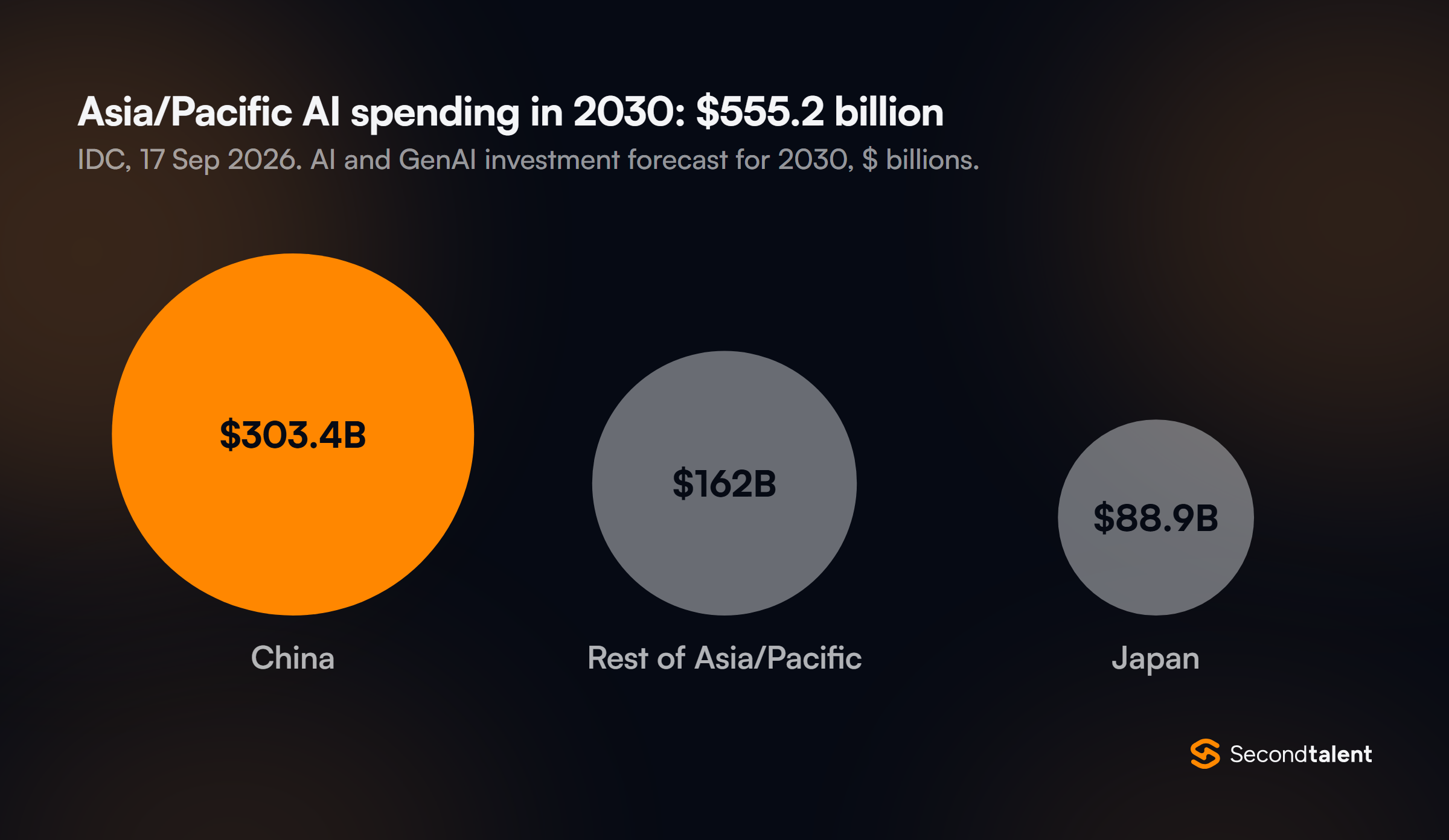
China accounts for more than half: $303.4 billion by 2030, growing 36.6% a year. Japan grows fastest at 39.8%, to $88.9 billion. The rest of the region goes from $41 billion to $162 billion.
Software and information services firms will account for 42.7% of regional spending in 2026, ahead of financial services at 9.8%. See our look at AI trends in Singapore and the LATAM vs CEE vs APAC AI talent report.
Hiring the Engineers to Scale AI
Moving AI from pilot to production takes engineers, and AI skills are now the hardest to hire.
Second Talent matches companies with vetted engineers across Asia within 24 hours, at 50-70% below equivalent US payroll, with a 92% retention rate across the 200+ companies building with us.
Teams hire AI and machine learning engineers and data engineers through us.
Tell us what you need to build and we will send a shortlist.
Frequently Asked Questions
What percentage of enterprises use AI in 2026?
88% of organizations used AI in at least one business function in McKinsey's 2025 survey of larger companies. Among all US employer firms, 23.2% used AI in the two weeks to 23 August 2026, per the Census Bureau.
In the EU, 20.0% of firms with 10 or more staff used AI in 2025.
Why do enterprise AI adoption statistics disagree?
They survey different companies and ask different questions. Executive surveys like McKinsey's sample large organizations and ask about any use in any function.
Government surveys sample all firms, most of them small, and ask about a short recent period.
Which industry has the highest AI adoption rate?
Information has the highest AI adoption among US firms, at 43.5% in August 2026, ahead of professional, scientific and technical services at 43.3%.
Do AI regulations affect enterprise adoption timelines?
Yes, and the dates have moved. The EU's AI Omnibus, in force since 27 July 2026, pushed high-risk obligations to December 2027 and August 2028. Our EU AI Act vendor compliance checklist tracks the current dates.